Celsius to Fahrenheit Converter: Easy Temperature Conversion for Everyday Use
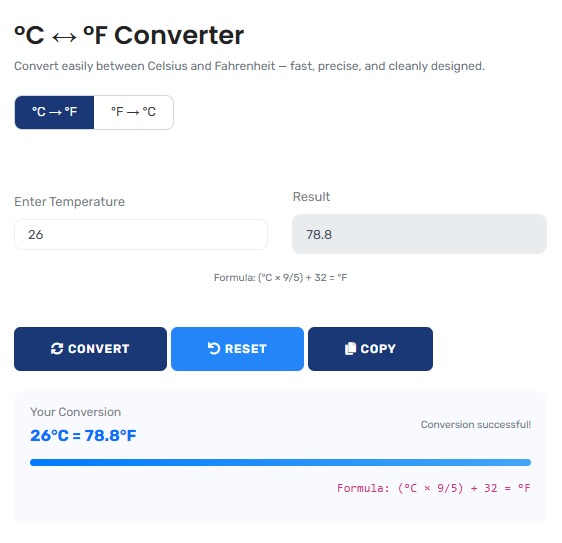
Converting between Celsius and Fahrenheit is something we all need to do - whether we're cooking with an international recipe, traveling to a different country, or just trying to understand the weather forecast. Our Celsius to Fahrenheit converter makes these conversions quick, accurate, and completely hassle-free.
With just a few clicks, you can convert any temperature between these two common measurement systems. No need to remember complex formulas or do mental math - our calculator handles all the calculations instantly, giving you precise results every time.
When you'll use temperature conversion most often:
- International Travel: Understanding weather forecasts in different countries
- Cooking & Baking: Converting oven temperatures in recipes from around the world
- Weather Understanding: Making sense of temperature reports in different units
- Science & Education: Working with temperature data in different measurement systems
- Daily Reference: Understanding temperature expressions in different contexts
Our converter is part of our complete suite of Temperature Converters, making it easy to handle all your temperature conversion needs.
Real-Life Temperature Conversion Scenarios
Sarah's European Cooking Adventure
Sarah found a wonderful French baking recipe that calls for the oven to be set at 180°C. Her American oven only shows Fahrenheit, so she needs to convert to the right temperature.
Cooking Conversion Analysis:
- Recipe temperature: 180°C
- Conversion formula: (°C × 9/5) + 32
- Calculation: (180 × 9/5) + 32 = (324) + 32 = 356°F
- Result: Set oven to 356°F
- Practical tip: Most ovens round to nearest 5°F, so 355°F or 360°F works fine
- Baking outcome: Perfectly baked goods at correct temperature
Without this conversion, Sarah might have used 180°F (incorrect) or guessed wrong, ruining her baking. The converter gives her confidence in her international cooking.
Mike's Winter Vacation Planning
Mike is planning a ski trip to Canada. The weather forecast says it will be -15°C, but he's used to Fahrenheit and wants to know how cold that really is.
Travel Weather Analysis:
- Forecast temperature: -15°C
- Conversion: (-15 × 9/5) + 32 = (-27) + 32 = 5°F
- Result: 5°F - very cold!
- Clothing decision: Pack heavy winter gear, thermal layers
- Activity planning: Plan for indoor breaks, hot drinks
- Safety consideration: Know frostbite risk at this temperature
Understanding the actual temperature helps Mike pack appropriately and plan activities that match the weather conditions.
Medical Temperature Understanding
A nurse reads that a patient's temperature is 38.5°C in their European medical records, but needs to understand this in Fahrenheit for American colleagues.
Medical Conversion Analysis:
- Patient temperature: 38.5°C
- Conversion: (38.5 × 9/5) + 32 = (69.3) + 32 = 101.3°F
- Result: 101.3°F - indicating fever
- Medical significance: Temperature above 100.4°F indicates fever
- Action required: Monitor patient, consider fever-reducing measures
- Accuracy importance: Medical decisions depend on precise temperature
Accurate conversion ensures proper medical understanding and appropriate care decisions across international healthcare systems.
For health-related calculations, try our BMI Calculator.
Temperature Conversion Formulas
The Simple Formulas Behind Temperature Conversion:
1. Celsius to Fahrenheit:
°F = (°C × 9/5) + 32
Example: 20°C = (20 × 9/5) + 32 = 68°F
2. Fahrenheit to Celsius:
°C = (°F - 32) × 5/9
Example: 68°F = (68 - 32) × 5/9 = 20°C
3. Quick Mental Approximation:
°C to °F: Double, subtract 10%, add 32
Example: 20°C → 40 - 4 + 32 = 68°F (approximate)
4. The Special Equal Point:
-40°C = -40°F (the only temperature where scales match)
Common Temperature Reference Points
| Description | Celsius (°C) | Fahrenheit (°F) | Practical Significance |
|---|---|---|---|
| Water Freezes | 0°C | 32°F | Ice forms, winter precipitation types |
| Comfortable Room Temperature | 20-22°C | 68-72°F | Ideal indoor comfort range |
| Normal Body Temperature | 37°C | 98.6°F | Average human body temperature |
| Water Boils (Sea Level) | 100°C | 212°F | Cooking, sterilization temperature |
| Hot Summer Day | 30°C | 86°F | Warm weather, possible heat advisory |
| Freezing Cold | -10°C | 14°F | Winter weather, frostbite risk |
| Moderate Oven | 180°C | 356°F | Common baking temperature |
Why Two Temperature Scales Exist
Historical Background of Temperature Scales:
- Celsius (1742): Created by Swedish astronomer Anders Celsius. Originally had 0° as boiling point, 100° as freezing (reversed later). Based on water's freezing and boiling points.
- Fahrenheit (1724): Developed by German physicist Daniel Gabriel Fahrenheit. Based on brine solution freezing (0°F), water freezing (32°F), and human body temperature (~96°F, later adjusted).
- Global Adoption: Celsius adopted by scientific community and most countries. Fahrenheit remains in US, Cayman Islands, Belize, and partially in Canada and UK.
- Practical Differences: Fahrenheit has smaller degrees (180 between freezing and boiling vs Celsius's 100), giving more precision for weather reporting.
Common Conversion Mistakes to Avoid
The "Just Multiply by 2" Error
Incorrect approach: Thinking 20°C = 40°F by simply
doubling.
Correct calculation: 20°C = 68°F using proper formula.
Why it matters: 40°F is 4.4°C - a huge 15.6°C difference!
Result: Wrong clothing choices, incorrect cooking temperatures,
misunderstanding weather conditions.
Forgetting to Add/Subtract 32
Many people remember to multiply by 9/5 or 5/9 but forget the crucial +32 or -32 step in the formula.
Common error: Calculating 20°C × 9/5 = 36°F (missing +32)
Correct calculation: (20°C × 9/5) + 32 = 36 + 32 = 68°F
Impact: 36°F is actually 2.2°C - thinking it's 20°C leads to
serious misunderstandings about actual temperature conditions.
Our calculator automatically handles all formula steps correctly, eliminating this common error.
For other common calculation errors to avoid, check our Percentage Calculator guide.
Practical Conversion Tips and Tricks
Quick Mental Conversions (Close Approximations)
When you don't have a calculator handy, these approximations work well:
-
Celsius to Fahrenheit (rough):
- Double the Celsius temperature
- Subtract 10% of the result
- Add 32
- Example: 20°C → 40 - 4 + 32 = 68°F (exact: 68°F)
-
Fahrenheit to Celsius (rough):
- Subtract 30 from Fahrenheit
- Divide by 2
- Example: 70°F → (70-30)/2 = 20°C (exact: 21.1°C)
-
Memorize Key Points:
- 10°C = 50°F (good reference point)
- Every 5°C change = 9°F change
- 16°C = 61°F (easy to remember)
- 28°C = 82°F (another memorable pair)
For exact calculations, always use our converter. For approximations, these tricks work well for everyday situations.
Temperature Conversion by Application
| Application | Typical Range | Precision Needed | Common Conversions | Special Considerations |
|---|---|---|---|---|
| Weather Reporting | -40°C to 50°C | ±1 degree | Daily highs/lows, feels-like temperatures | Round to whole numbers typically |
| Cooking/Baking | 100°C to 250°C | ±5 degrees | Oven settings, candy temperatures | Ovens often in 25°F increments |
| Medical Use | 35°C to 42°C | ±0.1 degree | Body temperature, fever thresholds | Critical for diagnosis |
| Science/Industry | Wide range | ±0.01 degree | Experiment conditions, process control | High precision required |
| Everyday Reference | -20°C to 40°C | ±2 degrees | Room temp, outdoor conditions | General understanding sufficient |
Special Temperature Situations
When Temperature Conversion Gets Interesting:
- -40°C = -40°F: The only temperature where both scales show the same number
- Body Temperature: 37°C = 98.6°F (actually 98.6°F is 37°C exactly)
- Cooking Precision: Candy making requires exact temperatures (soft ball: 112-116°C = 234-240°F)
- Weather Extremes: Hottest recorded: 56.7°C = 134°F; Coldest: -89.2°C = -128.6°F
- Altitude Effects: Water boils at lower temperatures at high altitude (95°C at 1500m = 203°F)
Our converter handles all these special cases accurately, including extreme temperatures and precise decimal values.
Mobile Optimization for Real-World Use
Why Our Converter Works Everywhere
Travel-Friendly: Quick conversions while checking weather forecasts abroad
Kitchen-Ready: Easy use with messy cooking hands, large buttons
Offline Capable: Basic functionality works without internet
Fast Results: Instant calculations - no waiting for page loads
Simple Interface: Clean design, no confusing options
Accessible: Works for all ages and tech skill levels
Whether you're in a European supermarket checking oven temperatures or on a mountain checking weather conditions, our converter works seamlessly on any device.
For other mobile-friendly tools, try our USD to PKR Converter for travel finances.
Key Insight: Temperature conversion isn't just about numbers - it's about understanding, comfort, safety, and success in daily activities. Whether you're cooking a family recipe, planning a vacation, monitoring health, or just making sense of the world, accurate temperature conversion matters. Our tool makes this easy, accurate, and accessible to everyone. For comprehensive conversion needs beyond temperature, explore our full Conversion Calculators collection.
Quick Reference: Must-Know Temperature Conversions
Memorize These for Daily Use:
- Freezing: 0°C = 32°F (water freezes, ice forms)
- Cool Room: 18°C = 64°F (sweater weather)
- Comfortable: 21°C = 70°F (ideal indoor temperature)
- Warm Day: 25°C = 77°F (pleasant outdoor temperature)
- Hot Day: 30°C = 86°F (summer heat)
- Body Temp: 37°C = 98.6°F (normal human temperature)
- Very Hot: 40°C = 104°F (heat warning territory)
- Boiling: 100°C = 212°F (water boils at sea level)
Cooking Temperatures:
- Slow Oven: 150°C = 300°F
- Moderate Oven: 180°C = 350°F
- Hot Oven: 200°C = 400°F
- Very Hot Oven: 230°C = 450°F
Remember: When in doubt, use our converter for exact values!
Frequently Asked Questions
Use our converter for exact results. For quick mental approximation: double the Celsius, subtract 10%, add 32. Example: 20°C → 40 - 4 + 32 = 68°F. For cooking and medical use, always use exact conversion.
37°C was established as normal human body temperature based on early measurements. Using the exact conversion formula: (37 × 9/5) + 32 = 66.6 + 32 = 98.6°F. Interestingly, recent studies suggest average body temperature may be slightly lower.
Use exact conversion: °F = (°C × 9/5) + 32. Most ovens have 25°F increments, so round to nearest increment. Example: 180°C = 356°F, round to 355°F or 350°F. For precise baking (like pastries), try to match exactly if your oven allows.
-40°C = -40°F. This is the only temperature where both scales have the same numerical value. You can prove this mathematically: if C = F, then C = (C × 9/5) + 32 → C - (9/5)C = 32 → (-4/5)C = 32 → C = -40.
For weather, ±1°C/F is usually sufficient since weather forecasts have inherent uncertainty. However, for critical decisions (extreme cold warnings, heat advisories), exact conversion matters more. Our converter provides exact values for all needs.
Yes! Our converter handles all temperatures, including negative values. Example: -10°C = 14°F. The formula works the same: (-10 × 9/5) + 32 = (-18) + 32 = 14°F. This is important for winter travel planning.
Most countries adopted Celsius as part of metric system standardization. The US kept Fahrenheit due to historical inertia, established infrastructure, and public familiarity. A few other countries also use Fahrenheit, but Celsius is the global standard for science and most daily use.
