Escape Velocity Calculator: Discover Cosmic Speeds Needed to Leave Planets and Stars
Have you ever wondered how fast a rocket needs to travel to break free from Earth's gravity and reach space? Or what speed you'd need to escape from the Moon, Mars, or even the Sun? Our Escape Velocity Calculator answers these fascinating questions by calculating the precise speed required to overcome any celestial body's gravitational pull.
Escape velocity is one of the most important concepts in space science and astrophysics. It represents the minimum speed an object must achieve to break free from a planet's or star's gravitational influence without any additional propulsion. This calculation is crucial for space mission planning, understanding planetary science, and exploring the physics of our universe.
Why understanding escape velocity matters:
- Space Exploration: Determines rocket requirements for reaching other planets
- Planetary Science: Explains why some planets have atmospheres and others don't
- Astrophysics: Helps understand black holes, neutron stars, and other cosmic phenomena
- Science Education: Teaches fundamental physics concepts in an engaging way
- Future Technology: Informs development of advanced propulsion systems
Our calculator makes complex astrophysical calculations simple and accessible. For related astronomical calculations, explore our Astronomy Calculators collection.
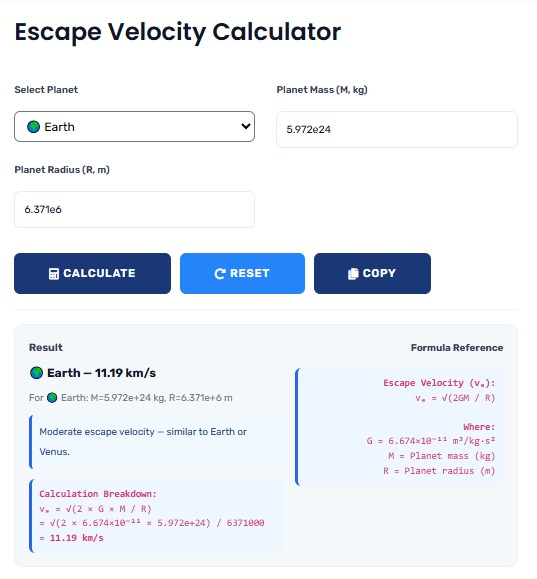
Real Cosmic Examples: Escape Velocities Around Our Solar System
Earth's Escape Velocity: The Speed to Reach Space
Earth's escape velocity is approximately 11.2 kilometers per second (25,000 miles per hour) from the surface. This is the speed NASA's rockets must achieve to send spacecraft to the Moon, Mars, and beyond.
Earth Escape Analysis:
- Earth mass: 5.97 × 10²⁴ kilograms
- Earth radius: 6,371 kilometers
- Gravitational constant: 6.67430 × 10⁻¹¹ m³/kg/s²
- Calculation: √(2 × 6.67430e-11 × 5.97e24 ÷ 6,371,000)
- Result: 11,186 meters/second = 11.2 km/s = 40,270 km/h
- Comparison: 33 times faster than sound, 0.0037% of light speed
- Rocket reality: Rockets don't need to reach this speed instantly; they accelerate gradually
This incredible speed explains why space travel requires such powerful rockets and massive amounts of fuel. For calculating orbital speeds, check our Orbital Period Calculator.
Moon's Escape Velocity: Much Easier to Leave
The Moon's escape velocity is only 2.38 km/s (8,568 km/h) from its surface. This is why Apollo astronauts could return from the Moon with relatively small rockets compared to what was needed to leave Earth.
Lunar Escape Analysis:
- Moon mass: 7.35 × 10²² kg (1.2% of Earth's mass)
- Moon radius: 1,737 kilometers
- Calculation: √(2 × 6.67430e-11 × 7.35e22 ÷ 1,737,000)
- Result: 2,380 meters/second = 2.38 km/s
- Comparison: Only 21% of Earth's escape velocity
- Historical context: Apollo Lunar Module ascent stage needed much less fuel than Saturn V first stage
The Moon's low escape velocity makes it an ideal location for future space launches - it's much easier to launch spacecraft from the Moon than from Earth.
Sun's Escape Velocity: The Ultimate Challenge
Escaping the Sun's gravity from Earth's orbit requires 42.1 km/s, but from the Sun's surface it's a staggering 617.5 km/s. This is why leaving the solar system is so challenging.
Solar Escape Analysis:
- Sun mass: 1.989 × 10³⁰ kg (333,000 Earth masses)
- Sun radius: 696,340 kilometers
- From solar surface: √(2 × 6.67430e-11 × 1.989e30 ÷ 696,340,000) = 617.5 km/s
- From Earth's orbit: 42.1 km/s (already moving at 29.8 km/s in orbit)
- Spacecraft achievement: Voyager 1 reached solar system escape velocity in 2012
- Future missions: New propulsion systems needed for practical interstellar travel
Understanding solar escape velocity helps explain why interstellar travel remains such a formidable challenge with current technology.
The Physics Behind Escape Velocity
Escape Velocity Formula:
v = √(2GM/R)
Where:
• v = escape velocity (m/s)
• G = gravitational constant = 6.67430 × 10⁻¹¹ m³/kg/s²
• M = mass of celestial body (kg)
• R = distance from center of mass (m)
Simple Explanation:
The formula comes from balancing kinetic energy (½mv²) with gravitational
potential energy (GMm/R). When these are equal, an object has just enough speed
to escape gravity.
Escape Velocities of Major Solar System Bodies
| Celestial Body | Escape Velocity | Comparison to Earth | Interesting Fact | Human Achievement |
|---|---|---|---|---|
| Mercury | 4.25 km/s | 38% of Earth's | Small but dense, heavy iron core | Messenger orbiter 2011-2015 |
| Venus | 10.36 km/s | 93% of Earth's | Similar mass to Earth, thick atmosphere | Multiple Soviet landers 1970s |
| Earth | 11.19 km/s | 100% (reference) | Our home, perfect for life | Apollo missions, Space Shuttle |
| Mars | 5.03 km/s | 45% of Earth's | Future human colony target | Perseverance rover landed 2021 |
| Jupiter | 59.5 km/s | 532% of Earth's | Massive gas giant, 318 Earth masses | Juno orbiter currently studying |
| Saturn | 35.5 km/s | 317% of Earth's | Famous rings, less dense than water | Cassini mission 1997-2017 |
Why Escape Velocity Matters for Space Missions
| Mission Type | Required Velocity | Energy Requirement | Real Example | Technical Challenge |
|---|---|---|---|---|
| Low Earth Orbit | 7.8 km/s | ~9.3 MJ/kg | International Space Station | Atmospheric drag, precise timing |
| Lunar Mission | 11.2 km/s | ~63 MJ/kg | Apollo 11 (1969) | Precision navigation, life support |
| Mars Mission | 11.2 + 5.0 km/s | ~94 MJ/kg | Perseverance rover (2020) | Long duration, radiation protection |
| Solar System Escape | 16.6 km/s | ~138 MJ/kg | Voyager 1 (1977) | Power for decades, communication |
| Interstellar Probe | 50+ km/s | ~1250 MJ/kg | Future concept | New propulsion, decades of travel |
How to Calculate Escape Velocity Step-by-Step
4-Step Calculation Process:
- Gather data: Find mass (M) and radius (R) of the celestial body
- Use gravitational constant: G = 6.67430 × 10⁻¹¹ m³/kg/s²
- Apply formula: v = √(2 × G × M ÷ R)
- Convert units: Change m/s to km/s or mph as needed
Example for Earth: v = √(2 × 6.67430e-11 × 5.972e24 ÷ 6.371e6) = 11,186 m/s = 11.19 km/s
For gravitational force calculations, use our calculators.
Common Misconceptions About Escape Velocity
"Rockets Need Constant Thrust to Escape"
Misconception: Rockets need to fire engines continuously until
they escape gravity.
Reality: Rockets only need to reach escape velocity, then can
coast without thrust.
Physics explanation: Once kinetic energy exceeds gravitational
potential energy, gravity gradually slows the object but can't pull it back.
Space mission reality: Most rockets burn for only a few
minutes, then spacecraft coast to their destination.
"Escape Velocity is the Same Everywhere on a Planet"
Actually, escape velocity depends on your distance from the planet's center. It's lower at higher altitudes.
Altitude effect examples:
• Earth surface (0 km): 11.19 km/s
• Low Earth orbit (400 km): 10.93 km/s (2.3% less)
• Geostationary orbit (35,786 km): 4.35 km/s (61% less)
• Moon's distance (384,400 km): 1.44 km/s (87% less)
This is why it's easier to launch missions to other planets from space stations than from Earth's surface.
For energy calculations in space missions, check our Kinetic Energy Calculator.
Extreme Cosmic Objects: Black Holes and Neutron Stars
Black Holes: Where Escape Velocity Exceeds Light Speed
The Ultimate Gravity: Black holes have such intense gravity that their escape velocity exceeds the speed of light (299,792 km/s). This creates an event horizon - a point of no return.
-
Event Horizon Calculation:
- Schwarzschild radius: R = 2GM/c²
- For a black hole with 10 solar masses:
- R = 2 × 6.674e-11 × (10 × 1.989e30) ÷ (299,792,458)²
- R ≈ 29.5 kilometers (size of a small city)
-
Escape Velocity at Event Horizon:
- At the Schwarzschild radius, escape velocity = c (light speed)
- Inside this radius, escape velocity > c (impossible)
- Nothing, not even light, can escape
-
Real Black Holes:
- Stellar black holes: 3-20 solar masses
- Supermassive black holes: Millions to billions solar masses
- Closest known: Sagittarius A* at Milky Way center
For more cosmic calculations, explore our Science Calculators collection.
Historical Space Missions and Escape Velocity
| Mission | Year | Achieved Velocity | Destination | Significance |
|---|---|---|---|---|
| Sputnik 1 | 1957 | 7.8 km/s (orbit) | Earth orbit | First artificial satellite |
| Vostok 1 | 1961 | 7.8 km/s (orbit) | Earth orbit | First human in space (Gagarin) |
| Apollo 11 | 1969 | 11.2 km/s (escape) | Moon | First humans on Moon |
| Voyager 1 | 1977 | 16.6 km/s (solar escape) | Interstellar space | Farthest human-made object |
| New Horizons | 2006 | 16.2 km/s (solar escape) | Pluto, Kuiper Belt | Fastest launch from Earth |
| Parker Solar Probe | 2018 | 192 km/s (at perihelion) | Sun's corona | Fastest spacecraft relative to Sun |
Future Technologies for Reaching Escape Velocity
Emerging Propulsion Systems:
- Ion Drives: Low thrust but highly efficient, used on Deep Space 1 and Dawn
- Solar Sails: Use sunlight pressure, no fuel required (LightSail 2 demonstrated)
- Nuclear Thermal: Heat propellant with nuclear reactor, 2× chemical rocket efficiency
- Project Orion: Nuclear pulse propulsion concept (theoretical, never built)
- Antimatter Engines: Maximum energy density, extreme theoretical efficiency
- Space Elevators: Mechanical ascent to geostationary orbit, then launch
- Launch Loops/StarTram: Magnetic acceleration to orbital velocity
These technologies could revolutionize space travel by reducing costs and enabling more ambitious missions.
Educational Projects Using Escape Velocity
Classroom Activity: Compare Planetary Escape Velocities
Learning Objective: Understand how mass and size affect escape velocity.
Materials: Calculator, planetary data table, graph paper
Procedure:
1. Research mass and radius for 8 solar system bodies
2. Calculate escape velocity for each using v = √(2GM/R)
3. Create a bar graph comparing results
4. Analyze which factors most affect escape velocity
5. Discuss implications for space exploration
Discussion Questions:
• Why is Jupiter's escape velocity so high despite its low density?
• Why would a Mars colony have launch advantages over Earth?
• How does escape velocity relate to whether a planet retains an atmosphere?
For related physics calculations, use our Physics Calculators.
Science Fair Project: Model Rocket Altitude vs Velocity
Concept: Experimentally demonstrate that altitude reduces required escape velocity.
Method:
1. Launch model rockets with altimeters from different elevations
2. Measure maximum altitude achieved with same engine
3. Calculate how gravitational acceleration changes with altitude
4. Show that launches from higher elevations achieve greater heights
5. Relate to real space launch advantages of equatorial, high-altitude sites
Real-World Connection: Explain why spaceports are often located near the equator (Earth's rotation adds velocity) and at high elevations (thinner atmosphere reduces drag).
Key Insight: Escape velocity isn't just a number - it's a fundamental concept that connects physics, astronomy, and engineering. It explains why space travel is challenging, why different planets have different characteristics, and what future technologies might enable. From the Moon landings to Voyager's interstellar journey to future Mars colonies, understanding escape velocity helps us appreciate both our current capabilities and future possibilities in space exploration.
Quick Reference: Famous Escape Velocities
Solar System Bodies:
- Sun (surface): 617.5 km/s - Why solar probes need gravity assists
- Jupiter (cloud tops): 59.5 km/s - Massive despite low density
- Earth (surface): 11.19 km/s - Our current technological limit
- Mars (surface): 5.03 km/s - Future colonization advantage
- Moon (surface): 2.38 km/s - Apollo return was relatively easy
- Pluto (surface): 1.21 km/s - You could jump into orbit!
Extreme Objects:
- White Dwarf: 3,000-6,000 km/s - Dense remnant of Sun-like star
- Neutron Star: 50,000-150,000 km/s - City-sized, star-mass object
- Black Hole (event horizon): 299,792 km/s - Speed of light, ultimate limit
Fun Fact: Ceres (largest asteroid) has escape velocity of only 0.51 km/s - you could throw a baseball into orbit!
Frequently Asked Questions
Escape velocity is the minimum speed needed to break free from a planet's or star's gravity without any additional push. Think of it like throwing a ball upward - if you throw it too slowly, it falls back down. Escape velocity is the throwing speed where the ball never comes back down (ignoring air resistance). For Earth, that's about 11.2 kilometers per second or 25,000 miles per hour.
Escape velocity depends on two things: the planet's mass and its radius. More mass means stronger gravity (harder to escape), while larger radius means you start further from the center (easier to escape). Jupiter has high escape velocity because it's massive, even though it's large. A white dwarf has extremely high escape velocity because it's very massive but tiny - all that gravity packed into a small space.
Yes, but not all at once. Rockets accelerate gradually as they burn fuel. They don't need to instantly reach 11.2 km/s at launch - that would require impossible acceleration. Instead, they reach orbital velocity (about 7.8 km/s) first, then additional burns can increase their speed to escape velocity. The Apollo missions to the Moon and all interplanetary probes have achieved escape velocity.
Absolutely - astronauts already have! The acceleration is what matters, not the final speed. Humans can tolerate gradual acceleration of 3-4 g's (3-4 times Earth's gravity) for several minutes. Rockets are designed to accelerate at rates humans can survive. The challenge is building rockets powerful enough to reach those speeds while carrying life support systems.
Among substantial objects, probably Mars' moon Deimos with about 5.5 m/s (20 km/h) - you could escape by jumping! Among dwarf planets, Pluto's moon Hydra has about 0.12 km/s. Among larger objects, Pluto itself has 1.21 km/s. For comparison, Earth's Moon is 2.38 km/s. These low escape velocities explain why small moons often have irregular shapes - their gravity isn't strong enough to pull them into spheres.
Black holes are where escape velocity equals or exceeds the speed of light. At the "event horizon" (the black hole's boundary), escape velocity is exactly light speed. Inside, it's greater than light speed, which is impossible according to physics. That's why nothing can escape from inside a black hole - not even light, which is why they're black. The size of the event horizon depends on the black hole's mass.
Not practically, no. To reduce Earth's escape velocity, we'd need to either decrease Earth's mass (impossible on human scales) or increase its radius (also impossible). However, we can take advantage of Earth's rotation - launching eastward from the equator gives rockets a "free" 0.46 km/s boost. And launching from high altitude reduces atmospheric drag. That's why spaceports are often located near the equator at coastal locations.
On the Moon, with its lower gravity and escape velocity of 2.38 km/s, no animal could jump to escape. However, some could jump into orbit! A flea could jump into low lunar orbit (needs about 1.6 km/s). On Deimos (Mars' tiny moon), with escape velocity of only 5.5 m/s, a human in a spacesuit could probably jump to escape with a good running start! This shows how escape velocity varies dramatically with object size.
