Liter to Gallon Converter: Quick & Accurate Volume Conversion
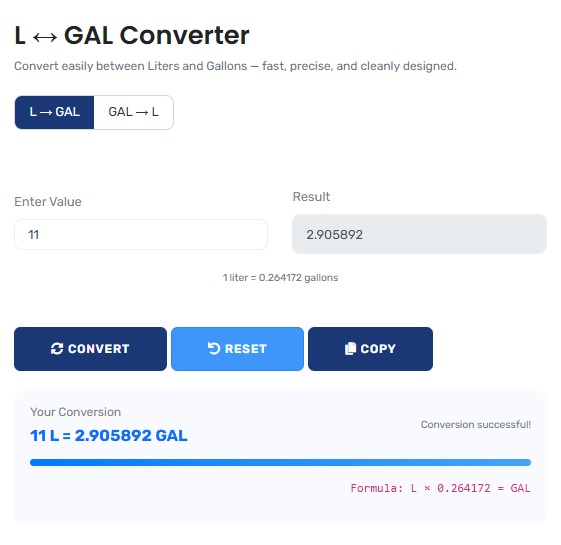
Converting between liters and gallons is essential for cooking international recipes, calculating fuel efficiency, understanding product quantities, and working with liquids across different measurement systems. Our Liter to Gallon Converter provides instant, accurate conversions using precise mathematical formulas that distinguish between US gallons and imperial gallons.
Whether you're following a European recipe that uses liters, calculating how much gas you need for a road trip, or comparing beverage sizes between countries, this tool eliminates confusion and ensures accuracy. The converter handles everything from small cooking measurements to large industrial quantities with equal precision.
Why accurate volume conversion matters:
- Cooking & Baking: Convert recipe measurements for international dishes
- Automotive: Calculate fuel efficiency and compare gas prices
- Travel: Understand product sizes when shopping abroad
- Science & Education: Work with measurements in different systems
- Home Improvement: Calculate paint, cleaning solutions, and other liquids
Our converter is part of our comprehensive suite of Volume Converters, designed to handle all your volume conversion needs accurately and efficiently.
Understanding Liters and Gallons
Liters and gallons represent two different approaches to measuring volume, each with its own history, applications, and regional preferences. Understanding the distinction between US gallons and imperial gallons is crucial for accurate conversions.
What is a Liter?
A liter (symbol: L) is a metric unit of volume equal to 1 cubic decimeter (dm³), 1,000 cubic centimeters (cm³), or 0.001 cubic meters (m³). It's the standard volume unit in the metric system used by most countries worldwide for everyday measurements of liquids and some solids.
What is a Gallon?
A gallon is an imperial unit of volume with two main definitions:
- US Gallon: Used in the United States, equal to exactly 3.78541 liters
- Imperial Gallon: Used in the United Kingdom and some Commonwealth countries, equal to exactly 4.54609 liters
This 17% difference between US and imperial gallons makes accurate conversion essential for international applications.
Real-World Conversion Scenarios
Cooking: Converting a European Recipe
Maria found a French soup recipe calling for 2 liters of broth. Her measuring cups are marked in cups and quarts, so she needs to convert to gallons to understand the quantity.
Conversion Analysis:
- Recipe requirement: 2 liters
- US gallons: 2 ÷ 3.78541 = 0.528 gallons
- In quarts: 0.528 × 4 = 2.112 quarts
- In cups: 2.112 × 4 = 8.448 cups
- Practical measurement: 2 quarts + ½ cup + 1 tablespoon
- Key insight: The soup will yield approximately 8-9 servings
Accurate conversion ensures the soup has the right consistency and flavor balance as intended by the recipe creator.
Automotive: Fuel Efficiency Comparison
John is comparing cars from US and European manufacturers. The US car gets 30 miles per gallon, while the European car gets 7.8 liters per 100 kilometers. He needs to compare them fairly.
Fuel Efficiency Analysis:
- US car: 30 mpg (miles per US gallon)
- European car: 7.8 L/100km
- First, convert 7.8 L/100km to mpg:
- 100 km ÷ 7.8 L = 12.82 km per liter
- Convert km to miles: 12.82 × 0.621371 = 7.96 miles per liter
- Convert to gallons: 7.96 × 3.78541 = 30.1 mpg
- Result: Both cars have nearly identical fuel efficiency
Without accurate conversion, John might have made an incorrect assumption about which car is more fuel-efficient.
Home Improvement: Painting Project
Sarah needs to paint her living room and found a paint she loves that's only available in 4-liter cans. She needs to calculate how many gallons this equals to compare with local prices.
Paint Quantity Analysis:
- Paint can size: 4 liters
- US gallons: 4 ÷ 3.78541 = 1.057 gallons
- Local paint: Sold in 1-gallon cans for $35 each
- Equivalent cost: 1.057 × $35 = $36.99
- Decision: If the 4-liter can costs less than $36.99, it's a better deal
- Coverage: Both provide similar coverage (1 gallon covers 350-400 sq ft)
Accurate conversion helps Sarah make an informed purchasing decision and avoid buying too much or too little paint.
For calculating how much paint you need, try our Paint Calculator.
Conversion Formulas and Calculations
Exact Conversion Formulas:
Liters to US Gallons:
US Gallons = Liters ÷ 3.785411784
Example: 5 liters = 5 ÷ 3.78541 = 1.32086 US gallons
US Gallons to Liters:
Liters = US Gallons × 3.785411784
Example: 2 US gallons = 2 × 3.78541 = 7.57082 liters
Liters to Imperial Gallons:
Imperial Gallons = Liters ÷ 4.54609
Example: 10 liters = 10 ÷ 4.54609 = 2.19969 imperial gallons
Imperial Gallons to Liters:
Liters = Imperial Gallons × 4.54609
Example: 3 imperial gallons = 3 × 4.54609 = 13.63827 liters
Common Conversion Reference Table
| Liters (L) | US Gallons | Imperial Gallons | Common Equivalent | Typical Use |
|---|---|---|---|---|
| 0.5 L | 0.132 gal | 0.110 gal | Standard water bottle | Beverages, small quantities |
| 1 L | 0.264 gal | 0.220 gal | Large soda bottle | Cooking, beverages |
| 2 L | 0.528 gal | 0.440 gal | Standard soda bottle | Cooking, household |
| 4 L | 1.057 gal | 0.880 gal | Slightly more than 1 US gallon | Paint, automotive |
| 10 L | 2.642 gal | 2.200 gal | Small fuel container | Fuel, bulk liquids |
| 20 L | 5.283 gal | 4.399 gal | Standard fuel can | Automotive, industrial |
| 50 L | 13.209 gal | 10.998 gal | Large container | Commercial, industrial |
Historical Context and Measurement Evolution
The History Behind Different Gallons:
Imperial Gallon (UK): Originally defined in 1824 as the volume of 10 pounds of distilled water at 62°F. This standardization created the imperial system used throughout the British Empire.
US Gallon: Based on the British wine gallon used in the American colonies before independence. The US standardized its own gallon in the 19th century, creating the discrepancy that persists today.
Liter: Created during the French Revolution as part of the metric system. Originally defined as the volume of 1 kilogram of water, it was redefined in 1964 as exactly 1 cubic decimeter for greater precision.
Understanding this history explains why accurate conversion matters - these units developed independently for different purposes in different regions.
Regional Usage and Practical Applications
| Country/Region | Primary Volume Unit | Common Applications | Conversion Need | Examples |
|---|---|---|---|---|
| United States | US Gallon | Fuel, milk, paint, beverages | High (for international products) | Gas prices, recipe conversion |
| Canada | Liter (official), gallon (some uses) | Fuel in liters, some beverages in gallons | Moderate | Fuel efficiency, cross-border shopping |
| United Kingdom | Liter (mostly), imperial gallon (some) | Fuel in liters, beer in pints | Moderate | Recipe conversion, product comparison |
| European Union | Liter exclusively | All liquids, fuel, beverages | High (for US products) | American recipes, product imports |
| Australia/NZ | Liter exclusively | All metric measurements | Moderate | International trade, travel |
Practical Conversion Tips and Common Pitfalls
Avoid These Common Conversion Mistakes
1. Confusing US and Imperial Gallons: The 17% difference
matters! Always check which gallon system you're working with.
2. Rounding Too Early: For precise work (science, medicine),
keep full precision until final calculation.
3. Forgetting Temperature Effects: While conversion factors are
fixed, liquid volume can vary with temperature in practical applications.
4. Assuming Linear Scaling: Some conversions (like fuel
efficiency) require more complex calculations.
5. Ignoring Container Shape: In practical applications,
container shape affects how volume is perceived and used.
Quick Mental Approximation Method
For quick estimates without a calculator:
- Liters to US Gallons: Divide by 4, then subtract 5%
- US Gallons to Liters: Multiply by 4, then add 5%
- Example: 20 liters ≈ (20 ÷ 4) - 5% = 5 - 0.25 = 4.75 gallons (actual: 5.28)
- Accuracy: About 90% accurate for quick estimates
For precise conversions, always use our calculator or the exact conversion factors.
Specialized Applications and Considerations
Case: Brewing Beer with International Recipes
Scenario: A home brewer wants to make a British ale recipe that calls for 23 liters of wort. Their equipment is marked in gallons, and they need precise measurements for proper fermentation.
-
Initial Conversion:
- Recipe: 23 liters
- To imperial gallons: 23 ÷ 4.54609 = 5.059 gallons
- To US gallons: 23 ÷ 3.78541 = 6.076 gallons
-
Equipment Consideration:
- Brew kettle marked in US gallons
- Fermenter marked in liters
- Need consistency across equipment
-
Practical Implementation:
- Brew in US gallons: Measure 6.076 US gallons
- Ferment in liters: Transfer 23 liters to fermenter
- Check: 6.076 US gallons × 3.78541 = 23.000 liters ✓
Precise conversion ensures proper yeast pitching rates, hop utilization, and final alcohol content.
Mobile and Cross-Platform Functionality
Accessible Anywhere, Anytime:
- Smartphone Optimized: Use while grocery shopping, traveling, or cooking
- Tablet Ready: Perfect for kitchen counter use during meal preparation
- Desktop Compatible: Full functionality for planning and research
- Offline Capable: Basic conversion works without internet connection
- Cross-Browser Support: Works on Chrome, Safari, Firefox, Edge, etc.
- Touch-Friendly Interface: Large buttons and clear displays for all devices
No matter where you are or what device you're using, our converter provides accurate results when you need them.
Educational Value and Learning Resources
Teaching Volume Conversion Concepts
Our converter serves as an excellent educational tool for:
- Mathematics Education: Teaching conversion factors and proportional reasoning
- Geography/Social Studies: Understanding regional measurement differences
- Home Economics: Practical cooking and measurement skills
- Science Classes: Working with different measurement systems
- International Studies: Understanding global standardization efforts
By providing instant feedback and accurate results, students can experiment with conversions and develop intuitive understanding of volume relationships.
Future of Volume Measurement
While digital tools make conversion easier than ever, understanding the underlying principles remains important. As globalization continues and international collaboration increases, the ability to work seamlessly between measurement systems becomes increasingly valuable. Our Liter to Gallon Converter represents not just a practical tool for today's needs, but also a bridge between different measurement traditions and a resource for building global measurement literacy.
For comprehensive measurement solutions, explore our full range of Conversion Calculators covering length, weight, temperature, and more.
Quick Reference Guide
Essential Conversion Factors
Exact Conversion Values:
- 1 US gallon = 3.785411784 liters (exactly)
- 1 Imperial gallon = 4.54609 liters (exactly)
- 1 liter = 0.264172052 US gallons
- 1 liter = 0.219969248 Imperial gallons
Common Approximations (for quick estimates):
- 1 liter ≈ ¼ US gallon (actually 0.264)
- 4 liters ≈ 1 US gallon (actually 1.057)
- 1 US gallon ≈ 3.8 liters
- 1 Imperial gallon ≈ 4.5 liters
Remember: For cooking, 5-10% accuracy is usually sufficient. For scientific or commercial applications, use exact values.
Related Conversion Tools
Our Liter to Gallon Converter works seamlessly with our other measurement tools:
- Cubic Feet to Cubic Meter Converter - For larger volume measurements
- Temperature Converters - For cooking and scientific applications
- All Calculators - Complete collection of calculation tools
Frequently Asked Questions
US gallons (3.78541 liters) are used in the United States, while imperial gallons (4.54609 liters) are used in the United Kingdom and some Commonwealth countries. The imperial gallon is about 20% larger than the US gallon. Our converter handles both types separately to ensure accuracy.
It depends on the gallon type: 5 US gallons = 18.9271 liters, while 5 imperial gallons = 22.7305 liters. Always specify which gallon system you're using for accurate conversion. Our converter makes this distinction clear and easy to select.
Conversion is essential for: cooking international recipes, comparing fuel efficiency between countries, understanding product sizes when traveling, working with scientific data from different regions, and purchasing liquids in unfamiliar measurement systems. In our globalized world, these conversions are increasingly common.
No, both US and imperial gallons are larger than liters. One US gallon equals approximately 3.785 liters, and one imperial gallon equals approximately 4.546 liters. So liters are smaller units - you need multiple liters to equal one gallon.
Our converter uses exact mathematical conversion factors to provide precise results. For US gallons, we use 3.785411784 liters per gallon. For imperial gallons, we use 4.54609 liters per gallon. These are the internationally accepted exact values, not approximations.
Yes, our converter is perfect for converting between miles per gallon (mpg) and liters per 100 kilometers (L/100km). Convert gallons to liters or vice versa, then apply to your distance measurements. For comprehensive automotive calculations, also check our EMI Calculator for car loan planning.
For most cooking, approximations are fine (using 4 liters ≈ 1 gallon). For baking, where precision matters more, use exact conversions. Our converter provides both exact values and practical approximations for different needs. For baking-specific conversions, try our Cups to Grams Converter.
For quick mental conversion: Divide liters by 4 to get approximate US gallons, then subtract 5%. Example: 20 liters ÷ 4 = 5 gallons, minus 5% (0.25) = 4.75 gallons (actual: 5.28). For accuracy, always use our calculator or the exact conversion factors.
Different gallon types developed independently in different regions with different historical measurement systems. The US retained the older British wine gallon after independence, while Britain adopted the imperial gallon in 1824. Other countries developed their own systems or adopted liters as part of the metric system.
Most countries have officially adopted the metric system and use liters, but gallons persist in everyday use in the US and some specialized applications elsewhere. International trade and science predominantly use liters, but gallons remain culturally significant in some regions.
