Kilograms to Pounds Converter: Your Ultimate Weight Conversion Tool
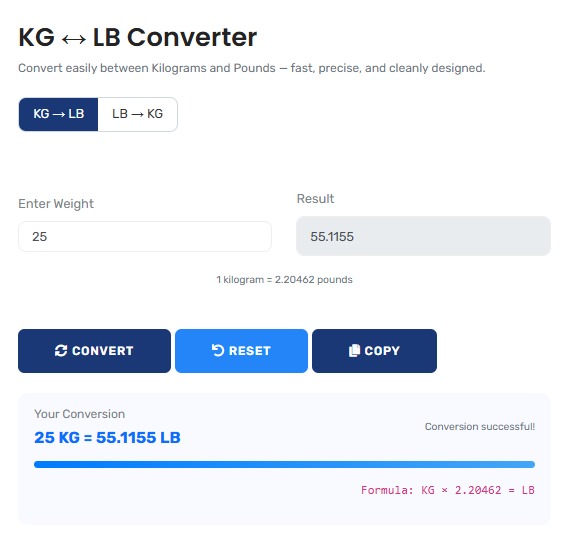
Navigating between kilograms and pounds can be confusing in our globally connected world. Whether you're packing for international travel, following a recipe from another country, tracking fitness progress, or comparing product weights, our Kilograms to Pounds Converter provides instant, accurate conversions with just a few clicks. Using the precise conversion factor of 1 kilogram = 2.20462 pounds, this tool ensures you get reliable results every time.
The metric system (kilograms) is used by most countries worldwide, while the imperial system (pounds) remains standard in the United States and a few other nations. This creates frequent conversion needs for travelers, cooks, fitness enthusiasts, and online shoppers. Our converter handles everything from tiny measurements like spices and ingredients to substantial weights like body weight and luggage limits. The intuitive design makes it accessible for everyone, from students learning measurement conversions to professionals needing quick calculations.
Beyond simple conversions, we provide practical examples, helpful tips, and detailed explanations to ensure you understand not just how to convert, but why accurate conversions matter in different contexts. For comprehensive weight conversion solutions, explore our complete collection of Weight and Mass Converters, including specialized tools for grams, ounces, stones, and tons.
Why Accurate Weight Conversion Matters in Daily Life
In our interconnected world, measurement confusion can lead to costly mistakes and frustrating experiences. Consider these common scenarios where precise kg to lbs conversion is essential:
- International Travel: Airline baggage limits vary by country - European airlines typically use kilograms while American carriers use pounds. Miscalculating can result in expensive overweight baggage fees or last-minute repacking stress.
- Global Cooking: Recipes from different countries use different measurement systems. Baking especially requires precision - a small conversion error can ruin an entire batch of cookies or cause a cake to collapse.
- Fitness Journey: Weight loss programs and fitness equipment often originate from different countries. Accurate conversion helps track progress consistently whether your scale shows kilograms or pounds.
- Online Shopping: When purchasing products internationally, understanding the actual weight helps with shipping cost calculations and ensures you're getting what you expect.
- Health Monitoring: Medical guidelines and weight-related health recommendations may come in different measurement systems, requiring conversion for proper understanding and application.
- Shipping and Logistics: Postal services and shipping companies use different weight units for calculating rates, making conversion essential for cost-effective shipping.
Comprehensive Conversion Scenarios with Real-World Applications
International Travel Planning: Avoiding Costly Baggage Fees
International travelers frequently face confusion when airlines use different weight systems. European carriers typically limit checked baggage to 23 kilograms in economy class, while American airlines often use 50-pound limits. Without proper conversion, travelers risk unexpected fees. Consider Sarah's situation: flying from London to New York with British Airways (23 kg limit) and returning with Delta (50 lbs limit). Using our converter, she calculates 23 kg equals 50.71 pounds, realizing she's actually 0.71 pounds over Delta's limit on her return flight. This foresight allows her to redistribute items between bags or remove non-essentials, potentially saving $75-$200 in overweight fees.
Practical Travel Tips:
- Always convert both ways: kg→lbs for US carriers, lbs→kg for international carriers
- Leave a 0.5-1 kg (1-2 lb) buffer for airport scale variations
- Weigh your luggage at home using a reliable scale
- Remember that carry-on limits also vary by measurement system
- Consider investing in a luggage scale with dual unit display
Culinary Excellence: Mastering International Recipes
The culinary world knows no borders, but measurement systems do. Professional chefs and home cooks alike encounter recipes from around the globe. Maria, an avid baker, discovers a perfect sourdough bread recipe from a French bakery using metric measurements. The recipe calls for 1 kilogram of bread flour. Using our converter, she learns this equals 2.20462 pounds. More practically for her American kitchen scale, this converts to 2 pounds 3.27 ounces. This precision matters because bread baking is sensitive to ingredient ratios - a 10% error in flour weight could result in dense, poorly risen bread. By converting accurately, Maria achieves the same light, airy crumb structure as the Parisian original.
Cooking Conversion Strategies:
- For baking: Use exact conversions (grams to ounces) for best results
- For general cooking: Approximations are usually acceptable
- Invest in a digital kitchen scale with unit conversion capability
- Bookmark conversion tools for quick access while cooking
- When doubling recipes, convert first, then multiply
Fitness Transformation: Tracking Progress Across Systems
Fitness journeys often involve equipment and programs from different countries. Mike, following a British weight training program measured in kilograms, uses American gym equipment calibrated in pounds. His program prescribes squats with 100 kilograms for 5 reps. Converting this to pounds reveals he needs to load 220.46 pounds on the bar. Most gym plates are in 5-pound increments, so he rounds to 220 pounds (four 45-pound plates plus two 5-pound plates on each side). Over 12 weeks, his goal is to increase to 120 kilograms. Our converter shows this equals 264.55 pounds, helping him plan progressive overload with available plate combinations at his gym.
Fitness Tracking Approach:
- Convert your starting weight and goal weight to both systems
- Track progress consistently in one system to avoid confusion
- Understand that small conversion errors are less critical for strength training than for baking
- Use conversion apps or bookmarked tools for quick gym calculations
- Remember that body composition matters more than exact weight numbers
For health and fitness calculations, utilize our BMI Calculator for body mass index assessment.
Detailed Conversion Formulas and Mathematical Principles
Precise Conversion Mathematics:
Exact Kilogram to Pound Conversion:
1 kilogram = 2.20462262185 pounds exactly
Formula: Pounds = Kilograms × 2.20462262185
Example: 5 kg × 2.20462262185 = 11.02311310925 lbs
Pound to Kilogram Reverse Conversion:
1 pound = 0.45359237 kilograms exactly
Formula: Kilograms = Pounds × 0.45359237
Example: 10 lbs × 0.45359237 = 4.5359237 kg
Mental Approximation Techniques:
• Quick kg→lbs: Multiply by 2, then add 10% of original value
• Quick lbs→kg: Divide by 2, then subtract 10%
• Example: 20 kg ≈ (20×2) + (20×0.2) = 40 + 4 = 44 lbs (actual: 44.0925)
Note: Mental approximations are for quick estimates only
Comprehensive Conversion Reference Table
| Kilograms (kg) | Pounds (lbs) | Common Equivalent | Practical Application | Ounce Equivalent |
|---|---|---|---|---|
| 0.25 kg | 0.551 lbs | 1/4 bag of sugar | Small recipe ingredient | 8.82 oz |
| 0.5 kg | 1.102 lbs | Standard butter block | Baking, cooking | 17.64 oz |
| 1 kg | 2.205 lbs | Bag of sugar/flour | Cooking, small packages | 35.27 oz |
| 5 kg | 11.023 lbs | Small dumbbell | Fitness, pet food | 176.37 oz |
| 10 kg | 22.046 lbs | Carry-on luggage limit | Travel, medium dog | 352.74 oz |
| 23 kg | 50.706 lbs | Checked luggage limit | International travel | 811.30 oz |
| 50 kg | 110.231 lbs | Average adult weight | Health, fitness | 1,763.70 oz |
| 100 kg | 220.462 lbs | Heavy luggage/person | Shipping, weight class | 3,527.40 oz |
Measurement Systems Explained: Metric vs Imperial
| Aspect | Metric System (Kilograms) | Imperial System (Pounds) | Conversion Challenge | Best Practice |
|---|---|---|---|---|
| Base Unit | Kilogram (1,000 grams) | Pound (16 ounces) | Non-decimal relationship | Use exact conversion factor |
| Global Usage | ~95% of world population | USA, Myanmar, Liberia | Travelers frequently convert | Know both systems when traveling |
| Scientific Use | Universal standard | Limited scientific use | Research consistency needed | Always use metric in science |
| Ease of Calculation | Decimal-based (easy) | Base-16 ounces (complex) | Mental math difficult | Use conversion tools |
| Historical Origin | French Revolution (1790s) | Roman libra (ancient) | Different historical paths | Understand both origins |
Step-by-Step Guide to Using Our Converter
Comprehensive User Instructions:
- Input Your Value: Enter the numerical weight value in the designated field. You can use whole numbers, decimals, or fractions depending on your needs.
- Select Conversion Direction: Choose between "Kilograms to Pounds" or "Pounds to Kilograms" based on your starting measurement unit.
- Choose Precision Level: Select your desired decimal places (0-5) based on application needs. Baking requires more precision than luggage weighing.
- View Instant Results: Receive immediate conversion with clear labeling showing both exact and rounded values where appropriate.
- Utilize Additional Features: Use the copy-to-clipboard function, save frequent conversions, or toggle between common preset values.
- Access Helpful Information: Refer to the conversion table, practical examples, and tips relevant to your specific use case.
Our converter is designed for both simplicity and depth - beginners get instant results while advanced users access detailed information and customization options.
For a complete suite of conversion tools, visit our Conversion Calculators Hub covering length, volume, temperature, and more.
Critical Conversion Errors and How to Avoid Them
The 10% Approximation Error: When "Close Enough" Isn't Enough
Widespread Misconception: Believing 1 kg equals exactly 2.2
pounds.
Mathematical Reality: 1 kg = 2.20462 pounds (0.00462 difference
per kg).
Cumulative Impact: For 50 kg, the 2.2 approximation gives 110
lbs versus actual 110.231 lbs - a 0.231 lb error.
Financial Consequence: In shipping, this error could push a
package into the next price bracket, increasing costs 15-30%.
Professional Solution: Always use the exact conversion factor
(2.20462) for calculations involving cost, health, or precision requirements.
Unit Confusion: Kilograms vs Pounds in Different Contexts
Different industries and contexts use weight measurements differently, creating potential for confusion:
- Aviation: Fuel is measured in pounds in US, kilograms elsewhere - critical for flight calculations
- Medicine: Drug dosages sometimes use different units in different countries
- Sports: Weight classes in boxing/martial arts vary between systems
- Manufacturing: Product specifications may use different units in different markets
- Education: Students learn different systems in different countries
Best Practices: Always verify which unit system is being used, convert carefully, and when in doubt, ask for clarification. Never assume you know which system is being used based on country alone - some industries use international standards regardless of location.
For mathematical calculations beyond weight conversion, utilize our Percentage Calculator for ratio and proportion calculations.
Specialized Applications: Precision Requirements by Field
Industry-Specific Conversion Protocols
-
Pharmaceutical & Medical Fields:
- Required precision: 0.0001 kg or 0.0002 lbs
- Critical for: Drug dosages, patient weight monitoring
- Special consideration: Always convert patient weight consistently
- Tool recommendation: Use medical-grade conversion tools
-
Aviation & Aerospace:
- Required precision: 0.01 kg or 0.02 lbs
- Critical for: Fuel calculations, payload weights
- Special consideration: Different aircraft use different systems
- Tool recommendation: Certified aviation calculators
-
Culinary & Baking:
- Required precision: 0.001 kg or 0.002 lbs
- Critical for: Recipe consistency, commercial baking
- Special consideration: Small errors affect chemical reactions
- Tool recommendation: Digital scales with unit conversion
-
Fitness & Sports Science:
- Required precision: 0.1 kg or 0.2 lbs
- Critical for: Competition weight classes, progress tracking
- Special consideration: Different sports use different systems
- Tool recommendation: Sports-specific conversion tools
For travel-related financial conversions, utilize our USD to PKR Currency Converter for international budgeting.
Precision Guidelines Across Different Applications
| Application Field | Recommended Precision | Tolerance Level | Consequences of Error | Verification Method |
|---|---|---|---|---|
| Scientific Research | 0.00001 kg | ±0.001% | Invalid results, failed experiments | Calibrated lab equipment |
| Pharmaceutical | 0.0001 kg | ±0.01% | Incorrect dosages, health risks | Medical verification |
| Commercial Baking | 0.001 kg | ±0.1% | Product inconsistency, waste | Recipe testing |
| International Shipping | 0.01 kg | ±0.5% | Cost errors, customs issues | Postal scale verification |
| Home Cooking | 0.01 kg | ±2% | Minor recipe variations | Taste adjustment |
| Fitness Tracking | 0.1 kg | ±5% | Progress measurement errors | Scale consistency |
| General Reference | 0.5 kg | ±10% | Approximation errors | Common sense check |
Advanced Features and Technological Integration
Innovative Converter Capabilities:
- Multi-Platform Accessibility: Fully responsive design works seamlessly on desktop, tablet, and mobile devices with optimized interfaces for each platform.
- Offline Functionality: Core conversion capabilities work without internet connection - perfect for travel, remote locations, or unstable connections.
- Voice Input Compatibility: Supports voice commands for hands-free operation while cooking, exercising, or multitasking.
- Historical Tracking: Optional feature to save and track conversion history for frequent users, with export capability for record-keeping.
- Custom Presets: Create and save frequently used conversions (like your airline's luggage limit or common recipe amounts) for instant access.
- Integration Ready: API access available for developers needing weight conversion in applications, websites, or business systems.
- Educational Mode: Step-by-step breakdown of conversion process for students and learners wanting to understand the mathematics.
Our converter evolves based on user feedback and technological advancements, ensuring it remains the most practical and comprehensive kg to lbs conversion solution available.
Essential Insight: Weight conversion between kilograms and pounds is more than a mathematical exercise - it's a practical skill for navigating our globalized world. From avoiding airline fees to baking perfect bread, from tracking fitness progress to shipping packages internationally, accurate conversion impacts daily life in tangible ways. The key to mastery is understanding when precision matters (baking, medicine) and when approximations suffice (general reference). Always use reliable tools for important conversions, verify critical measurements, and when in doubt, convert conservatively. For all your calculation needs beyond weight conversion, explore our comprehensive collection of All Calculators covering mathematics, finance, health, construction, and science.
Comprehensive Conversion Reference Guide
Memorization Guide for Common Conversions:
- Exact Values to Remember:
- 1 kg = 2.20462 lbs (the golden conversion)
- 0.453592 kg = 1 lb (the reverse conversion)
- 2.2 lbs ≈ 1 kg (quick approximation)
- Frequent Travel Conversions:
- 23 kg = 50.706 lbs (standard economy luggage)
- 32 kg = 70.548 lbs (business class luggage)
- 7 kg = 15.432 lbs (typical carry-on limit)
- Common Body Weight Benchmarks:
- 50 kg = 110.231 lbs (light adult weight)
- 70 kg = 154.324 lbs (average adult weight)
- 90 kg = 198.416 lbs (heavy adult weight)
- Cooking & Baking Standards:
- 0.5 kg = 1.102 lbs (standard butter block)
- 1 kg = 2.205 lbs (bag of flour/sugar)
- 2 kg = 4.409 lbs (large recipe quantities)
Mental Calculation Techniques:
- For kg→lbs: Double the kg value, then add 10% of the original
- For lbs→kg: Halve the lbs value, then subtract 10%
- Example: 30 kg → (30×2) + (30×0.2) = 60 + 6 = 66 lbs (actual: 66.1386)
Critical Reminder: For precision-dependent applications (medicine, baking, science), always use exact conversion tools rather than mental approximations. Bookmark reliable conversion resources and verify important calculations twice.
Comprehensive Frequently Asked Questions
The internationally accepted exact conversion is 1 kilogram = 2.20462262185 pounds. This value is defined by international agreement and maintained by standards organizations worldwide. For virtually all practical applications, using 2.20462 provides sufficient accuracy. Our calculator uses the full precision value for internal calculations but displays rounded results appropriate to your selected precision level.
85 kilograms equals 187.3929 pounds (85 × 2.20462). For fitness tracking purposes, most people round to 187.4 pounds or simply 187 pounds. It's helpful to remember common body weight benchmarks: 70 kg = 154.3 lbs, 80 kg = 176.4 lbs, 90 kg = 198.4 lbs. When tracking weight loss or gain, consistency in measurement system matters more than absolute precision - choose one system and stick with it for consistent progress tracking.
Kilograms and pounds come from completely different historical measurement systems with independent origins. The kilogram is based on the mass of a specific platinum-iridium cylinder kept in France, while the pound originated from Roman measurements. Their relationship emerged naturally rather than by design. The 2.2 approximation (actually 2.20462) results from these independent historical developments. While 2.2 works for quick estimates, the exact factor is necessary for precision applications.
200 pounds equals 90.7185 kilograms (200 ÷ 2.20462). This is a common conversion for understanding weight limits, fitness goals, and health metrics. For practical purposes, 200 lbs is often considered approximately 90.7 kg. When precision matters (such as for weight class sports or medical applications), use the exact conversion rather than approximations.
Our converter uses scientifically accurate conversion factors and provides precision up to 5 decimal places, making it suitable for most non-critical scientific and educational applications. However, for medical dosages, pharmaceutical preparations, or published scientific research, we recommend verification against certified standards and consultation with appropriate professionals. Always follow institutional guidelines for critical applications.
Yes to both! Our converter has basic offline functionality for essential conversions without internet access. For integration into websites, applications, or business systems, we offer API access with documentation for developers. Contact our technical team for integration details, rate limits, and customization options. We also provide mobile-friendly versions and progressive web app capabilities for seamless cross-device use.
In physics, mass (measured in kg) is the amount of matter, while weight (measured in lbs) is the force of gravity on that mass. On Earth's surface, they're proportional, so conversion works. In space or different gravity, 1 kg mass would have different weight in pounds. For everyday Earth applications, this distinction doesn't affect conversion accuracy. Our converter assumes standard Earth gravity (9.80665 m/s²), appropriate for all terrestrial applications.
