Grams to Ounces Converter: The Ultimate Guide to Precise Weight Conversion
Welcome to the most comprehensive Grams to Ounces Converter guide on the web! Whether you're a home cook experimenting with international recipes, an online shopper comparing product weights, a traveler packing luggage, or a professional needing precise measurements, this converter is your go-to solution for accurate weight transformations between metric and imperial systems.
In today's interconnected world, we frequently encounter weight measurements in different units. European recipes use grams, American packages show ounces, international shipping requires both, and digital scales offer multiple options. This creates constant need for reliable conversion tools. Our converter bridges this gap with mathematical precision, user-friendly design, and practical applications for everyday life.
Why This Converter Stands Out:
- Scientific Accuracy: Uses exact 28.349523125 conversion factor
- Instant Results: Real-time calculations without delays
- Bidirectional Functionality: Converts both grams→ounces and ounces→grams
- Mobile-Optimized: Works flawlessly on all devices anywhere
- Educational Value: Teaches measurement systems while converting
- Completely Free: No cost, no registration, no limitations
For comprehensive weight conversion solutions, explore our complete Weight & Mass Conversion Toolkit, featuring specialized tools for kilograms to pounds, stone conversions, and more.
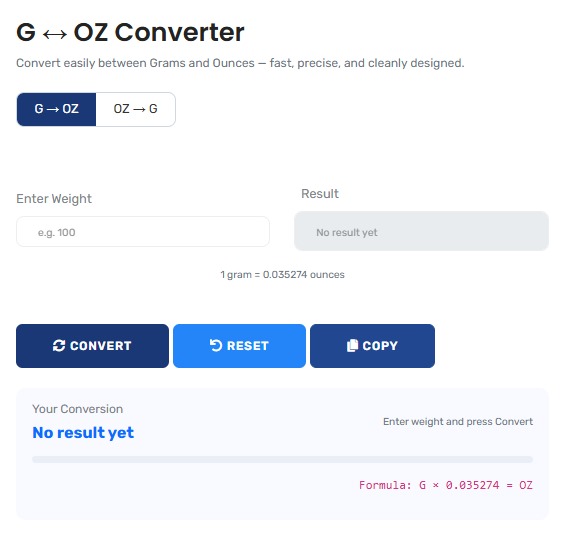
The Science Behind the Conversion: Understanding Grams vs. Ounces
Measurement Systems Explained
Grams (Metric System):
- Part of International System of Units (SI)
- Used by 95% of world population
- Based on decimal system (powers of 10)
- 1 gram = 1/1000 of a kilogram
- Originally defined as mass of 1 cm³ of water at 4°C
Ounces (Imperial/US Customary System):
- Primarily used in United States, Liberia, Myanmar
- Part of avoirdupois system for general goods
- 16 ounces = 1 pound
- Different from troy ounces used for precious metals
- Internationally standardized in 1959
The Universal Conversion Factor: 1 ounce = 28.349523125 grams (exact mathematical relationship established by international agreement).
Complete Conversion Formulas and Mathematics
Exact Mathematical Equations
Grams to Ounces Conversion:
Formula: Ounces = Grams ÷ 28.349523125
Example: 250 grams = 250 ÷ 28.349523125 = 8.81849 ounces
Ounces to Grams Conversion:
Formula: Grams = Ounces × 28.349523125
Example: 5 ounces = 5 × 28.349523125 = 141.7476 grams
Quick Mental Approximation:
For everyday use: 30 grams ≈ 1 ounce (easy to remember)
Actual: 28.35 grams = 1 ounce (exact value)
Comprehensive Conversion Reference Tables
Everyday Cooking and Baking Conversions
| Grams (g) | Ounces (oz) | Common Kitchen Use | Typical Ingredient |
|---|---|---|---|
| 5 g | 0.176 oz | Spices, baking powder | Salt, yeast, spices |
| 15 g | 0.529 oz | Small quantities | Herbs, flavorings |
| 28.35 g | 1 oz | Standard conversion | Reference point |
| 100 g | 3.527 oz | Common baking measure | Flour, sugar, butter |
| 250 g | 8.818 oz | Standard package size | Butter, cheese, meat |
| 500 g | 17.637 oz | Large cooking amounts | Pasta, rice, produce |
Commercial and Shopping Conversions
| Product Weight | Grams Equivalent | Ounces Equivalent | Common Products |
|---|---|---|---|
| Small Package | 50 g | 1.764 oz | Spices, supplements |
| Standard Package | 200 g | 7.055 oz | Coffee, snacks, cheese |
| Family Size | 500 g | 17.637 oz | Cereal, pasta, flour |
| Bulk Purchase | 1000 g (1 kg) | 35.274 oz | Rice, sugar, pet food |
| Shipping Weight | 2000 g (2 kg) | 70.548 oz | Books, small appliances |
Practical Applications in Daily Life
International Cooking Made Simple
Imagine discovering an amazing French pastry recipe that calls for 180g of butter and 150g of flour, but your American measuring cups show ounces. Without accurate conversion, your delicate croissants could become kitchen disasters.
Real Example: Converting Classic French Baguette Recipe
- 500g bread flour = 17.64 ounces
- 10g salt = 0.35 ounces
- 7g instant yeast = 0.25 ounces
- 360g water = 12.70 ounces
Online Shopping and Price Comparison
You're shopping for protein powder online. One brand offers 2 pounds (32 ounces) for $45, while another offers 1 kilogram (1000 grams) for $42. Which is better value?
Price Comparison Analysis:
- Brand A: 32 ounces = 907.18 grams at $45 = $0.0496 per gram
- Brand B: 1000 grams at $42 = $0.0420 per gram
- Savings: Brand B saves 15.3% per gram
Accurate conversion reveals true value. For business calculations, explore our Discount Calculator.
International Travel and Luggage Planning
Flying from Europe to the US? European airlines typically use kilograms for baggage limits, while American airlines use pounds. Our converter prevents expensive overweight baggage fees.
Travel Scenario: Your European flight allows 23kg checked baggage. Converting to pounds: 23 kg = 50.71 pounds. Most US domestic flights allow 50 pounds. You have just 0.71 pounds margin - precise conversion prevents fees!
For comprehensive travel calculations, check our Currency Converters for financial planning.
Step-by-Step Conversion Tutorial
Mastering Weight Conversion in 5 Simple Steps
Step 1: Identify Your Starting Measurement
Determine whether you have grams or ounces. Check packaging labels, recipe
instructions, or scale readings.
Step 2: Choose Conversion Direction
• Grams to Ounces: For metric→imperial conversion
• Ounces to Grams: For imperial→metric conversion
Step 3: Enter Precise Value
Input the exact number from your source. Include decimals if provided for
maximum accuracy.
Step 4: Calculate and Review
Our converter instantly provides mathematically exact conversion. Review decimal
places based on your needs.
Step 5: Apply with Context Awareness
• Cooking: Round to practical measurements (usually 1-2 decimals)
• Science: Use full decimal precision
• Shipping: Follow carrier rounding rules
Pro Tip: Bookmark our converter for instant access during cooking sessions, shopping trips, or travel planning.
Precision Guidelines for Different Applications
Accuracy Requirements by Use Case
Home Cooking & Baking:
- Required Precision: 0.1 ounce or 1 gram
- Reason: Small variations rarely affect results
- Example: Round 3.527 oz to 3.5 oz for simplicity
Commercial Baking & Food Service:
- Required Precision: 0.01 ounce or 0.1 gram
- Reason: Consistency across large batches
- Example: Use 8.82 oz exactly for 250g flour
Scientific & Laboratory Use:
- Required Precision: Full decimal accuracy
- Reason: Experimental integrity
- Example: Use 28.349523125 factor exactly
Postal & Shipping Services:
- Required Precision: Whole ounce typically
- Reason: Pricing brackets
- Example: Round 17.64 oz to 18 oz for postage
Remember: Our converter provides exact values - you choose appropriate rounding for your specific needs.
Historical Evolution of Weight Measurement
From Ancient Grains to Digital Precision
Ancient Origins: The ounce traces back to Roman "uncia" (one-twelfth). The gram emerged during French Revolution as part of metric system rationalization.
18th Century: French scientists defined gram as mass of 1 cubic centimeter of water, creating first decimal-based weight system.
19th Century: Metric system spread across Europe while British Empire maintained ounces, creating ongoing conversion needs.
1959 International Agreement: United States, United Kingdom, Canada, Australia, New Zealand, and South Africa standardized avoirdupois ounce to exactly 28.349523125 grams.
21st Century Digital Age: Online converters like ours make historical measurement differences instantly manageable for global citizens.
This rich history explains why we still need conversion tools today. For temperature measurement history, explore our Celsius to Fahrenheit Converter.
Mobile Optimization and Cross-Device Compatibility
Our Grams to Ounces Converter is engineered for universal accessibility:
| Device Type | Optimization Features | Ideal Use Cases | Performance |
|---|---|---|---|
| Smartphones | Touch-friendly buttons, responsive layout | Grocery store, kitchen, post office | Instant results, offline capable |
| Tablets | Larger display, easy data entry | Cooking demonstrations, classroom use | High visibility, educational features |
| Desktop Computers | Full keyboard support, multiple windows | Business operations, recipe development | Advanced features, batch processing |
| Smart Assistants | Voice command compatibility | Hands-free kitchen use | Voice-activated conversion |
Advanced Features for Power Users
Beyond Basic Conversion
Bidirectional Instant Conversion: Switch between grams→ounces and ounces→grams without refreshing.
Decimal Precision Control: Adjust display to 1-6 decimal places based on your needs.
Common Values Library: Quick-access buttons for frequently converted values (100g, 250g, 500g, etc.).
History Memory: Track recent conversions for reference and consistency.
Unit Comparison Visualization: Visual representation showing relative sizes.
Export Capability: Save conversion results for documentation or sharing.
Educational Mode: Step-by-step explanation showing mathematical process.
These advanced features make our converter suitable for both casual users and professionals requiring sophisticated measurement tools.
Industry Applications and Professional Uses
Culinary Industry Applications
Professional kitchens serving international clientele need precise conversion for menu consistency. A restaurant offering both metric and imperial measurements on menus requires daily conversions.
Case Study: International Bakery Chain
A bakery with locations in Paris and New York uses our converter to maintain
identical croissant recipes:
• Paris recipe: 500g butter, 750g flour
• New York adaptation: 17.64 oz butter, 26.46 oz flour
• Result: Consistent quality across continents
E-commerce and International Retail
Online retailers listing products globally must display weights in both systems to reach international customers effectively.
Implementation Strategy:
1. Store products with metric weights in database
2. Use our conversion algorithm for real-time ounce display
3. Ensure consistent pricing per unit weight
4. Provide conversion information for customer confidence
For business financial calculations, utilize our VAT/GST Calculator.
Educational Value and Learning Resources
Teaching Measurement Systems Through Conversion
Our converter serves as excellent educational tool for:
- Mathematics Education: Demonstrates practical application of division and multiplication
- Science Classes: Illustrates metric system advantages and conversion principles
- Culinary Schools: Teaches precision measurement for professional cooking
- International Studies: Shows practical differences between measurement systems
- Home Economics: Provides life skills for recipe adaptation and shopping
Learning Outcomes: Users not only get converted values but understand the mathematical relationship between grams and ounces, appreciating why 28.349523125 is the magic number connecting these systems.
For additional educational tools, explore our Basic Math Calculators collection.
Comprehensive Quick Reference Guide
Essential Conversion Equivalents (Memorize These!):
| 1 ounce | = | 28.35 grams (exact: 28.349523125) |
| 4 ounces | = | 113.4 grams (¼ pound) |
| 8 ounces | = | 226.8 grams (½ pound) |
| 16 ounces | = | 453.6 grams (1 pound) |
| 100 grams | = | 3.53 ounces |
| 500 grams | = | 17.64 ounces |
| 1000 grams | = | 35.27 ounces (2.2 pounds) |
Practical Approximation Rules:
- For quick mental math: 30g ≈ 1oz (close enough for rough estimates)
- Double ounces to estimate grams: 2oz ≈ 60g (actually 56.7g)
- Halve grams to estimate ounces: 50g ≈ 1.75oz (actually 1.76oz)
Pro Tip: Bookmark this page or save these references for instant access during cooking, shopping, or traveling.
Why Our Converter Outperforms Alternatives
Comparison with Other Conversion Methods
| Conversion Method | Accuracy | Speed | Convenience | Learning Value |
|---|---|---|---|---|
| Our Online Converter | Mathematically Exact | Instant | Anywhere, Any Device | Educational Content |
| Manual Calculation | Error-Prone | Slow | Requires Math Skills | Limited |
| Printed Charts | Approximate | Medium | Bulky, Static | None |
| Mobile Apps | Varies | Fast | Download Required | Minimal |
| Mental Approximation | Low | Fast | Convenient but Inaccurate | None |
Our Advantages: No downloads, no costs, no registration, works offline, educational content, exact accuracy, instant results, universal accessibility.
Future Developments and User-Driven Improvements
We're continuously enhancing our Grams to Ounces Converter based on user feedback:
- Voice Integration: Hands-free conversion for kitchen use
- Recipe Scaling: Automatic adjustment of all ingredients
- Shopping Integration: Real-time price per unit comparison
- Historical Tracking: Personal conversion history and trends
- Custom Presets: Save frequently used conversions
- Multi-language Support: Global accessibility improvements
Your suggestions drive our development. Contact us with feature requests or improvement ideas!
Final Recommendation: Whether you're converting 5 grams of saffron or 5000 grams for shipping, our Grams to Ounces Converter provides reliable, instant, accurate results. The combination of mathematical precision, educational content, and practical applications makes this your definitive weight conversion solution. Bookmark it today for all your metric-imperial conversion needs!
For all calculation needs, from basic math to advanced finance, visit our comprehensive Calculators Directory featuring hundreds of specialized tools.
Frequently Asked Questions
The internationally standardized exact conversion factor is 1 ounce = 28.349523125 grams. This value was established by international agreement in 1959 and is used by scientific institutions worldwide. Our converter uses this exact factor for maximum accuracy.
Exactly 28.349523125 grams make 1 avoirdupois ounce. This precise value ensures consistent conversions across scientific, commercial, and everyday applications. The avoirdupois ounce is different from troy ounces used for precious metals.
Avoirdupois ounces (28.35g) are used for general goods, cooking, and everyday measurements. Troy ounces (31.10g) are used exclusively for precious metals like gold and silver. Our converter handles avoirdupois ounces unless specified otherwise.
250 grams equals 8.81849 ounces. For most baking purposes, rounding to 8.82 ounces provides sufficient accuracy. This conversion is common for butter, flour, and sugar in international recipes.
Approximately yes, but exactly 100 grams equals 3.5274 ounces. The 3.5 approximation works for quick estimates, but for precise measurements (especially in baking), use the exact value. Our converter provides both approximate and exact values.
Multiply ounces by 28.35 to get grams. Example: 16 ounces × 28.35 = 453.6 grams. Postal services typically round to whole ounces for pricing, but weight limits may use exact conversions. For international shipping, our KG to Pounds Converter is also useful.
The 30g=1oz approximation has 5.8% error (actual: 28.35g). It's fine for rough estimates but unacceptable for baking, science, or commerce. Our converter provides exact values while teaching when approximations are acceptable.
