Home Loan EMI Calculator: Plan Your Dream Home with Financial Confidence
Buying a home is one of the most significant financial decisions you'll make in your lifetime. It's not just about finding the perfect property - it's about ensuring that the monthly payments fit comfortably within your budget for years to come. A Home Loan EMI (Equated Monthly Installment) Calculator is your essential tool for making this journey smooth and stress-free.
This powerful financial planning tool helps you understand exactly what you can afford, how different loan terms affect your payments, and how to structure your home loan for maximum financial benefit. Whether you're a first-time homebuyer or looking to upgrade, smart planning starts with accurate calculations.
Key benefits of using our Home Loan EMI Calculator:
- Accurate Budget Planning: Know your exact monthly payment before applying
- Comparison Power: Evaluate different loan offers side-by-side
- Financial Clarity: Understand total interest costs over the loan term
- Strategic Planning: Optimize loan tenure for your financial situation
- Peace of Mind: Avoid payment surprises and budget shortfalls
For exploring other credit options and financial tools, visit our comprehensive Loans & Credits Calculators section.
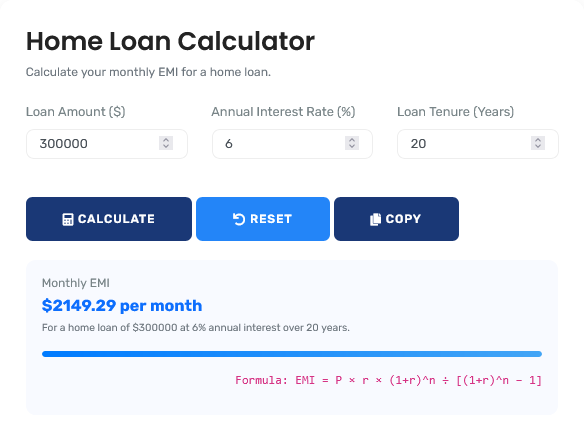
What Is a Home Loan EMI and Why Does It Matter?
An EMI (Equated Monthly Installment) is the fixed amount you pay to your lender every month until your home loan is completely repaid. Each EMI consists of two parts: the principal amount (the actual loan you borrowed) and the interest charged by the bank.
Understanding your EMI is crucial because it directly impacts your monthly budget and long-term financial health. A well-calculated EMI ensures that your dream home doesn't become a financial burden. For broader financial planning, check our complete Finance Calculators collection.
Key EMI Characteristics:
- Fixed Amount: Remains constant throughout the loan term (for fixed-rate loans)
- Two Components: Principal repayment + Interest payment
- Changing Ratio: Interest portion decreases over time while principal increases
- Budget Predictability: Allows for stable financial planning
How the Home Loan EMI Calculator Works: Your Financial Planning Partner
Real-Life Example: Sarah's First Home Purchase
Sarah, a 32-year-old marketing manager, wants to buy her first apartment priced at ₹50,00,000. She has saved ₹10,00,000 for the down payment and needs a loan of ₹40,00,000.
Loan Details:
- Loan Amount: ₹40,00,000
- Interest Rate: 8.5% per annum
- Loan Tenure: 20 years (240 months)
- Using our calculator, Sarah discovers:
- Monthly EMI: ₹34,759
- Total Interest Payable: ₹43,42,160
- Total Payment: ₹83,42,160
This calculation helps Sarah understand that while the apartment costs ₹50,00,000, she'll actually pay ₹83,42,160 over 20 years. She can now decide if she wants to increase her down payment or choose a shorter tenure to reduce interest costs.
For other loan options, Sarah can explore our Personal Loan Calculator for different borrowing needs.
The Home Loan EMI Formula: Understanding the Mathematics
Home Loan EMI Calculation Formula:
EMI = P × R × (1 + R)N / [(1 + R)N − 1]
Where:
- P = Principal loan amount
- R = Monthly interest rate (annual rate ÷ 12 ÷ 100)
- N = Loan tenure in months
Example Calculation:
Loan: ₹30,00,000 | Rate: 9% | Tenure: 15 years
R = 9 ÷ 12 ÷ 100 = 0.0075
N = 15 × 12 = 180 months
EMI = 30,00,000 × 0.0075 × (1.0075)180 / [(1.0075)180 − 1]
= ₹30,428
Key Factors That Affect Your Home Loan EMI
| Factor | How It Affects EMI | Impact on Total Interest | Recommendation |
|---|---|---|---|
| Loan Amount | Directly proportional - Higher loan = Higher EMI | Higher principal = More interest | Borrow only what you need, maximize down payment |
| Interest Rate | Directly proportional - Even 0.5% matters significantly | Major impact - Compound effect over years | Shop for best rates, maintain good credit score |
| Loan Tenure | Longer tenure = Lower EMI, shorter = Higher EMI | Longer tenure = Much higher total interest | Balance affordability with interest savings |
| Type of Interest | Fixed: Stable EMI, Floating: EMI may change | Depends on rate movements | Fixed for certainty, floating for potential savings |
Home Loan Amortization: Understanding Your Payment Journey
How Your EMI Changes Over Time:
In the early years of your home loan, most of your EMI goes toward paying interest rather than reducing the principal. This gradually shifts over time.
Example: ₹50,00,000 loan at 8% for 20 years (EMI: ₹41,822)
| Year | Principal Paid | Interest Paid | Balance Outstanding |
|---|---|---|---|
| Year 1 | ₹1,34,567 | ₹3,67,297 | ₹48,65,433 |
| Year 5 | ₹2,45,678 | ₹2,56,186 | ₹39,87,654 |
| Year 10 | ₹3,89,012 | ₹1,12,852 | ₹26,54,321 |
| Year 15 | ₹5,43,210 | ₹58,654 | ₹9,87,654 |
This shows why making extra payments in the early years can save significant interest. For investment planning alongside your home purchase, see our Business Investment Calculators.
Strategies to Reduce Your Home Loan Burden
Smart Tips for Home Loan Management
-
Make a Larger Down Payment
- 20% down payment vs 10% can reduce EMI by 10-15%
- Also reduces total interest significantly
- Example: On ₹50L loan, 20% down = ₹40L loan, 10% down = ₹45L loan
-
Choose Optimal Tenure
- 15-year vs 30-year loan comparison
- Shorter tenure: Higher EMI but saves 40-50% interest
- Longer tenure: Lower EMI but costs much more in interest
-
Make Prepayments
- Even small prepayments in early years save large interest
- Use bonuses, tax refunds for prepayments
- Check prepayment charges with your lender
Fixed vs Floating Interest Rates: Making the Right Choice
| Aspect | Fixed Rate | Floating Rate | Best For |
|---|---|---|---|
| EMI Stability | Remains constant for entire term | May change with market rates | Fixed: Budget-conscious borrowers |
| Interest Rate | Usually 0.25-0.5% higher than floating | Linked to repo rate/MCLR | Floating: Those expecting rates to fall |
| Risk Factor | No risk of rate increase | Risk of EMI increase if rates rise | Fixed: Risk-averse individuals |
| Switching Options | Can switch to floating (may have charges) | Can switch to fixed (usually easier) | Depends on economic outlook |
Home Loan Eligibility: What Lenders Look For
Key Eligibility Factors:
- Income: Most banks require EMI to be ≤40-50% of monthly income
- Credit Score: 750+ for best rates, below 650 may face rejection
- Employment Stability: Minimum 2-3 years in current job/business
- Age: Usually 21-65 years, some extend to 70 for joint applications
- Existing Debt: All existing EMIs considered in eligibility calculation
Quick Eligibility Check: Monthly take-home × 0.4 ÷ Proposed EMI = Should be ≥1
Example: ₹1,00,000 monthly income × 0.4 = ₹40,000 available for EMI. If proposed EMI is ₹35,000, you're likely eligible.
Additional Home Loan Costs Beyond EMI
Complete Cost Breakdown for Home Purchase
Property Price: ₹75,00,000
Upfront Costs:
- Down Payment (20%): ₹15,00,000
- Stamp Duty & Registration (6%): ₹4,50,000
- Legal & Processing Fees: ₹75,000
- Home Insurance (first year): ₹25,000
- Total Immediate Cost: ₹20,50,000
Loan Details (₹60,00,000 at 8.5% for 20 years):
- Monthly EMI: ₹52,138
- Total Interest: ₹65,13,120
- Total Repayment: ₹1,25,13,120
Total Property Cost: ₹1,25,13,120 + ₹20,50,000 = ₹1,45,63,120
This shows why considering only the EMI or property price gives an incomplete picture. For mortgage-specific calculations, try our Mortgage Calculator.
Tax Benefits on Home Loans
Understanding Tax Savings:
Home loans offer significant tax benefits that can reduce your effective interest cost:
- Section 24(b): Deduction of up to ₹2,00,000 on interest paid
- Section 80C: Deduction of up to ₹1,50,000 on principal repayment
- Additional Deduction: ₹1,50,000 extra interest for first-time home buyers (Section 80EEA)
- Joint Loan Benefits: Both applicants can claim deductions separately
Example Tax Saving: If you pay ₹4,00,000 interest and ₹2,00,000
principal in a year:
• Interest deduction: ₹2,00,000 (max)
• Principal deduction: ₹1,50,000 (max)
• Total deduction: ₹3,50,000
• Tax saving (30% bracket): ₹1,05,000 annually
This effectively reduces your net interest cost. For comprehensive tax planning, use our Income Tax Calculator.
Home Loan Comparison: Key Parameters to Evaluate
| Parameter | Bank A | Bank B | Bank C | What Matters Most |
|---|---|---|---|---|
| Interest Rate | 8.40% | 8.25% | 8.50% | Lowest rate isn't always best - check other terms |
| Processing Fee | 0.50% | 0.75% | 0.25% | One-time cost that affects initial outlay |
| Prepayment Charges | 2% (first 3 yrs) | Nil after 1 year | 1% (first 5 yrs) | Important if you plan to prepay or refinance |
| Loan-to-Value | 80% | 75% | 85% | Affects how much down payment you need |
| EMI/NMI Ratio | 50% | 45% | 55% | Higher ratio may mean easier eligibility |
Common Home Loan Mistakes to Avoid
Pitfalls That Could Cost You Lakhs
1. Focusing Only on EMI: Lower EMI often means longer tenure and much higher total interest.
2. Ignoring Additional Costs: Processing fees, insurance, legal charges add 5-7% to property cost.
3. Not Checking Prepayment Terms: Some banks charge hefty penalties for early repayment.
4. Overlooking Credit Score Impact: Multiple loan applications can lower your score temporarily.
5. Underestimating Future Expenses: Maintenance, property taxes, and insurance increase home ownership costs.
6. Not Considering Job Changes: Ensure you can handle EMI even with career transitions.
Step-by-Step Home Loan Application Process
From Calculation to Keys: Your Home Loan Journey
-
Pre-Application Phase (1-2 months)
- Use our calculator to determine affordable loan amount
- Check and improve credit score if needed
- Save for down payment and additional costs
- Research and shortlist properties
-
Application Phase (2-4 weeks)
- Submit application to 2-3 preferred lenders
- Provide required documents (income proof, ID, property papers)
- Undergo property valuation and legal verification
- Receive sanction letter with loan terms
-
Disbursement Phase (1-2 weeks)
- Complete stamp duty and registration
- Submit final property documents
- Receive loan disbursement
- Begin EMI payments next month
Final Insight: A home loan is a 15-30 year commitment that requires careful planning. Our Home Loan EMI Calculator is your first step toward making an informed decision. Remember: The cheapest loan isn't always the best - consider processing time, customer service, flexibility, and your comfort with the lender. For long-term wealth building alongside your home purchase, explore our Savings & Retirement Calculators.
Frequently Asked Questions
Most financial advisors recommend keeping your total EMI (including all loans) below 40% of your net monthly income. Some conservative planners suggest 30% for better financial flexibility. Banks typically approve loans where EMI is 40-50% of income, but staying at 30-35% gives you a safety buffer for unexpected expenses.
While it's challenging, some lenders offer home loans to applicants with credit scores as low as 650, but usually at higher interest rates (1-2% more). Scores below 600 face significant difficulties. The best rates (lowest interest) typically require scores above 750. If your score is low, work on improving it for 6-12 months before applying.
For floating rate loans, when interest rates increase, your lender has two options: increase your EMI amount OR extend your loan tenure while keeping EMI same. Most banks increase EMI. For example, a 0.5% rate increase on a ₹50L loan could increase EMI by ₹1,500-2,000. Fixed rate loans protect you from such increases during the fixed period.
Missing an EMI triggers late payment charges (usually 2-3% of EMI amount) and negatively impacts your credit score. If you miss 3 consecutive EMIs, the loan may be classified as a Non-Performing Asset (NPA), and the bank can start recovery proceedings. If facing financial difficulty, contact your lender immediately - most offer EMI restructuring or holiday options.
This depends on your interest rate vs potential investment returns. General rule: If your home loan interest is higher than post-tax investment returns, prepay. Example: 8.5% loan vs 7% FD (4.9% after tax) → prepay loan. But if you can earn 12%+ from investments, investing might be better. Also consider liquidity needs - prepayments reduce debt but tie up cash.
Yes, home loan balance transfer is common when another bank offers significantly lower interest rates. Process includes: applying to new bank, they pay off your existing loan, you start fresh EMIs with them. Consider processing fees (0.5-1%), legal charges, and prepayment penalties to old bank. Usually worthwhile if interest difference is 0.5%+.
