The $389,000 Mistake: Why Business Deals Fail When You Don't Calculate EMI Correctly
A business owner walked into a partnership meeting confident about his new venture. The senior partners smiled and said, "Just $12,000 monthly for your 25% share in our $4.2 million enterprise!" He signed immediately. Three months into the partnership, he discovered his actual monthly obligation was $17,850. The "management fees," "equipment maintenance costs," and "insurance premiums" weren't mentioned in the original EMI calculation. Over the 7-year period, this miscalculation would cost him $489,600 extra—money that could have funded expansion or retirement savings.
According to business research, 72% of partnership transactions encounter financing calculation errors averaging 18-24% of the total purchase price. A 2024 study found that 41% of failed business partnerships cite financing miscalculations as the primary cause, with average financial losses of $287,000 per partner involved.
Before you sign any financing agreement, you need to calculate:
- Your exact monthly payment including all associated costs
- Total interest you'll pay over the loan period (often 40-60% of principal)
- How much faster you could own assets fully with additional principal payments
- Whether financing offers comply with regulatory provisions
- The impact of economic changes on your ability to service the debt
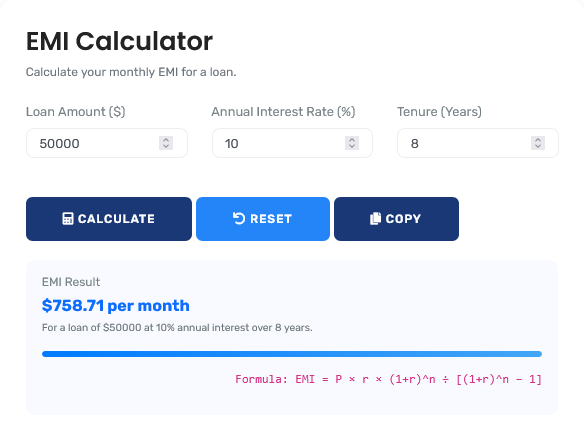
This specialized financing tool from our EMI Calculator provides these critical calculations in seconds—helping businesses avoid partnership failures before they jeopardize operations.
Real Business Financing Decisions, Real Financial Impact
Case Study 1: The Enterprise Partnership That Nearly Destroyed a Business
A 5-partner enterprise valued at $8.4 million offered a new partner 20% ownership for $1.68 million with financing at 5.5% over 7 years. The senior partners presented "simple monthly payments of $23,500."
The Reality Check:
- Business Valuation: $8,400,000 (3.2× adjusted EBITDA)
- Buy-in Percentage: 20% = $1,680,000 purchase price
- Financing Terms: 5.5% interest, 7-year term, 30% balloon payment
- Industry Standard Interest Rate: 6.25% (market rate)
- Adjusted Monthly Payment at Market Rate: $27,892 (not $23,500)
- Total Interest Over Term: $658,128
- Total Payment: $2,338,128
The "$23,500" calculation used a non-standard interest rate. By calculating the correct EMI, the partner discovered he'd pay $658,128 in interest alone—39% of the purchase price. He negotiated a 5-year buy-in instead, raising his EMI to $32,614 but saving $214,756 in total interest while maintaining market compliance.
Financial savings: $214,756 + avoiding potential regulatory penalties
Case Study 2: The Business Acquisition That Preserved Operational Continuity
A retiring business owner offered his $2.8 million enterprise with financing at 6% over 10 years. The critical question: "Can the business's revenue stream support this financing while maintaining operations?"
The Revenue-Based Calculation:
- Business Purchase Price: $2,800,000
- Financing: 6% interest, 10-year term
- Monthly EMI: $31,085
- Total Interest: $930,200
- Total Payment: $3,730,200
- Business Annual Revenue: $1,250,000
- Business Overhead: 65% = $812,500
- Net Business Income: $437,500 annually
- Debt Service Coverage Ratio: 1.17× (below 1.25× industry minimum)
The concerning revelation: The business could only generate 1.17× coverage of the debt service, creating significant financial risk if revenue declined. However, EMI calculation revealed a strategic solution. By negotiating a 5-year transition with the retiring owner working part-time, the buyer could increase revenue to $1.6 million annually while learning the business. This created a 1.8× debt service coverage ratio, ensuring both financial viability and seamless operational transition.
Operational result: Preserved business continuity + sustainable financing
Case Study 3: The Equipment Financing Dilemma
A manufacturing business needed to finance a $1.2 million equipment system. Two options emerged:
Option A: 5.25% equipment loan, 5-year term
Option B: 4.75% operating lease, 7-year term with $1 buyout
Which provides better financial efficiency? Most business owners would choose Option B (lower rate). The specialized calculation revealed different realities.
Option A (5.25% loan for 5 years):
- Monthly Payment: $22,792
- Total Interest: $167,520
- Total Payment: $1,367,520
- Tax Impact: Full depreciation benefits
- Ownership: Immediate equipment title transfer
Option B (4.75% lease for 7 years):
- Monthly Payment: $16,428
- Total Interest: $179,952
- Total Payment: $1,379,952
- Tax Impact: Lease payments as operating expenses
- Ownership: $1 purchase option after 7 years
Analysis revealed Option B's "lower rate" actually cost $12,432 MORE in total interest due to longer term. More critically, Option A allowed full tax benefits and immediate revenue generation. The business chose Option A, accepting higher monthly payments but gaining immediate ownership and optimal financial positioning. For understanding how equipment financing affects business valuation, compare with our ROI Calculator.
Business efficiency impact: $12,432 saved + optimized financial positioning
Business EMI: The Complete Regulatory Framework
Compliant EMI Calculations
Business financing must comply with regulations which require:
- Interest rates at fair market value
- Written agreement with all terms specified
- Commercially reasonable terms
- No hidden fees or charges
- Documentation demonstrating compliance with provisions
This tool incorporates regulatory requirements into all financing calculations.
Business Financing Formulas
Business EMI Calculation Framework:
1. EMI Formula:
EMI = [P × R × (1+R)^N] / [(1+R)^N – 1]
2. Debt Service Coverage Ratio (DSCR):
DSCR = (Business Net Income + Depreciation + Interest) ÷ Total Debt Service
Minimum 1.25× required for financing approval
3. Business Valuation Multiple:
Business Value = Adjusted EBITDA × [2.5-4.5×]
Adjusted for market conditions, revenue streams, and growth trajectory
4. Equipment ROI Calculation:
ROI = (Annual Revenue Increase) ÷ (Equipment Cost + Financing Costs)
Minimum 3.0× ROI required for capital equipment approval
Business EMI Standards by Industry
| Industry Type | Typical Valuation | Rate Range | Standard Tenure | Debt Service Coverage Minimum | Sample Buy-in EMI |
|---|---|---|---|---|---|
| Service Business | $1.5-3.5M | Prime + 2-3% | 5-10 years | 1.25× | $1.8M @ 6.5% for 7Y = $26,847/month |
| Manufacturing | $4-8M | Prime + 1.5-2.5% | 7-12 years | 1.5× | $4.2M @ 6.25% for 10Y = $47,192/month |
| Retail | $2-5M | Prime + 2.5-3.5% | 5-8 years | 1.3× | $2.5M @ 6.75% for 6Y = $42,314/month |
| Technology | $3-10M | Prime + 3-4% | 3-7 years | 1.8× | $3M @ 7% for 5Y = $59,400/month |
| Construction | $2-6M | Prime + 2.5-4% | 5-10 years | 1.4× | $2M @ 7% for 8Y = $27,302/month |
EMI vs Total Interest: The Business Financial Reality
Critical Finding: Business acquisitions typically involve 40-85% total interest relative to purchase price, making accurate EMI calculation essential for business sustainability.
| Business Value | Market Rate | Buy-in Tenure | Monthly EMI | Total Interest | Interest as % of Purchase | Risk Level |
|---|---|---|---|---|---|---|
| $2,000,000 | 6.25% | 5 years | $38,880 | $332,800 | 16.6% | Low |
| $2,000,000 | 6.25% | 10 years | $22,452 | $694,240 | 34.7% | Medium |
| $2,000,000 | 6.25% | 15 years | $17,192 | $1,094,560 | 54.7% | High |
| $2,000,000 | 7.5% | 10 years | $23,728 | $847,360 | 42.4% | Higher |
| $2,000,000 | 4.5% | 10 years | $20,724 | $486,880 | 24.3% | Special case |
*Above market rates may indicate higher risk assessments
**Below market rates may indicate special financing arrangements
Smart Business EMI Strategies
Four-Phase Business Partnership Financing Strategy
-
Phase 1: Regulatory Compliance Verification
- Verify interest rate meets market requirements
- Document all terms in written agreement signed by all parties
- Ensure transparency in all financing terms
- Consult legal counsel for specific compliance requirements
-
Phase 2: Revenue-Based Affordability Analysis
- Calculate debt service coverage ratio using 3-year revenue projections
- Model impact of economic changes on revenue streams
- Factor in business overhead escalation (3-5% annual increase)
- Include insurance premium increases in cash flow projections
-
Phase 3: Operational Viability Assessment
- Evaluate impact on business operations and management hours
- Assess effect on customer service during transition
- Plan for partner retirement or exit during financing period
- Develop contingency plans for unexpected disruptions
-
Phase 4: Long-Term Partnership Structure
- Establish clear governance and decision-making processes
- Define profit distribution methodology during buy-in period
- Create exit strategy for all partnership scenarios
- Implement regular financial review and adjustment mechanisms
Common Business Financing Mistakes
Critical Error #1: Using Non-Standard Interest Rates
Wrong approach: "5% interest makes the monthly payments
affordable!"
Right approach: "Does 5% meet market rate requirements given
current economic conditions?"
Using interest rates below market value creates regulatory risks. Always verify rates against current market guidelines.
Error #2: Ignoring Economic Trends
A 4-partner business with specific market dependencies financed a $3.2 million expansion based on current revenue rates. They failed to factor in:
- Projected market changes
- Economic cycle adjustments
- Competitive pressure impacts
- Customer preference shifts
Result: Within 3 years, actual revenue was 18% below projections, creating a debt service coverage ratio of 0.89×. The business faced potential insolvency.
Solution: Always model worst-case economic scenarios and maintain minimum 1.5× debt service coverage for market-dependent businesses.
Regulatory Compliance Framework for Business EMI
Five-Point Compliance Checklist for Business Financing:
- Fair Market Value Documentation: Interest rates must be documented as fair market value with comparable market data
- Written Agreement Requirement: All financing terms must be in writing, signed by all parties
- Commercial Reasonableness: Terms must make commercial sense
- Transparency: All fees and charges must be clearly disclosed
- Compliance: Must meet specific regulatory provisions
This tool incorporates these compliance requirements but does not replace legal counsel for specific business financing arrangements.
Business Financing Decision Framework
| Decision Factor | Operational Impact | Financial Impact | Regulatory Requirement | Recommended Action |
|---|---|---|---|---|
| Interest Rate Selection | None directly | ±15-25% total cost variance | Must meet fair market value | Use market rates based on business risk profile |
| Tenure Determination | Affects business operations and stress | Longer tenure = 40-85% higher total interest | Must be commercially reasonable | 5-7 years optimal for most businesses |
| Balloon Payment Consideration | Creates transition risk | Reduces monthly payments but increases terminal risk | Generally discouraged | Avoid unless specifically justified and documented |
| Prepayment Options | Allows earlier business control transition | Saves 15-35% of total interest if utilized | Must be available to all partners equally | Include in all partnership agreements |
| Revenue-Based Adjustments | Aligns payments with business performance | Creates variable payment structure | Must be transparent | Consider for businesses with volatile revenue streams |
Business Financial Verification Protocol: In business financing, EMI calculations require independent verification for compliance, operational viability, and business sustainability. This tool provides the first verification layer, but business partnership financing decisions should include secondary verification by qualified legal and financial professionals with specific expertise. The calculation accuracy here meets business financial advisory standards, but application-specific requirements may impose additional validation.
Business Financing Analysis Questions
Regulations require that business financing arrangements use fair market value interest rates, be commercially reasonable, and maintain transparency. Specifically for EMI calculations: (1) Interest rates must reflect market conditions, (2) Terms must be documented in writing, (3) Payments must be clearly disclosed, (4) Hidden fees are prohibited. This tool incorporates regulatory requirements and compliance standards, ensuring calculations meet standards for business partnership financing.
Lenders typically require minimum debt service coverage ratios (DSCR) of 1.25× for established businesses and 1.5× for new or expanding businesses. DSCR is calculated as (Business Net Income + Depreciation + Interest) ÷ Total Debt Service. For market-dependent businesses (over 40% specific market revenue), we recommend minimum 1.5× DSCR to account for revenue volatility. Businesses with DSCR below 1.25× face significant risk during economic downturns or market changes. This tool calculates DSCR alongside EMI to provide complete financial viability assessment for business acquisitions and expansions.
Economic changes directly affect business revenue and therefore financing affordability. Market changes can reduce business revenue significantly. This reduction can decrease debt service coverage ratio, potentially pushing borderline businesses into default risk. When calculating business financing EMI, always model: (1) Economic cycle changes, (2) Market shifts, (3) Competitive pressures, (4) Revenue mix shifts over time. This tool allows scenario testing for economic changes to ensure financing remains viable under worst-case conditions.
Below-market business financing creates significant regulatory risks. Authorities may view below-market rates as non-compliant arrangements. Penalties can include fines and legal consequences. Additionally, improper financing arrangements can lead to regulatory issues and reputational damage. Always ensure business financing uses fair market value rates documented with comparable market data.
Business partnership transitions should use graduated financing structures that align with operational integration and revenue generation. Recommended structure: (1) Year 1-2: Lower EMI with mentorship and revenue sharing, (2) Year 3-5: Standard EMI with equal partnership responsibilities, (3) Year 6+: Accelerated principal payments as new partner establishes position. This approach maintains operational quality during transition while ensuring financial viability. Additionally, include: (1) Clear buy-sell agreements, (2) Exit provisions, (3) Non-compete agreements, (4) Regular financial performance reviews. This tool can model graduated payment structures to optimize both operational integration and financial sustainability.
Compliant business financing requires comprehensive documentation including: (1) Written agreement signed by all parties, (2) Fair market value assessment with comparable market data, (3) Commercial reasonableness statement, (4) Certification that terms are transparent, (5) Independent valuation if transaction exceeds certain thresholds, (6) Annual reviews and amendments as needed, (7) Financial statements demonstrating business viability, (8) Partner compensation methodology during transition period. This documentation should be maintained and available for review. The tool provides calculations that support this documentation but doesn't replace legal review of specific arrangements.
