Daily Calorie Burn Calculator: How to Calculate Your TDEE Accurately
Knowing how many calories you burn in a day is the starting point for almost every fitness or weight-management goal — whether you're trying to lose fat, build muscle, or simply maintain your current weight. Your Total Daily Energy Expenditure (TDEE) combines your resting metabolism with the calories you burn through daily movement and exercise.
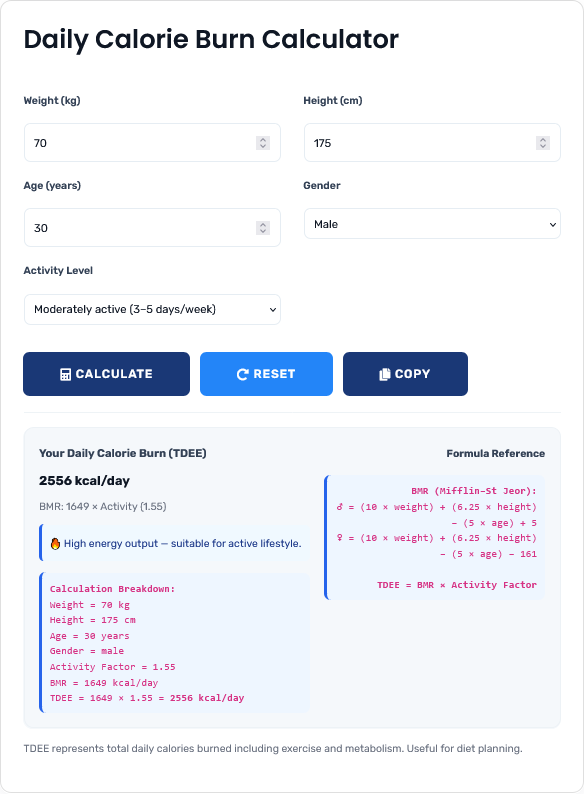
This daily calorie burn calculator uses the Mifflin–St Jeor equation, one of the most widely used and research-backed formulas for estimating Basal Metabolic Rate (BMR), and multiplies it by an activity factor to give you a practical calorie calculator estimate you can act on.
Understanding your calorie needs matters across several everyday situations, including:
- Weight loss or weight gain planning: setting a realistic calorie deficit or surplus instead of guessing
- Athletic training: fueling workouts adequately to support performance and recovery
- General health tracking: understanding how activity level changes your energy needs
- Nutrition planning: pairing your TDEE with a macro or meal plan
For a complete picture of your nutrition and fitness goals, explore our full range of nutrition calculators.
What Is TDEE and Why Does It Matter?
TDEE stands for Total Daily Energy Expenditure — the total number of calories your body burns in 24 hours. It's made up of four components:
- Basal Metabolic Rate (BMR): calories burned at complete rest to keep your organs and body functioning (typically 60–70% of total expenditure)
- Thermic Effect of Food (TEF): calories used to digest and process food (roughly 10%)
- Non-Exercise Activity Thermogenesis (NEAT): calories burned through daily movement like walking, standing, and fidgeting
- Exercise Activity Thermogenesis (EAT): calories burned through structured workouts and sport
A calorie calculator that only estimates BMR misses the bigger picture — pairing BMR with an activity multiplier, as this tool does, gives a far more useful daily calorie burn estimate for real-life planning.
The Mifflin–St Jeor Formula, Explained
Basal Metabolic Rate (Mifflin–St Jeor Equation):
Men: BMR = (10 × weight in kg) + (6.25 × height in cm) − (5 × age in years) + 5
Women: BMR = (10 × weight in kg) + (6.25 × height in cm) − (5 × age in years) − 161
TDEE = BMR × Activity Factor
This equation was developed as an update to the older Harris-Benedict formula and is generally considered more accurate for modern populations. Multiplying your BMR by an activity factor — ranging from 1.2 for a sedentary lifestyle to 1.9 for very physically demanding routines — converts your resting metabolism into a realistic estimate of your daily calorie burn.
Activity Levels Used in This Calculator
| Activity Level | Multiplier | Typical Description |
|---|---|---|
| Sedentary | 1.2 | Little to no regular exercise, desk-based lifestyle |
| Lightly Active | 1.375 | Light exercise or sports 1–3 days per week |
| Moderately Active | 1.55 | Moderate exercise or sports 3–5 days per week |
| Very Active | 1.725 | Hard exercise or sports 6–7 days per week |
| Extra Active | 1.9 | Physically demanding job or twice-daily training |
Using Your TDEE for Weight Loss, Maintenance, or Muscle Gain
Once you know your daily calorie burn, you can set an intake target based on your goal:
- Weight loss: a moderate calorie deficit (typically 15–20% below TDEE) supports gradual, sustainable fat loss
- Weight maintenance: eating close to your TDEE keeps your weight stable
- Muscle gain: a modest calorie surplus (typically 5–15% above TDEE), combined with resistance training, supports lean mass gains
For a deeper dive into structuring your intake around macronutrients, try our macro nutrient calculator, or plan a specific weight target with our weight loss goal calculator.
Why Calorie Needs Change Over Time: Metabolic Adaptation
A common frustration during dieting is hitting a plateau even while sticking to a calorie deficit. This happens because of metabolic adaptation — as body weight decreases, the body requires fewer calories to function, and energy expenditure naturally adjusts downward to some degree.
This doesn't mean your metabolism is "broken" — it's a normal adaptive response. Recalculating your TDEE every few weeks as your weight changes, rather than relying on a single fixed number for months, helps you stay aligned with your actual energy needs.
Common Misconception: Exercise Machine Calorie Counters
Many people rely on the calorie counters shown on treadmills, ellipticals, or stationary bikes. These displays use generic algorithms that don't account for your individual body composition, fitness level, or exact effort — so they tend to overestimate actual calories burned. A formula-based calorie calculator that factors in your weight, height, age, and typical activity level generally provides a more consistent baseline for daily planning than a single workout's machine readout.
Reference Standards and Further Reading
Energy expenditure guidance referenced by professionals in the field is generally drawn from organizations such as the American College of Sports Medicine (ACSM), the National Academy of Medicine's Dietary Reference Intakes, and sports nutrition position statements published by bodies like the International Olympic Committee. These sources emphasize individualized assessment, since predictive equations — including Mifflin–St Jeor — are population averages and can vary from an individual's actual measured energy expenditure.
How to use this calculator responsibly: Treat your TDEE result as a starting estimate rather than an exact number. Track your actual weight trend over 2–3 weeks at a given intake level, and adjust your calorie target up or down based on real-world results. If you have a medical condition affecting metabolism (such as a thyroid disorder), or specific athletic performance goals, consult a registered dietitian or sports medicine professional for individualized guidance.
Frequently Asked Questions About Daily Calorie Burn
Formula-based calculators like this one provide a solid estimate for most healthy adults using validated equations such as Mifflin–St Jeor. Individual metabolism can still vary, so the result is best treated as a starting point to refine based on your real-world weight trend over time.
BMR (Basal Metabolic Rate) is the energy your body needs at complete rest. TDEE (Total Daily Energy Expenditure) adds in your activity level on top of BMR, giving you the total calories you burn across a full day, including exercise and daily movement.
This is due to metabolic adaptation — as body weight drops, your body naturally requires fewer calories to function. Recalculating your TDEE every few weeks and adjusting your intake accordingly helps you account for this normal, expected change.
Athletes and very active individuals often need to adjust their activity multiplier based on training volume and periodize their intake around competition and recovery phases, since a single generic activity factor may not fully capture heavy training demands.
Yes. Once you know your TDEE, you can add a calorie surplus instead of a deficit to support weight or muscle gain, ideally combined with resistance training for lean mass rather than fat gain.
