Cell Growth Rate Calculator: Measure Doubling Time Accurately
Understanding how quickly cells multiply is essential for researchers, biologists, and students working in life sciences. Our Cell Growth Rate Calculator provides precise calculations for determining cell doubling times and growth rates using established scientific formulas.
Whether you're studying cancer cells, bacteria, yeast, or any other cell type, this tool helps you analyze proliferation rates accurately. From cancer research and drug development to microbiology and biotechnology, accurate growth rate calculations are fundamental to experimental success.
Key applications of cell growth calculations:
- Cancer Research: Measuring proliferation rates of tumor cells
- Drug Development: Assessing compound effects on cell growth
- Microbiology: Monitoring bacterial growth under different conditions
- Biotechnology: Optimizing cell culture for protein production
- Stem Cell Research: Tracking expansion and differentiation
For other biological calculations, explore our comprehensive Biology Calculators collection.
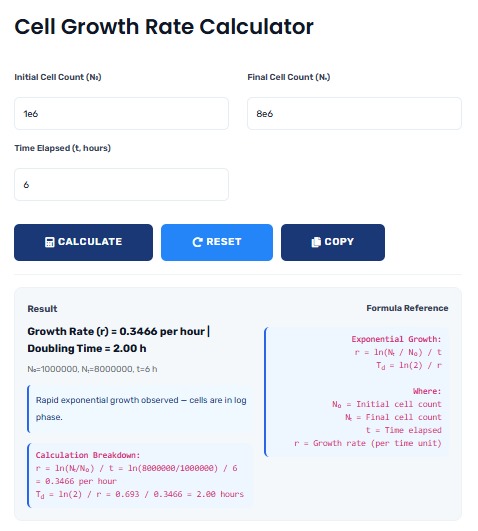
Real-World Cell Growth Scenarios
Cancer Research: Assessing Tumor Cell Proliferation
Dr. Sarah Chen, a cancer researcher, needed to determine how quickly breast cancer cells were dividing under different treatment conditions. She started with 50,000 cells/mL and measured 400,000 cells/mL after 72 hours of growth.
Growth Analysis:
- Initial concentration: 50,000 cells/mL
- Final concentration: 400,000 cells/mL
- Time duration: 72 hours
- Doubling time calculation: (72 × ln2) / ln(400,000/50,000)
- Result: 24.1 hours doubling time
- Growth rate: ln(400,000/50,000) / 72 = 0.0288 per hour
- Research insight: Treatment A increased doubling time by 40%
- Implication: Slower proliferation suggests therapeutic potential
Accurate doubling time calculations helped Dr. Chen identify promising drug candidates that significantly slowed cancer cell growth.
For enzyme-related calculations, check our Enzyme Activity Calculator.
Microbiology: Bacterial Growth in Different Media
Microbiology student Alex Rodriguez was comparing E. coli growth in nutrient-rich vs minimal media. Starting with 1×10⁶ cells/mL, he measured populations after 4 hours of incubation.
Bacterial Growth Analysis:
- Rich media: Grew to 1.6×10⁷ cells/mL in 4 hours
- Doubling time: (4 × ln2) / ln(16) = 1 hour
- Minimal media: Grew to 4×10⁶ cells/mL in 4 hours
- Doubling time: (4 × ln2) / ln(4) = 2 hours
- Key finding: Rich media supported twice as fast growth
- Experimental value: Quantified nutritional requirements
Precise growth rate calculations allowed Alex to quantify exactly how much faster bacteria grew in nutrient-rich conditions.
For DNA-related calculations, use our DNA Dilution Calculator.
Biotechnology: Optimizing Yeast Culture for Production
Biotechnology engineer Maria Gonzalez needed to optimize yeast culture conditions for protein production. She monitored growth from 2×10⁶ cells/mL to 1.6×10⁷ cells/mL over 6 hours.
Yeast Culture Analysis:
- Initial concentration: 2×10⁶ cells/mL
- Final concentration: 1.6×10⁷ cells/mL (8-fold increase)
- Time: 6 hours
- Doubling time: (6 × ln2) / ln(8) = 2 hours
- Growth rate: ln(8) / 6 = 0.3466 per hour
- Production optimization: Harvest at late log phase for maximum yield
- Scale-up planning: Use doubling time to schedule production cycles
Accurate growth calculations helped Maria determine the optimal harvest time for maximum protein production while maintaining cell viability.
For scientific calculations in other disciplines, explore our Science Calculators.
Cell Growth Formulas Explained
Essential Cell Growth Formulas:
1. Doubling Time (Generation Time):
Td = (t × ln2) / ln(Nt/N₀)
Where: Td = doubling time, t = time interval, N₀ = initial concentration, Nt =
final concentration
2. Growth Rate Constant:
μ = ln(Nt/N₀) / t
Where: μ = specific growth rate (per unit time)
3. Number of Generations:
n = (lnNt - lnN₀) / ln2
Where: n = number of cell divisions during growth period
4. Exponential Growth Equation:
Nt = N₀ × 2^(t/Td)
Where: Nt = population at time t, N₀ = initial population
Typical Doubling Times for Common Cell Types
| Cell Type | Typical Doubling Time | Growth Conditions | Research Applications | Special Considerations |
|---|---|---|---|---|
| E. coli Bacteria | 20-30 minutes | Rich media, 37°C | Microbiology, genetics | Extremely fast growth |
| Yeast (S. cerevisiae) | 1.5-2 hours | YPD media, 30°C | Biotechnology, brewing | Eukaryotic model organism |
| HeLa Cells (Cancer) | 20-24 hours | DMEM + 10% FBS, 37°C | Cancer research | Standard cancer cell line |
| HEK293 Cells | 18-22 hours | DMEM + 10% FBS, 37°C | Protein production | Common for transfection |
| Primary Fibroblasts | 24-48 hours | Specialized media, 37°C | Tissue engineering | Slower, limited divisions |
| Stem Cells | 36-72 hours | Stem cell media, 37°C | Regenerative medicine | Require specific factors |
Factors Affecting Cell Growth Rates
| Factor | Effect on Growth Rate | Optimal Range | Measurement Impact | Control Recommendations |
|---|---|---|---|---|
| Temperature | Doubles with every 10°C increase (up to optimum) | 37°C mammalian, 30°C yeast | Critical for accurate comparisons | Maintain within ±0.5°C |
| Nutrient Availability | Limited nutrients slow growth | Follow media protocols exactly | Affects exponential phase duration | Fresh media, proper supplements |
| pH Level | Narrow optimal range (7.2-7.4 mammalian) | pH 7.2-7.4 for most cells | Small changes significantly affect rates | Use buffered media |
| Oxygen Concentration | Aerobic cells require oxygen | 5% CO₂ for mammalian cells | Hypoxia slows growth | Proper incubator conditions |
| Cell Density | Contact inhibition at high density | Maintain sub-confluent | Growth slows as density increases | Plate at optimal seeding density |
| Passage Number | Primary cells slow with passages | Use low passage cells | Senescence affects growth rates | Document passage numbers |
Practical Growth Calculation Framework
6-Step Protocol for Accurate Growth Measurements:
- Plate cells appropriately: Seed at optimal density for exponential growth
- Measure initial count: Use hemocytometer or automated counter
- Incubate under controlled conditions: Maintain temperature, CO₂, humidity
- Measure final count: At appropriate time points
- Calculate using proper formula: Use our calculator for accuracy
- Interpret in biological context: Consider cell type and conditions
This systematic approach ensures reliable, reproducible growth rate measurements. For converting between concentration units, use our Conversion Calculators.
Common Growth Calculation Errors
The "Log vs Linear" Phase Confusion
Common mistake: Measuring growth during lag or stationary
phase.
Correct approach: Only use exponential (log) phase for
calculations.
Why it matters: Growth formulas assume exponential growth.
Solution: Take multiple time points to identify true
exponential phase.
Inaccurate Cell Counting Methods
Manual counting with hemocytometers often leads to inconsistent results between researchers or even between counts by the same person.
Common errors:
• Inconsistent dilution factors
• Poor mixing before sampling
• Counting non-viable cells
• Small sample sizes leading to statistical error
Best practices:
• Count multiple squares and average
• Use trypan blue to exclude dead cells
• Consider automated counters for consistency
• Always count in duplicate or triplicate
For percentage calculations related to viability, use our Percentage Calculator.
Advanced Growth Analysis Techniques
Case Study: Comparing Drug Effects on Cancer Cell Growth
Research Question: Does Drug X slow breast cancer cell proliferation more than standard treatment?
-
Experimental Design:
- Plate MCF-7 cells at 25,000 cells/well
- Treat with: Control, Drug X (10μM), Standard drug (10μM)
- Count cells at 0, 24, 48, 72 hours
- Use trypan blue to count only viable cells
-
Growth Calculations:
- Control: 25,000 → 200,000 in 72h, Td = 27.1h
- Drug X: 25,000 → 85,000 in 72h, Td = 48.8h
- Standard: 25,000 → 120,000 in 72h, Td = 36.2h
- Growth inhibition: Drug X = 80% slower than control
-
Statistical Analysis:
- Perform triplicate experiments
- Calculate mean ± standard deviation
- Use t-test for significance (p < 0.05)
- Result: Drug X significantly better than standard (p = 0.003)
For statistical analysis of your data, consider our Statistics Calculators.
Growth Measurement Methods Comparison
| Method | Accuracy | Time Required | Cost | Best Applications | Limitations |
|---|---|---|---|---|---|
| Hemocytometer | Medium (10-20% error) | 10-15 min/sample | $ (inexpensive) | Teaching labs, basic research | Manual, subjective, low throughput |
| Automated Cell Counter | High (5-10% error) | 1-2 min/sample | $$$ (expensive equipment) | High-throughput screening | Equipment cost, maintenance |
| Flow Cytometry | Very High (1-5% error) | 30-60 min setup | $$$$ (very expensive) | Advanced research, cell cycle analysis | Complex, requires expertise |
| Spectrophotometry | Low-Medium (indirect) | 5 min/sample | $ (inexpensive) | Bacterial cultures, quick estimates | Doesn't distinguish live/dead |
| Real-time Monitoring | High (continuous) | Continuous | $$$$ (specialized equipment) | Growth kinetics, detailed analysis | Very expensive, specialized |
Troubleshooting Common Growth Problems
When Growth Doesn't Match Expectations:
- No growth or very slow growth: Check media freshness, contamination, cell viability
- Growth faster than expected: Verify cell line identity, check for contamination
- Inconsistent results between replicates: Improve pipetting technique, ensure proper mixing
- Growth stops abruptly: Nutrient depletion, pH change, toxic metabolite accumulation
- High variability between experiments: Standardize protocols, control environmental factors
- Calculated doubling time seems wrong: Verify counting method, ensure exponential phase
Always include positive controls and document all experimental conditions carefully.
Educational Applications in Teaching Labs
Classroom Exercise: Measuring Bacterial Growth Rates
Learning Objectives:
1. Understand exponential growth concepts
2. Practice accurate cell counting techniques
3. Calculate doubling times from experimental data
4. Compare growth under different conditions
Student Protocol:
1. Inoculate E. coli in two media types (rich vs minimal)
2. Take samples every hour for 6 hours
3. Perform serial dilutions and plate counts
4. Calculate cell concentrations at each time point
5. Determine doubling times using our calculator
6. Compare results between media conditions
Assessment: Students submit calculations and interpret biological significance of differences in growth rates.
This practical exercise combines hands-on laboratory skills with quantitative analysis using our calculator.
Research Project: Optimizing Culture Conditions
Advanced student project investigating multiple growth factors:
Variables tested:
• Temperature: 30°C, 37°C, 42°C
• Media supplements: 5%, 10%, 15% serum
• pH: 6.8, 7.2, 7.6
• Seeding density: 10³, 10⁴, 10⁵ cells/mL
Data analysis using our calculator:
1. Calculate doubling time for each condition
2. Compare growth rates statistically
3. Identify optimal conditions
4. Determine which factors most influence growth
5. Create growth curves for each condition
Outcome: Students learn experimental design, data collection, quantitative analysis, and scientific reporting.
Key Insight: Accurate cell growth rate calculations are fundamental to biological research, biotechnology, and pharmaceutical development. Whether you're a student learning basic techniques, a researcher investigating disease mechanisms, or a biotechnologist optimizing production processes, understanding and accurately calculating growth parameters is essential. Our calculator provides the mathematical precision needed for reliable results, but remember that careful experimental technique and appropriate data interpretation are equally important. For comprehensive mathematical support in your research, explore our full range of Math Calculators.
Quick Reference: Growth Calculation Checklist
Before Calculation:
- ✓ Confirm cells were in exponential growth phase
- ✓ Verify counting method accuracy
- ✓ Check that only viable cells were counted
- ✓ Ensure proper dilution factors if used
- ✓ Document exact time between measurements
During Calculation:
- ✓ Use consistent units throughout
- ✓ Double-check concentration values
- ✓ Verify time interval is correct
- ✓ Use natural log (ln) not log10
- ✓ Consider if waste or error factors apply
After Calculation:
- ✓ Compare with expected values for cell type
- ✓ Consider biological context of results
- ✓ Document all parameters for reproducibility
- ✓ Perform statistical analysis if multiple replicates
- ✓ Share raw data along with calculated values
Remember: Growth rates are sensitive indicators of cell health and environmental conditions!
Frequently Asked Questions
Doubling time and generation time are often used interchangeably, but technically: Doubling time refers to the time for population to double, while generation time refers to the time between cell divisions. For exponentially growing populations with no cell death, they're essentially the same. Our calculator provides doubling time, which is the more commonly used parameter in research.
Yes, absolutely! The same mathematical principles apply to bacteria, yeast, mammalian cells, and any other exponentially growing cell population. Just ensure you're measuring during the exponential growth phase (log phase) and using appropriate concentration units (usually CFU/mL for bacteria).
While you can calculate with just two time points (initial and final), taking multiple time points throughout growth is better. This allows you to: 1) Confirm exponential growth phase, 2) Identify when growth slows or stops, 3) Calculate growth rates at different phases, 4) Create growth curves for visualization. For research publications, multiple time points are standard.
If cells aren't in exponential phase, the standard formulas don't apply accurately. This can happen if: 1) You measure during lag phase (just after plating), 2) Cells have reached stationary phase (nutrient depletion), 3) Conditions are suboptimal. Solution: Take measurements at multiple time points to identify true exponential phase, or use more complex models for non-exponential growth.
Our calculator assumes net growth (growth minus death). For more precise analysis where death rate is significant: 1) Use viability stains (like trypan blue) to count only live cells, 2) Calculate specific growth rate and death rate separately if you have both live and dead counts, 3) For experiments with high death rates (like drug treatments), consider alternative analysis methods.
OD600 (optical density at 600nm) is commonly used for bacterial cultures but is an indirect measure that doesn't distinguish live/dead cells or account for cell size changes. For accurate growth rate calculations: 1) Establish correlation between OD600 and viable count for your specific conditions, 2) Use OD600 only within linear range (usually 0.1-0.8), 3) Remember it measures turbidity, not necessarily cell number.
