Work Calculator: Calculate Mechanical Work Instantly with Our Physics Tool
Understanding and calculating mechanical work is fundamental to physics, engineering, and everyday life. Our Work Calculator provides instant, accurate calculations using the standard physics work formula W = F × d. This specialized tool helps students, engineers, and DIY enthusiasts determine how much work is done when a force moves an object.
Whether you're a student learning physics principles, an engineer analyzing mechanical systems, or a homeowner calculating how much effort a project will take, this tool delivers precise work calculations to support your needs. Work calculations appear in everything from simple moving tasks to complex engineering projects.
Common applications of work calculations:
- Physics Education: Learning fundamental mechanics concepts
- Engineering Design: Analyzing mechanical systems and machines
- DIY Projects: Calculating effort needed for home improvement tasks
- Fitness Training: Measuring work done during exercise
- Workplace Safety: Assessing manual handling requirements
Our calculator takes the complexity out of physics calculations. For related energy calculations, check our Kinetic Energy Calculator.
What Is Work in Physics?
In physics, work has a specific definition that differs from everyday usage. Work occurs only when a force causes an object to move in the direction of the force. The physics definition requires three essential components: application of force, movement of the object, and movement in the direction of the force.
This might seem technical, but it's actually intuitive. Think about pushing a heavy box across the floor:
- If you push and the box moves forward, you're doing work
- If you push but the box doesn't move (like pushing against a wall), you're not doing work in physics terms
- If you carry a box while walking horizontally, you're not doing work on the box (gravity does work when you lift it)
This fundamental relationship makes work calculations essential for understanding energy transfer in mechanical systems. For calculating forces involved, try our Force Calculator.
The Work Formula: W = F × d
The Fundamental Work Formula:
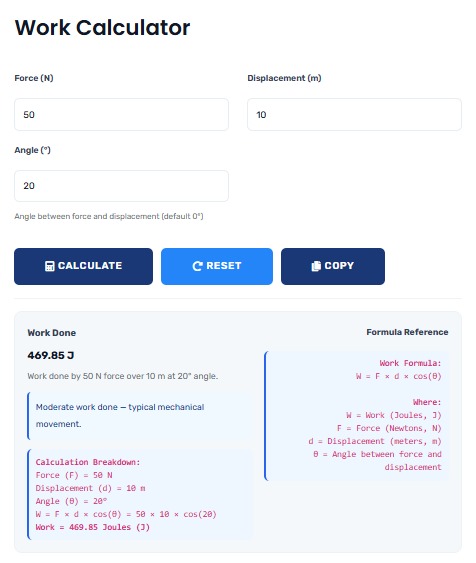
Work (W) = Force (F) × Distance (d) × cos(θ)
Where:
- W = Work measured in Joules (J)
- F = Force measured in Newtons (N)
- d = Distance measured in meters (m)
- θ = Angle between force and movement directions
When the force is applied in the same direction as the movement (θ = 0°), the formula simplifies to W = F × d because cos(0°) = 1. This is the most common scenario in basic calculations.
Real-Life Work Calculation Examples
Example 1: Pushing a Shopping Cart
You push a shopping cart with a constant force of 50 Newtons for 20 meters. How much work do you do?
Calculation:
- Force (F) = 50 N
- Distance (d) = 20 m
- Angle (θ) = 0° (pushing in direction of movement)
- Work = 50 N × 20 m × cos(0°) = 50 × 20 × 1 = 1,000 Joules
You do 1,000 Joules of work pushing the cart. That's equivalent to the energy needed to lift a 100 kg weight 1 meter off the ground.
Example 2: Pulling a Suitcase at an Angle
You pull a suitcase with a force of 40 Newtons at a 30° angle above horizontal for 15 meters. How much work is done?
Calculation:
- Force (F) = 40 N
- Distance (d) = 15 m
- Angle (θ) = 30°
- cos(30°) = 0.866
- Work = 40 N × 15 m × 0.866 = 519.6 Joules
Even though you're applying 40 Newtons of force, only about 34.6 Newtons (40 × 0.866) actually contribute to horizontal movement. The rest lifts the suitcase slightly.
For related calculations involving motion, check our Speed Calculator.
Example 3: Lifting Weights at the Gym
You lift a 20 kg weight vertically 2 meters. How much work do you do against gravity?
Calculation:
- Weight = mass × gravity = 20 kg × 9.8 m/s² = 196 Newtons
- Distance (d) = 2 m
- Angle (θ) = 0° (lifting straight up against gravity)
- Work = 196 N × 2 m = 392 Joules
Each repetition requires 392 Joules of work. If you do 10 reps, you've done 3,920 Joules total work on the weight.
Understanding Joules: The Unit of Work
What Is a Joule?
One Joule (J) is defined as the work done when a force of one Newton moves an object one meter in the direction of the force:
1 Joule = 1 Newton × 1 meter
Practical examples of 1 Joule:
- Lifting a small apple (about 100 grams) 1 meter straight up
- The energy released by a mosquito in flight
- The work your heart does with each beat
- The energy in a single raisin
Different Types of Work in Physics
| Type of Work | Description | Formula Variation | Example |
|---|---|---|---|
| Positive Work | Force and motion in same direction | W = F × d (positive value) | Pushing a car that's moving forward |
| Negative Work | Force opposes motion | W = F × d (negative value) | Brakes slowing down a moving car |
| Zero Work | Force perpendicular to motion | W = 0 (cos 90° = 0) | Carrying a box while walking horizontally |
| Work Against Gravity | Lifting objects vertically | W = m × g × h | Lifting weights at the gym |
| Work by Friction | Non-conservative, path-dependent | W = μ × N × d | Pushing furniture across carpet |
Work Calculation in Different Fields
Applications Across Various Disciplines
Engineering Applications:
- Calculating power requirements for motors and engines
- Designing mechanical systems like elevators and cranes
- Analyzing efficiency of machines and tools
- Determining fuel consumption for vehicles
Everyday Life Applications:
- Calculating effort needed for moving furniture
- Determining exercise intensity and calories burned
- Planning home improvement projects
- Understanding energy consumption of appliances
Sports Science Applications:
- Measuring work output during training
- Analyzing athletic performance
- Designing exercise programs
- Calculating power output in cycling, rowing, etc.
Work vs. Power: Understanding the Difference
Key Distinction:
Work measures total energy transferred (Joules).
Power measures how fast work is done (Joules per second = Watts).
Example: Two people lift identical weights to the same height:
- Both do the same work (same weight × same height)
- The person who lifts faster uses more power
- Formula: Power = Work ÷ Time
For power calculations, use our Power Calculator.
Step-by-Step Guide to Using Our Work Calculator
5 Simple Steps for Accurate Calculations:
- Choose your calculation type: Simple (W = F × d) or angled force
- Enter force value: In Newtons, or let the calculator convert from mass
- Enter distance: In meters, the distance the object moves
- Enter angle if needed: Only for forces not parallel to movement
- Get your result: Work in Joules, with clear explanation
The calculator handles all the math, unit conversions, and trigonometry automatically.
Common Work Calculation Scenarios
| Scenario | Force Direction | Angle (θ) | cos(θ) | Calculation Method |
|---|---|---|---|---|
| Pushing horizontally | Same as motion | 0° | 1 | W = F × d |
| Pulling at 45° angle | 45° above horizontal | 45° | 0.707 | W = F × d × 0.707 |
| Lifting vertically | Against gravity | 0° | 1 | W = m × g × h |
| Pushing downward on moving object | 90° to motion | 90° | 0 | W = 0 (no work done) |
| Braking a moving car | Opposite to motion | 180° | -1 | W = -F × d (negative work) |
Work-Energy Theorem: The Fundamental Connection
The Work-Energy Theorem:
Net Work Done = Change in Kinetic Energy
W_net = ΔKE = ½mv_f² - ½mv_i²
This theorem connects work calculations directly to energy changes. When you do work on an object, you change its energy. For example:
- Pushing a stationary car gives it kinetic energy
- Braking a moving car removes its kinetic energy
- Lifting an object gives it gravitational potential energy
For energy calculations, try our Potential Energy Calculator.
Practical Tips for Accurate Work Calculations
Professional Tips for Best Results:
- Use consistent units: Always convert to Newtons and meters before calculating
- Consider all forces: Include friction, gravity, applied forces as needed
- Measure angles carefully: Small angle errors lead to significant calculation errors
- Account for efficiency: Real-world systems are less than 100% efficient
- Check your signs: Positive work adds energy, negative work removes it
- Consider the system: What's included in your "object" affects the calculation
Historical Perspective on Work Concepts
The concept of mechanical work has evolved significantly over centuries:
- Ancient Greece: Archimedes studied simple machines but didn't formalize work concepts
- 17th Century: Galileo studied motion but didn't connect force and distance mathematically
- Late 17th Century: Gottfried Leibniz proposed "vis viva" (living force), an early energy concept
- 19th Century: French mathematician Gaspard-Gustave Coriolis first defined work as "force times distance"
- 1840s: James Prescott Joule established the mechanical equivalent of heat
- Modern Era: Work became fundamental to thermodynamics and energy conservation
The term "Joule" honors James Prescott Joule, who demonstrated that mechanical work could be converted directly into heat.
Advanced Work Calculation Concepts
For Advanced Physics Students:
Variable Forces: When force changes during motion, work is calculated by integration:
W = ∫ F(x) dx (from initial to final position)
Work in Three Dimensions: Using vector dot product:
W = F · d = F_x d_x + F_y d_y + F_z d_z
Conservative vs. Non-Conservative Forces:
- Conservative: Work depends only on endpoints (gravity, springs)
- Non-Conservative: Work depends on path taken (friction, air resistance)
For more advanced physics tools, explore our Science Calculators collection.
Work Calculator in Education
Our calculator serves multiple educational purposes:
- Homework Helper: Quickly check physics problem solutions
- Learning Tool: Experiment with different values to understand relationships
- Teaching Aid: Demonstrate work concepts visually in classrooms
- Lab Companion: Calculate work from experimental measurements
- Study Resource: Prepare for tests and exams with practice calculations
Mobile Optimization for Learning Anywhere
Study and Calculate Anywhere:
- Phone Compatibility: Works perfectly on smartphones for on-the-go calculations
- Tablet Optimization: Enhanced interface for larger touchscreens
- Offline Access: Basic functionality available without internet
- Cross-Device Syncing: Calculations accessible across all your devices
- Educational Interface: Designed for learning, not just calculation
The responsive design ensures students, teachers, and professionals can access accurate calculation capabilities wherever learning or work occurs.
Comparing Work Calculation Methods
| Method | Best For | Accuracy | Speed | Learning Value |
|---|---|---|---|---|
| Manual Calculation | Understanding fundamentals | High (if careful) | Slow | Excellent |
| Our Calculator | Quick, accurate results | Very High | Very Fast | Good (with explanations) |
| Spreadsheet Formulas | Multiple calculations | High | Medium | Fair |
| Physics Software | Complex systems | Very High | Fast | Variable |
Future of Physics Calculation Tools
While our current calculator provides accurate, instant results, the future holds exciting possibilities:
- AI Integration: Intelligent problem-solving guidance
- Augmented Reality: Visualize forces and work in real environments
- Real-Time Data: Connect to sensors for immediate calculations
- Interactive Learning: More engaging educational experiences
- Collaborative Features: Share and discuss calculations with others
Despite technological advances, understanding fundamental work concepts will remain essential, ensuring our calculator's continued relevance for students, educators, and professionals.
Final Thought: Work calculation is more than just physics homework—it's a fundamental concept that connects force, motion, and energy in our physical world. Whether you're pushing a shopping cart, lifting weights, or designing machinery, understanding work helps you quantify effort and energy transfer. Our calculator makes these calculations accessible to everyone, from students learning physics to professionals applying it in their work.
Quick Reference: Work Calculation Facts
Key Formulas:
- Basic work: W = F × d
- Work with angle: W = F × d × cos(θ)
- Work against gravity: W = m × g × h
- Work-energy theorem: W = ΔKE = ½mv_f² - ½mv_i²
Important Values:
- Gravity (g) = 9.8 m/s² (Earth's surface)
- cos(0°) = 1, cos(90°) = 0, cos(180°) = -1
- 1 Joule = 1 Newton × 1 meter
- 1 kJ = 1000 J, 1 MJ = 1,000,000 J
Common Conversions:
- 1 pound-force ≈ 4.45 Newtons
- 1 foot ≈ 0.3048 meters
- 1 kg weighs about 9.8 Newtons on Earth
Frequently Asked Questions
The simplest calculation is W = F × d when force and motion are in the same direction. Multiply force in Newtons by distance in meters to get work in Joules. Our calculator makes this even easier by handling the math automatically.
For lifting against gravity: W = m × g × h, where m is mass in kg, g is 9.8 m/s², and h is height in meters. Alternatively, calculate weight (m × g) in Newtons, then multiply by height. Our calculator can handle both approaches.
For variable forces, you need calculus (integration). However, for many practical purposes, using average force gives a good approximation. Our calculator uses constant force assumption unless specified otherwise.
Yes! Negative work occurs when force opposes motion. Examples include brakes slowing a car or friction reducing speed. Negative work removes energy from a system rather than adding it.
Work and energy are directly related—work transfers energy. The work-energy theorem states that net work equals change in kinetic energy. Doing work on an object increases its energy; having work done on an object decreases its energy.
Work measures total energy transfer (Joules). Power measures how fast work is done (Joules per second = Watts). Doing the same work in less time requires more power. For power calculations, use our Power Calculator.
