Meter to Feet Converter: Instantly Convert Between Metric and Imperial Length Measurements
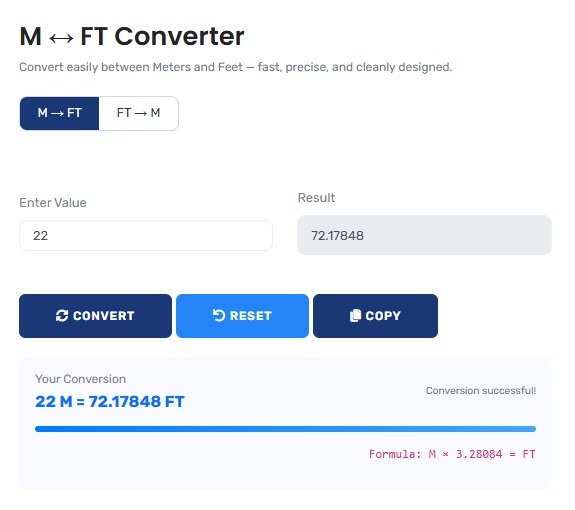
Converting between meters and feet is one of the most common measurement conversions needed in today's globalized world. Whether you're working on international construction projects, buying furniture from overseas, planning a home renovation, or simply trying to understand sports measurements, our Meter to Feet Converter provides instant, accurate conversions with the click of a button.
This essential tool bridges the gap between the metric system (used by most of the world) and the imperial system (still widely used in the United States, United Kingdom, and other countries). With precise calculations based on the exact conversion factor of 1 meter = 3.28084 feet, you can trust our converter for everything from small craft projects to large-scale engineering work.
Why you need accurate meter-feet conversions:
- International Projects: Working with teams or materials from different countries
- Home Improvement: Buying furniture, flooring, or materials with metric specifications
- Travel Planning: Understanding distances and dimensions when traveling abroad
- Sports and Fitness: Converting athletic field measurements and track distances
- Education: Helping students understand different measurement systems
- DIY Projects: Following international patterns, plans, or instructions
Our converter is part of our comprehensive conversion calculator collection, designed to make all your measurement conversions quick and accurate.
Understanding Meters: The International Standard
What is a Meter?
The meter (symbol: m) is the base unit of length in the International System of Units (SI), used by every country in the world except the United States, Liberia, and Myanmar. Originally defined in 1793 as one ten-millionth of the distance from the equator to the North Pole, today it's defined more precisely as the distance light travels in 1/299,792,458 seconds in a vacuum.
Common Meter Measurements:
- Door height: Approximately 2 meters (6.56 feet)
- Swimming pool lane: 25 or 50 meters (82 or 164 feet)
- Room ceiling height: 2.4-3 meters (7.9-9.8 feet)
- Running track: 400 meters (1,312 feet)
- Football field: 105 meters (344.5 feet) long
Understanding Feet: The Imperial Standard
What is a Foot?
The foot (symbol: ft) is a unit of length in the imperial and US customary measurement systems. Since 1959, it has been defined as exactly 0.3048 meters. Historically, the foot was based on the actual length of a human foot, which varied between 250-335 mm in different cultures before standardization.
Common Foot Measurements:
- Standard ceiling height: 8 feet (2.44 meters)
- Basketball hoop height: 10 feet (3.05 meters)
- Football field: 300 feet (91.44 meters) long
- Room dimensions: Often measured in feet (e.g., 12×15 feet)
- Height measurements: People's heights are commonly given in feet and inches
Real-Life Conversion Examples
Example 1: Home Renovation - Buying European Furniture
Sarah found the perfect European sofa online, but the dimensions are listed in centimeters and meters. Her living room wall is 12 feet long, and she needs to know if the 3.5-meter sofa will fit.
Conversion Calculation:
- Sofa length: 3.5 meters
- Conversion: 3.5 × 3.28084 = 11.48 feet
- Wall space: 12 feet available
- Clearance: 12 - 11.48 = 0.52 feet (about 6.25 inches) on each side
- Result: Sofa will fit perfectly with space for end tables
Without accurate conversion, Sarah might have ordered furniture that doesn't fit her space. For more home improvement calculations, try our Paint Calculator.
Example 2: International Construction Project
Mike, an American contractor, is working on a project with German architects. The plans specify concrete slabs 6 meters thick, but his equipment is calibrated in feet.
Professional Conversion Analysis:
- Concrete thickness: 6 meters
- Conversion: 6 × 3.28084 = 19.685 feet
- Equipment adjustment: Set to 19 feet 8.25 inches
- Tolerance check: Within acceptable construction tolerances
- Critical insight: 0.001 meter error = 0.00328 foot error
- Quality assurance: Verify with laser measurement tools
Precision matters in construction. A 1% error on a large project could mean thousands of dollars in material waste or rework.
For construction material calculations, use our Concrete Volume Calculator.
Example 3: Athletic Track Conversion
A track coach needs to convert workout distances for athletes accustomed to different measurement systems. The workout calls for 400-meter repeats, but the local track is marked in yards.
Athletic Conversion Analysis:
- Workout distance: 400 meters
- Conversion to feet: 400 × 3.28084 = 1,312.34 feet
- Conversion to yards: 1,312.34 ÷ 3 = 437.45 yards
- Track markings: Standard track = 400m = 437.45 yards
- Practical adjustment: Round to nearest 5 yards for practical marking
- Training impact: Proper distance ensures correct training stimulus
Accurate conversion ensures athletes train at the correct intensities and distances for optimal performance.
The Exact Conversion Formula
Meter to Feet Conversion:
Feet = Meters × 3.280839895
Feet to Meters Conversion:
Meters = Feet ÷ 3.280839895 or Feet × 0.3048
Exact Conversion Factor:
1 meter = 3.280839895 feet exactly
1 foot = 0.3048 meters exactly
Quick Approximation:
1 meter ≈ 3.28 feet (for mental calculations)
1 foot ≈ 0.305 meters (for quick estimates)
Common Conversion Reference Table
| Meters (m) | Feet (ft) | Common Application | Precision Level |
|---|---|---|---|
| 0.1 m | 0.328 ft | Small craft measurements | High precision needed |
| 1 m | 3.281 ft | Basic unit conversion | Standard precision |
| 2 m | 6.562 ft | Door height, person height | Standard precision |
| 5 m | 16.404 ft | Room dimensions | Construction precision |
| 10 m | 32.808 ft | Small building dimensions | Construction precision |
| 100 m | 328.084 ft | Sports track, large spaces | General precision |
| 1000 m (1 km) | 3,280.84 ft | Long distances | General precision |
When Precision Matters Most
Critical Applications Requiring Exact Conversion
Engineering and Construction:
- Structural calculations: Beam lengths, support spacing
- Material ordering: Exact quantities prevent waste
- Building codes: Specific requirements for safety
- International projects: Coordination between teams
Manufacturing and Production:
- Part dimensions: Interchangeable components
- Quality control: Measurement verification
- International standards: ISO compliance
- Tolerance specifications: ±0.001" requirements
Scientific Research:
- Experimental setups: Precise equipment placement
- Data collection: Accurate measurement recording
- Publication standards: Consistent unit reporting
- International collaboration: Shared data understanding
Step-by-Step Conversion Guide
4 Easy Steps for Perfect Conversions:
- Identify your starting unit: Are you converting from meters to feet, or feet to meters?
- Enter the exact value: Use decimals for precision (e.g., 2.5 not 2½)
- Select conversion direction: Choose "m to ft" or "ft to m"
- Apply the result: Use converted value in your project with appropriate rounding
Pro Tips:
- For construction: Round to nearest ¼ inch or 1 cm
- For crafts: Maintain maximum precision
- For estimates: Use 1m ≈ 3.3ft quick approximation
- Always double-check critical measurements
Historical Context: Why Two Systems?
The Metric System (1795 - Present)
Origin: Created during French Revolution to replace chaotic
regional systems
Philosophy: Decimal-based, logical, internationally focused
Adoption: Gradually adopted worldwide, now used by 95% of world
population
Advantages: Easy conversions (powers of 10), standardized
prefixes
The Imperial System (British Empire - Present)
Origin: Evolved from ancient Roman and Anglo-Saxon
measurements
Philosophy: Based on practical human-scale measurements
Current Use: Primarily United States, some UK applications
Challenges: Inconsistent conversions (12 inches = 1 foot, 3
feet = 1 yard, etc.)
The Global Reality: Both systems coexist, making conversion tools essential for international work, trade, and communication.
Conversion Accuracy Levels
| Application | Required Precision | Suggested Rounding | Impact of Error | Tool Recommendation |
|---|---|---|---|---|
| Fine Craftsmanship | ±0.1 mm / ±0.004 in | Full decimal precision | Visible defects, poor fit | Digital calipers + calculator |
| Home Construction | ±3 mm / ±⅛ in | Nearest ¼ inch or cm | Material waste, rework | Tape measure + converter |
| Civil Engineering | ±10 mm / ±⅜ in | Nearest ½ inch or cm | Structural issues, safety | Survey equipment + software |
| Landscaping | ±50 mm / ±2 in | Nearest inch or 5 cm | Aesthetic issues only | Measuring wheel + app |
| Sports Fields | ±100 mm / ±4 in | Nearest 6 inches or 0.1m | Fair play, records | Field markers + converter |
Specialized Conversion Techniques
Converting Complex Measurements: Feet and Inches to Meters
Problem: Convert 6 feet 2 inches to meters
-
Convert inches to decimal feet:
- 6 feet = 6.0 feet
- 2 inches = 2 ÷ 12 = 0.1667 feet
- Total = 6.0 + 0.1667 = 6.1667 feet
-
Convert feet to meters:
- 6.1667 feet × 0.3048 = 1.8799 meters
-
Round appropriately:
- For height: 1.88 meters (rounded to 2 decimals)
- For medical: 1.880 meters (3 decimals)
- For construction: 1.88 meters or 188 cm
Mobile and Field Applications
Using the Converter on Job Sites:
Smartphone Advantages:
- Instant calculations without manual math
- Works offline once page is loaded
- Large buttons for use with work gloves
- Save frequent conversions for quick access
- Share results with team members
Field Best Practices:
- Measure twice, convert once
- Note both original and converted values
- Consider local measurement conventions
- Account for temperature effects on materials
- Verify critical conversions with second method
Our converter is optimized for all devices as part of our length and distance calculator collection.
Common Conversion Challenges and Solutions
Challenge 1: Mixed Units (Feet and Inches)
Problem: Plans show 15' 6" but need meters
Solution: Convert to decimal feet first (15.5'), then to meters (4.724 m)
Challenge 2: Large Numbers with Commas/Periods
Problem: 1,000 meters vs 1.000 meters (international notation differences)
Solution: Our converter handles both formats automatically
Challenge 3: Significant Figures
Problem: Measuring tape shows 2.5 m (2 significant figures) but need feet
Solution: Convert 2.5 m = 8.2 ft (not 8.2021 ft - maintain 2 significant figures)
Challenge 4: Material Expansion/Contraction
Problem: Wood measures differently in humid vs dry conditions
Solution: Convert based on standard conditions, adjust for material properties
Educational Value and Learning Applications
Teaching Measurement Conversion:
For Students:
- Visualize the relationship between systems
- Practice with real-world examples
- Understand precision and rounding
- Learn both exact and approximate methods
For Teachers:
- Create conversion exercises and worksheets
- Demonstrate international measurement differences
- Show practical applications of math concepts
- Teach estimation skills alongside exact calculation
Lifelong Learning:
- Understand product specifications from other countries
- Read international news and reports accurately
- Communicate effectively with international colleagues
- Make informed decisions when traveling or shopping globally
Key Insight: The ability to convert accurately between meters and feet is more than just a mathematical skill—it's a practical necessity in our interconnected world. Whether you're building a house, buying furniture, planning a trip, or working on international projects, understanding both measurement systems gives you flexibility, prevents errors, and opens up global opportunities. Our converter is designed to make this essential skill accessible to everyone, from professionals to students to casual users.
For comprehensive measurement solutions, explore our full range of calculator tools including our KG to Pounds Converter and Celsius to Fahrenheit Converter.
Quick Reference: Essential Conversion Values
Memorize These Common Conversions:
- 1 meter = 3.28 feet (fundamental relationship)
- 1 foot = 0.305 meters (reverse conversion)
- 5 meters = 16.4 feet (common room height)
- 10 meters = 32.8 feet (small building dimension)
- 100 meters = 328 feet (sports track length)
- 1 kilometer = 3,281 feet (0.62 miles)
Human Scale References:
- Average person height: 1.7 m = 5'7"
- Door height: 2.0 m = 6'7"
- Ceiling height: 2.4 m = 7'10"
- Car length: 4.5 m = 14'9"
- Swimming pool: 25 m = 82'0"
Quick Estimation Trick: For meters to feet, multiply by 3.3 and subtract 1%. For feet to meters, divide by 3.3 and add 1%.
Frequently Asked Questions
1 meter equals exactly 3.280839895 feet. This precise factor is based on the international definition where 1 foot = 0.3048 meters exactly. Our calculator uses this exact value for all conversions, ensuring mathematical accuracy for all applications from scientific research to construction projects.
Yes! Convert inches to decimal feet first (divide inches by 12), add to feet, then convert to meters. Example: 6'2" = 6 + (2÷12) = 6.1667 feet, × 0.3048 = 1.8799 meters. Or use our calculator which handles mixed units automatically as part of our Inches to Feet Converter functionality.
US survey foot = 1200/3937 meters ≈ 0.3048006 m (used in US land surveying until 2022). International foot = 0.3048 m exactly (used worldwide since 1959). Our calculator uses international feet. The difference is about 2 parts per million - significant for large land surveys but negligible for most applications. Since 2022, the US officially uses international feet for all measurements.
Yes! Our converter is fully mobile-responsive and works on all smartphones, tablets, and devices. It's designed for field use with large buttons, clear displays, and works offline once loaded. Many construction professionals use it daily for on-site conversions between metric and imperial measurements.
Speed conversion uses the same factor: 1 m/s = 3.28084 ft/s. Example: 10 m/s = 32.8084 ft/s. For comprehensive speed conversions including km/h to mph, use our KMH to MPH Converter.
