Ideal Weight Calculator: Find Your Healthy Weight Range
Your ideal weight isn't a single number — it's a healthy range shaped by your height, gender, and body frame. Ideal body weight (IBW) formulas were actually first developed to help calculate medication dosages, not to define an aesthetic target, so it's worth understanding what they can and can't tell you.
This calculator uses the Devine formula by default — the most widely used IBW formula on the web — with Hamwi and Robinson available for comparison. For a broader picture of your health, you can also check our BMI calculator.
Where the Devine Formula Comes From (and Its Limits)
The Devine formula was published in 1974 by Dr. B.J. Devine to help estimate medication dosing weight, not as a population health standard. It wasn't derived from a formal dataset — it was based on estimates from Devine's mentor. Later analysis has shown it tends to underestimate healthy weight for shorter women in particular. It remains the most commonly used formula online because it's simple and requires only height, but it's best treated as one reference point among several, not a strict target.
Ideal Weight Formulas: How They're Calculated
Devine Formula (1974) — used in this calculator:
Male: 50 kg + 2.3 kg per inch over 5 feet
Female: 45.5 kg + 2.3 kg per inch over 5 feet
Hamwi Formula (1964):
Male: 48 kg + 2.7 kg per inch over 5 feet
Female: 45.5 kg + 2.2 kg per inch over 5 feet
Robinson Formula (1983):
Male: 52 kg + 1.9 kg per inch over 5 feet
Female: 49 kg + 1.7 kg per inch over 5 feet
Miller Formula (1983):
Male: 56.2 kg + 1.41 kg per inch over 5 feet
Female: 53.1 kg + 1.36 kg per inch over 5 feet
Worked Example
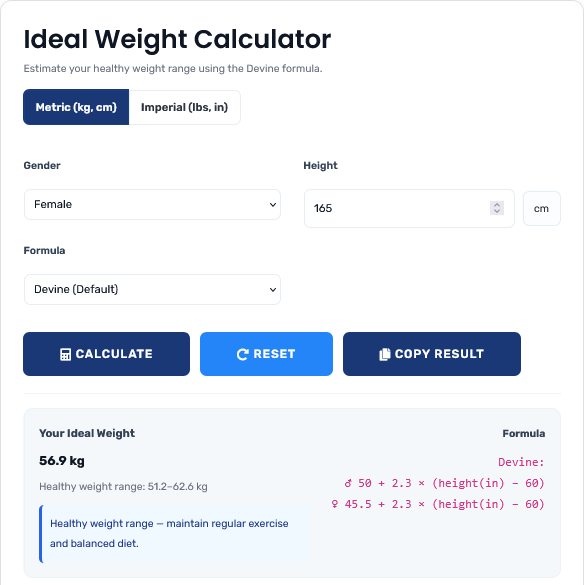
A woman who is 165 cm tall (about 5'5") calculates her ideal weight using the Devine formula:
- Height in inches: 165 ÷ 2.54 = 64.96 in
- Devine IBW = 45.5 + 2.3 × (64.96 − 60) = ~56.9 kg
- Healthy range (±10% for frame variation): ~51.2 – 62.6 kg
This range, not the single 56.9 kg figure, is the more useful number — it accounts for natural variation in frame size and muscle mass.
Body Frame Size Adjustment
| Frame Size | Wrist Circumference (Women) | Wrist Circumference (Men) | Suggested Adjustment |
|---|---|---|---|
| Small Frame | < 15.2 cm (6 in) | < 17.8 cm (7 in) | -10% from calculated value |
| Medium Frame | 15.2 - 16.5 cm (6-6.5 in) | 17.8 - 19.1 cm (7-7.5 in) | Standard calculation |
| Large Frame | > 16.5 cm (6.5 in) | > 19.1 cm (7.5 in) | +10% from calculated value |
Healthy Weight Ranges by Height (Devine, ±10%)
| Height | Women (kg) | Women (lbs) | Men (kg) | Men (lbs) |
|---|---|---|---|---|
| 150 cm (4'11") | 39.0 - 47.7 | 86 - 105 | 43.0 - 52.6 | 95 - 116 |
| 160 cm (5'3") | 47.1 - 57.6 | 104 - 127 | 51.2 - 62.6 | 113 - 138 |
| 170 cm (5'7") | 55.3 - 67.6 | 122 - 149 | 59.3 - 72.5 | 131 - 160 |
| 180 cm (5'11") | 63.4 - 77.5 | 140 - 171 | 67.5 - 82.5 | 149 - 182 |
| 190 cm (6'3") | 71.6 - 87.5 | 158 - 193 | 75.6 - 92.5 | 167 - 204 |
Figures rounded; calculated using the Devine formula with a ±10% frame adjustment. Use the calculator above for your exact numbers.
Why Weight Alone Doesn't Tell the Whole Story
- Muscle vs. fat: muscle is denser than fat, so a fit person can weigh more than the "ideal" figure while being lean.
- Body fat percentage: two people at the same weight can have very different health profiles.
- Waist-to-hip ratio: where fat is stored matters as much as total weight.
- Hydration: day-to-day water weight can shift by 1-2 kg.
- Bone density: naturally heavier bone structure adds weight without added health risk.
For a fuller picture, pair this calculator with our waist-hip ratio calculator and body fat calculator.
Common Weight Goal Mistakes
The "One Perfect Weight" Myth
Many people assume there's a single correct weight for their height. In reality, a healthy weight is a range of several kilograms (roughly 9-13 lbs), not a fixed point. Aim for the middle of your range rather than an exact figure, and expect normal daily fluctuations of 1-2 kg from hydration and food intake.
Chasing a Weight From Years Ago
It's common to target a weight from your teens or twenties, which may no longer be realistic or even healthy decades later. Healthy weight shifts with age due to natural muscle loss (roughly 3-8% per decade after 30), bone density changes, and a gradually slowing metabolism. Adjusting expectations for your current age and lifestyle — rather than a past number — leads to more sustainable goals. For a daily calorie target that matches your goal, see our calorie intake calculator.
Special Considerations for Different Groups
| Group | Key Consideration | Suggested Focus |
|---|---|---|
| Athletes | Higher muscle mass often pushes weight above the standard range | Body fat % and performance, not just the scale |
| Older adults | Some weight above the "ideal" figure is normal with age | Strength, mobility, and waist size |
| Teens and young adults | Still growing — standard adult formulas don't apply | Pediatric growth charts, not adult IBW formulas |
| Postpartum | Body needs time to recover; breastfeeding adds energy needs | Gradual, gentle changes rather than rapid loss |
| Strength trainers | Weight may increase even while getting leaner | Measurements and progress photos over scale weight |
Practical Steps Toward a Healthy Weight
A Simple 4-Week Starting Plan
Weeks 1-2: Assess and start small
- Calculate your ideal weight range using this tool
- Take baseline measurements (waist, hips)
- Add one extra vegetable serving daily
- Start with 15 minutes of walking a day
- Aim for around 2 liters of water daily
Weeks 3-4: Build the habit
- Track food intake a few days a week to build awareness
- Increase protein at breakfast and lunch
- Add resistance training twice a week
- Practice eating without screen distractions
- Reassess progress and adjust
Maintaining a Healthy Weight Long-Term
- Regular monitoring: weekly weigh-ins, monthly measurements.
- Flexible eating: aim for roughly 80% nutrient-dense foods, 20% flexibility.
- Consistent activity: at least 150 minutes of exercise per week.
- Sleep: 7-8 hours of quality sleep supports weight regulation.
- Stress management: chronic stress can affect appetite and weight.
Key takeaway: your ideal weight is a range, not a single number, and formulas like Devine are a starting reference — not a verdict. Regular activity, balanced nutrition, sleep, and stress management matter more day to day than hitting an exact figure on the scale.
When to Talk to a Professional
Consider speaking with a doctor or registered dietitian if:
- You have a medical condition such as diabetes, heart disease, or a thyroid disorder
- You have a history of disordered eating
- Your goal involves losing more than 20% of your current body weight
- You're pregnant or breastfeeding
- You're on medication that may affect your weight
- Previous attempts haven't led to lasting results
Frequently Asked Questions
Each formula was developed at a different time with different assumptions: Devine (1974) was created for medication dosing and became the de facto web standard, Hamwi (1964) was designed for quick clinical estimation, and Robinson (1983) and Miller (1983) were later modifications of Devine.
The results usually differ by 2-4 kg (4-9 lbs), which is why this calculator presents a range rather than a single number.
The Devine formula was originally developed to estimate medication dosing weight, not as a population health standard, and it was based on estimates rather than a formal dataset. It tends to underestimate healthy weight for shorter women in particular.
It's still widely used as a quick reference, but it works best alongside other measures like BMI, body frame size, and body composition rather than as a strict target.
They're complementary rather than competing. BMI is useful for general population health screening, while ideal body weight formulas give a personalized target range based on height and gender.
Neither accounts for muscle mass, so athletes and muscular individuals may fall outside both without being unhealthy.
None of the classic formulas (Devine, Hamwi, Robinson, Miller) account for frame size on their own. A common adjustment is to add or subtract about 10% from the calculated value for a large or small frame, based on wrist circumference relative to height.
Being outside the range doesn't automatically mean you're unhealthy — these formulas don't account for muscle mass, bone density, age, or ethnicity.
If you're concerned about your weight, it's best to look at additional markers like waist circumference and body composition, and to talk to a healthcare provider for personalized guidance.
They work reasonably well for heights roughly between 150-190 cm (4'11"-6'3"). Outside that range, results become less reliable — the formulas may underestimate healthy weight for very short people and overestimate it for very tall people.
At height extremes, body composition and waist measurement are generally more useful than a strict weight target.
