Waist-to-Hip Ratio Calculator: A Complete Guide to Body Fat Distribution and Health Risk
The waist-to-hip ratio (WHR) compares the circumference of your waist to the circumference of your hips. Unlike weight or BMI, which measure overall body mass, WHR looks specifically at where your body stores fat — around the abdomen or around the hips and thighs. This distinction matters because abdominal fat behaves differently in the body than fat stored elsewhere, and it is linked to a higher risk of several chronic conditions.
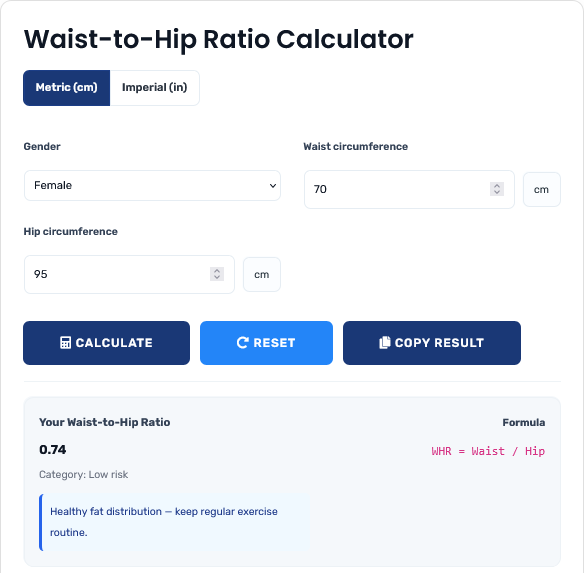
Use the calculator above to get your ratio instantly in either metric or imperial units, then read on to understand what the number means, how it compares with other tools like BMI and waist circumference, and how age, sex, and ethnicity affect interpretation.
For a fuller picture of your health, you can pair this result with other tools in our Body & Fitness Calculators collection, including BMI and ideal weight calculators.
Why Waist-to-Hip Ratio Matters
Why fat location matters: Fat stored around the abdomen (visceral fat) surrounds internal organs and is metabolically active. It is associated with:
- Higher insulin resistance and increased type 2 diabetes risk
- Higher blood pressure and cardiovascular disease risk
- Unfavorable cholesterol and triglyceride levels
- Increased low-grade inflammation
- Higher risk of certain cancers
Fat stored around the hips and thighs (subcutaneous fat) is generally less strongly linked to these effects. This is why two people with the same weight or BMI can have very different metabolic health depending on where they carry their fat. For nutritional planning, see our Macro Nutrient Calculator.
How to Measure Your Waist and Hips Correctly
Step-by-Step Measurement Guide
Measuring your waist:
- Stand upright with feet hip-width apart and breathe out gently
- Find your natural waist — the narrowest point between your lower ribs and hip bones (if there's no obvious narrowing, measure at navel level)
- Wrap the tape horizontally around your waist without compressing the skin
- Keep the tape level at the front and back, parallel to the floor
- Take the reading after a normal exhale, to the nearest 0.5 cm or 1/8 inch
Measuring your hips:
- Stand with feet together
- Find the widest point around your buttocks and hips
- Wrap the tape around this point, keeping it horizontal
- Keep the tape snug but not compressing the skin
- Record the measurement to the nearest 0.5 cm or 1/8 inch
Tips for accuracy: Use a flexible, non-stretch tape measure, measure directly against skin or over thin clothing, take each measurement twice to confirm consistency, and always measure at the same time of day for comparable results over time.
How the Calculator Works
Use the same unit for both measurements. For example, a waist of 88 cm and hips of 100 cm gives a WHR of 88 ÷ 100 = 0.88. In imperial units, a waist of 34.5 in and hips of 40 in gives 34.5 ÷ 40 = 0.86 (rounded to two decimal places).
Understanding Your Result: Health Risk Categories
The table below reflects commonly used risk bands referenced in health and fitness guidance. These are population-level associations, not an individual diagnosis.
| Risk Category | Women | Men | What it generally suggests |
|---|---|---|---|
| Low risk | Below 0.80 | Below 0.95 | Fat distribution associated with lower cardiometabolic risk |
| Moderate risk | 0.80 – 0.85 | 0.95 – 1.00 | Worth monitoring alongside diet, activity, and other markers |
| High risk | Above 0.85 | Above 1.00 | Associated with meaningfully higher population-level risk |
WHO reference point: The World Health Organization uses a simpler single cut-off for abdominal obesity: a WHR above 0.90 for men and above 0.85 for women. The tiered table above is a more granular version of that same guidance used by many health resources to show a moderate-risk band rather than a single line.
Body Shape: Apple, Pear, and Hourglass
WHR is often described using body-shape language. These are informal, descriptive terms rather than medical classifications, but they can make the numbers easier to picture.
Apple-shaped (higher WHR)
Pattern: More fat carried around the abdomen relative to the
hips.
Typical range: Women above 0.85, men above 1.00.
Relevance: Associated with higher risk of heart disease,
type 2 diabetes, and related conditions, even at a normal body weight.
Pear-shaped (lower WHR)
Pattern: More fat carried around the hips, buttocks, and
thighs relative to the waist.
Typical range: Women below 0.80, men below 0.95.
Relevance: Generally associated with lower metabolic risk,
though this doesn't rule out other health considerations.
Hourglass / balanced proportions
Pattern: Waist and hip measurements are proportionate, with a
defined waist relative to hip width.
Relevance: Often associated with the lower end of the
moderate-to-low risk range, though individual health still depends on many
other factors.
Worked Examples
Example 1 (woman): Waist 85 cm, hips 95 cm → WHR = 85 ÷ 95 = 0.89 (high-risk band). Even with a normal or overweight-range BMI, this result would generally prompt a closer look at lifestyle factors and other markers such as blood pressure and fasting glucose.
Example 2 (man): Waist 94 cm, hips 100 cm → WHR = 94 ÷ 100 = 0.94 (low-risk band). If other markers are within normal range, this suggests comparatively lower risk despite a sizeable absolute waist measurement.
WHR vs BMI vs Waist Circumference: Which Should You Use?
- BMI compares weight to height. It's useful for population-level screening but doesn't distinguish muscle from fat or show where fat is stored. You can check yours with our BMI Calculator.
- Waist circumference alone is a direct, simple measure of abdominal size, commonly flagged above roughly 102 cm (40 in) in men and 88 cm (35 in) in women in some guidelines.
- WHR adds context by relating waist size to hip size, which helps account for differences in overall frame and highlights fat distribution specifically.
Most clinicians and health resources recommend using two or more of these measures together, rather than relying on a single number in isolation.
Age and Ethnicity Considerations
Age: Fat distribution tends to shift toward the abdomen with age, particularly after menopause in women, so a WHR that was low earlier in life may rise gradually over time even without significant weight gain.
Ethnicity: Population studies show that the relationship between WHR and cardiometabolic risk isn't identical across all ethnic groups. Some groups, including South Asian populations, appear to face higher risk at comparatively lower WHR or BMI values. Universal cut-offs are a useful starting point, but individual risk assessment should account for this variation.
Special Situations
Pregnancy and postpartum: Waist and hip measurements change substantially during pregnancy, so WHR is not a meaningful measure during this time. Most guidance suggests waiting until postpartum recovery is well underway — commonly six weeks or more, and longer for a full return to baseline — before using WHR again, and following individualized medical advice. Related tool: Pregnancy Due Date Calculator.
Athletes and high muscle mass: WHR doesn't distinguish muscle from fat. Someone with well-developed abdominal or gluteal muscle can have a WHR that doesn't reflect their actual metabolic risk. Body composition methods such as DXA scans give a more precise picture for this group.
Practical Ways to Improve Your Waist-to-Hip Ratio
Improving WHR generally means reducing abdominal fat and, in some cases, building hip and gluteal muscle. Changes should be gradual and sustainable.
Diet:
- If weight loss is appropriate, aim for a modest calorie deficit — roughly 0.5–1% of body weight per week is a commonly cited sustainable pace
- Prioritize vegetables, fruit, lean protein, legumes, whole grains, and healthy fats
- Limit added sugar and refined carbohydrates, which are linked to visceral fat accumulation
- Include adequate protein to help preserve lean mass during weight loss
Exercise:
- Aim for at least 150 minutes of moderate-intensity (or 75 minutes of vigorous) aerobic activity per week
- Add strength training 2–3 times weekly, including compound movements like squats, deadlifts, lunges, and hip thrusts to build hip and gluteal muscle
- Note that "spot reduction" — losing fat from one area through targeted exercise alone — isn't supported by evidence; overall fat loss is what changes waist measurements over time
Lifestyle:
- Prioritize sleep quality — poor sleep is linked to increased visceral fat
- Manage chronic stress, which raises cortisol and can promote abdominal fat storage
- Track progress every few weeks rather than daily, since day-to-day fluctuation from bloating or posture is normal
For a calorie target that matches your goals, try our Calorie Intake Calculator.
Limitations of the Waist-to-Hip Ratio
- It does not measure total body fat or lean mass — two people with the same WHR can have very different body compositions
- Measurement technique affects results — tape placement, posture, and breathing can shift the number between attempts
- It is not diagnostic on its own and works best combined with waist circumference, BMI, blood pressure, and lab markers such as fasting glucose and lipids
- It is not applicable during pregnancy or shortly after abdominal surgery
When to Talk to a Healthcare Provider
Consider speaking with a doctor if:
- Your WHR falls in the high-risk band
- You notice a sudden or unexplained change in waist size
- You have a family history of heart disease or type 2 diabetes
- You have other risk factors such as high blood pressure or elevated cholesterol
For a broader set of health metrics, see our Medical Calculators section.
Bottom line: Waist-to-hip ratio is a free, simple way to screen for how your body stores fat, and it adds information that weight or BMI alone can't provide. Used alongside waist circumference, BMI, and regular check-ups, it's a practical part of tracking long-term health. Pair it with our Body Fat Calculator and Ideal Weight Calculator for a fuller picture.
Frequently Asked Questions
Commonly used lower-risk thresholds are below 0.80 for women and below 0.95 for men, with the World Health Organization's broader abdominal obesity cut-off set at 0.85 for women and 0.90 for men. Healthy ranges can vary somewhat with age, ethnicity, and individual body frame, so treat these as general guides rather than strict targets.
They measure different things. BMI reflects overall weight relative to height, while WHR reflects fat distribution. Some research, including a JAMA Network Open study, has found WHR to be a stronger predictor of mortality risk than BMI in certain populations. Most health professionals recommend using both together rather than relying on either alone. Compare yours with our BMI Calculator.
Every few weeks to a couple of months is generally enough if you're tracking progress after a lifestyle change. Daily measurements aren't useful, since normal day-to-day variation from bloating, posture, or hydration can obscure any real trend. Measure under similar conditions each time for the most consistent comparison.
Yes, to some extent. Building muscle around the hips and glutes through strength training can increase hip measurement, while reducing abdominal fat through diet and overall activity can reduce waist measurement — both shift the ratio even if total body weight barely changes. This is sometimes called body recomposition.
WHR is most reliable for adults roughly 20–65 years old. It is less meaningful for children and teenagers, whose bodies are still developing, and can be misleading for athletes with above-average muscle mass in the hips or abdomen. In older adults, some increase in abdominal fat with age is common, but a high WHR still signals increased risk worth discussing with a doctor.
Both add value. Waist circumference alone directly reflects abdominal size, while WHR adds context by comparing that to hip size, which varies naturally by body frame. Many health resources recommend tracking both alongside BMI for the clearest overall picture.
Yes. Waist size increases substantially during pregnancy and the body needs time to return to its pre-pregnancy state afterward, so WHR isn't a meaningful measure during pregnancy or the early postpartum period. Wait until you've had individualized medical guidance on your recovery before using WHR to assess risk again.
