Gravity Calculator: Understand Gravitational Force Easily
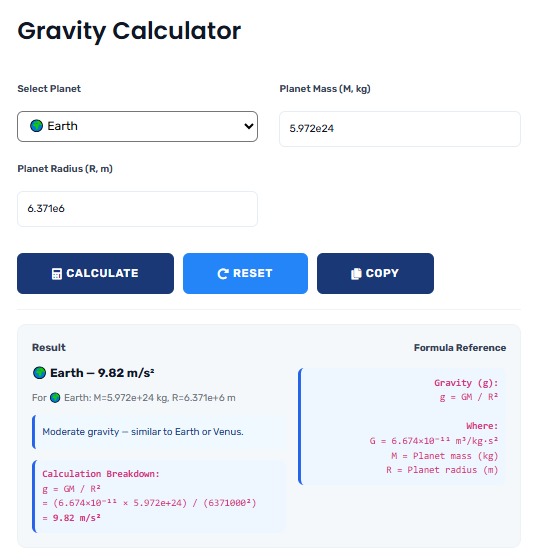
Gravity is one of the fundamental forces of nature that affects everything in our universe, from apples falling from trees to planets orbiting stars. Our Gravity Calculator helps you understand and calculate gravitational forces between any two objects using Newton's law of universal gravitation.
Whether you're a student learning physics, a teacher preparing lessons, or just someone curious about how gravity works, this tool makes complex gravitational calculations simple and accessible. You can calculate the force between Earth and the Moon, between two people standing apart, or even between tiny particles.
What you can do with our Gravity Calculator:
- Calculate gravitational force between any two objects with mass
- Understand planetary orbits and celestial mechanics
- Compare gravitational forces on different planets
- Learn physics concepts through practical examples
- Solve homework problems quickly and accurately
For more physics-related calculations, check our Physics Calculators collection.
What Is Gravity and Why Does It Matter?
Gravity is the force that attracts two objects toward each other. Every object that has mass exerts a gravitational pull on every other object with mass. The strength of this force depends on two things: how much mass the objects have, and how far apart they are.
Here's why understanding gravity is important:
- Keeps us grounded: Earth's gravity keeps our feet on the ground
- Governs the universe: Planets orbit stars, moons orbit planets
- Affects time: Strong gravity actually slows down time (time dilation)
- Shapes galaxies: Gravity holds entire galaxies together
- Creates tides: The Moon's gravity creates ocean tides on Earth
Newton's Law of Universal Gravitation
Sir Isaac Newton discovered that every object in the universe attracts every other object with a force that is:
- Proportional to the product of their masses (more mass = stronger pull)
- Inversely proportional to the square of the distance between them (further apart = much weaker pull)
The Gravity Formula:
F = G × (m₁ × m₂) ÷ r²
Where:
- F = Gravitational force (in newtons)
- G = Gravitational constant (6.674 × 10⁻¹¹ N·m²/kg²)
- m₁ = Mass of first object (in kilograms)
- m₂ = Mass of second object (in kilograms)
- r = Distance between centers of objects (in meters)
Real-World Examples of Gravitational Force
Example 1: Earth and the Moon
The celestial dance that creates tides:
- Earth's mass: 5.97 × 10²⁴ kg
- Moon's mass: 7.35 × 10²² kg
- Average distance: 384,400,000 meters
- Gravitational force: Approximately 1.98 × 10²⁰ newtons
- Interesting fact: This force is strong enough to keep the Moon in orbit but weak enough that astronauts on the Moon feel only 1/6 of Earth's gravity
For more astronomy calculations, try our Astronomy Calculators.
Example 2: You and Earth
Why you don't float away:
- Your mass: Let's say 70 kg
- Earth's mass: 5.97 × 10²⁴ kg
- Distance (Earth's radius): 6,371,000 meters
- Gravitational force: Approximately 686 newtons
- This is your weight! Weight = mass × gravity
- On Earth: 70 kg × 9.8 m/s² = 686 newtons
For weight-related calculations, use our KG to Pounds Converter.
Example 3: Two People Standing Apart
The gravity you don't feel:
- Person A: 70 kg
- Person B: 80 kg
- Distance: 1 meter apart
- Gravitational force: 3.73 × 10⁻⁷ newtons
- That's tiny! About 0.000000373 newtons
- Why you don't feel it: Other forces (friction, air resistance) are much stronger
This shows why we only notice gravity with very large masses like planets.
Gravity on Different Planets
| Planet | Surface Gravity | Compared to Earth | Your Weight There | Interesting Facts |
|---|---|---|---|---|
| Mercury | 3.7 m/s² | 38% of Earth's | If you weigh 70 kg on Earth: 26.6 kg | Small but dense, close to Sun |
| Venus | 8.87 m/s² | 91% of Earth's | If you weigh 70 kg on Earth: 63.7 kg | Similar size to Earth, thick atmosphere |
| Earth | 9.8 m/s² | 100% (reference) | If you weigh 70 kg: 70 kg | Our home planet, perfect for life |
| Mars | 3.71 m/s² | 38% of Earth's | If you weigh 70 kg on Earth: 26.6 kg | Future human colony target |
| Jupiter | 24.79 m/s² | 253% of Earth's | If you weigh 70 kg on Earth: 177.1 kg | Gas giant, largest planet |
| Moon (Earth's) | 1.62 m/s² | 17% of Earth's | If you weigh 70 kg on Earth: 11.9 kg | Only place humans have walked besides Earth |
The Gravitational Constant (G)
The Universal Number That Makes Gravity Work:
G = 6.67430 × 10⁻¹¹ N·m²/kg²
This number is incredibly small, which explains why:
- You don't feel gravity pulling you toward other people
- We need planet-sized masses to notice gravitational effects
- Gravity is the weakest of the four fundamental forces
History: Henry Cavendish first measured G accurately in 1798 using a torsion balance experiment. His measurement was within 1% of today's accepted value!
How to Use the Gravity Calculator
Simple 3-Step Process:
-
Enter Masses:
- Input mass of first object (in kilograms)
- Input mass of second object (in kilograms)
- Use scientific notation for very large or small numbers
-
Enter Distance:
- Input distance between object centers (in meters)
- Remember: For planets, use distance from center to center
- For surface gravity, use planet's radius
-
Get Results:
- Click calculate to see gravitational force
- Result shows in newtons (N)
- Also shows comparisons to everyday forces
Common Questions About Gravity
Why Don't We Feel Gravity Between Small Objects?
The gravitational constant G is extremely small (6.674×10⁻¹¹). This means gravity between everyday objects is incredibly weak. For example:
- Two 1 kg masses 1 meter apart: Force = 6.67×10⁻¹¹ N
- Compare to: Weight of a small apple = about 1 N
- The gravity between small objects is billions of times weaker than other forces we experience daily
How Does Gravity Create Orbits?
Orbits happen when an object is moving sideways fast enough that it falls around a planet instead of into it. It's like:
- Throw a ball - it falls to ground (too slow)
- Throw it faster - it goes further before hitting ground
- Throw it at orbital velocity (about 28,000 km/h for Earth) - it keeps missing Earth as it falls
- The International Space Station is constantly falling toward Earth but moving sideways so fast it keeps missing!
Einstein's Theory of General Relativity
While Newton's gravity works perfectly for most everyday situations, Albert Einstein gave us a deeper understanding in 1915. Einstein said gravity isn't really a "force" but rather:
- Mass warps spacetime: Like a heavy ball on a trampoline
- Objects follow curved paths: They move along the curves in spacetime
- Explains more phenomena: Like Mercury's orbit, black holes, gravitational lensing
- Predicts gravitational waves: Ripples in spacetime, detected in 2015
For everyday calculations, Newton's gravity is perfectly accurate. But for precision work (GPS satellites, studying black holes), we need Einstein's equations.
Practical Applications of Gravity Calculations
| Application | How Gravity Calculations Help | Real-World Example | Why It Matters |
|---|---|---|---|
| Space Exploration | Calculating orbital paths, fuel requirements | Mars rover missions, satellite launches | Enables space travel and communication |
| GPS Systems | Accounting for gravitational time dilation | Your smartphone navigation | Makes accurate positioning possible |
| Tide Prediction | Calculating Moon's and Sun's gravitational pull | Shipping schedules, coastal planning | Affects maritime activities globally |
| Geology | Mapping underground structures by gravity variations | Finding oil, minerals, underground water | Resource discovery and management |
| Architecture | Accounting for gravitational loads | Skyscrapers, bridges, large structures | Ensures structural safety and stability |
Interesting Gravity Facts
Mind-Blowing Gravity Facts:
- Time slows in strong gravity: Clocks run slower on Earth than in space (by nanoseconds)
- Black holes have extreme gravity: So strong that not even light can escape
- You're slightly lighter at equator: Due to Earth's rotation and bulge
- Gravity waves exist: Ripples in spacetime from massive events like black hole mergers
- Mountains affect gravity: You weigh slightly less on top of a mountain
- Ocean tides are gravity's work: Mainly from Moon, partially from Sun
- Your hair grows against gravity: One of few biological processes that does
Gravity Calculation Practice Problems
Problem 1: Earth and Sun
Calculate the gravitational force between Earth and Sun:
- Sun mass: 1.989 × 10³⁰ kg
- Earth mass: 5.972 × 10²⁴ kg
- Average distance: 149.6 × 10⁹ meters
- Try it yourself first, then check: Answer ≈ 3.54 × 10²² N
- That's: 35,400,000,000,000,000,000,000 newtons!
Problem 2: Gravity Between Cars
Two cars parked 5 meters apart:
- Each car: 1500 kg
- Distance: 5 meters
- Calculate the gravitational attraction: Answer ≈ 6.00 × 10⁻⁷ N
- Comparison: That's like the weight of a speck of dust!
For more math practice, use our Basic Math Calculators.
Key Insight: Gravity is everywhere and affects everything, but we only notice it with large masses. The same force that makes an apple fall also keeps galaxies together. Understanding gravity helps us understand our place in the universe, from why we don't float off Earth to how planets move through space. For exploring more scientific concepts, visit our complete Science Calculators collection.
Advanced Concepts: When Newton Isn't Enough
Situations Requiring Einstein's General Relativity:
- Near black holes: Extreme gravity bends light and warps time
- Precise GPS: Satellite clocks need relativity corrections
- Mercury's orbit: Newton couldn't explain it perfectly
- Gravitational lensing: Massive objects bending light from behind them
- Gravitational waves: Ripples in spacetime from cosmic collisions
The good news: For 99.9% of situations (including all your calculations), Newton's gravity is perfectly accurate and much simpler to use!
Quick Reference: Gravity Numbers to Remember
Important Constants:
- Gravitational constant (G): 6.674 × 10⁻¹¹ N·m²/kg²
- Earth's mass: 5.972 × 10²⁴ kg
- Earth's radius: 6,371 km (6.371 × 10⁶ m)
- Earth's surface gravity: 9.8 m/s² (often rounded to 10 for estimates)
- Moon's mass: 7.348 × 10²² kg (about 1/81 of Earth's)
- Sun's mass: 1.989 × 10³⁰ kg (333,000 × Earth's)
Useful Conversions:
- 1 kilogram (mass) = 9.8 newtons (weight on Earth)
- 1 newton = about the weight of a small apple
- Your weight on Moon = your Earth weight ÷ 6
- Your weight on Jupiter = your Earth weight × 2.5
Gravity in Everyday Life
You experience gravity every day without even thinking about it:
- Walking: Gravity keeps your feet on the ground
- Pouring drinks: Gravity pulls liquid downward
- Rain: Gravity pulls raindrops from clouds
- Ball sports: Basketballs, footballs all follow parabolic paths due to gravity
- Your posture: Gravity affects how you stand and sit
- Blood circulation: Gravity helps blood return from your feet
Next time you drop something, remember: you're witnessing the same force that holds galaxies together!
Frequently Asked Questions
Gravity is incredibly weak compared to other fundamental forces. For example, the electromagnetic force between two protons is about 10³⁶ times stronger than their gravitational attraction! Scientists don't fully understand why gravity is so weak, but it might be related to extra dimensions in string theory or other advanced physics concepts.
Unlike electromagnetic forces that can be blocked by materials, gravity cannot be shielded. It passes through everything. If you dig a hole, gravity doesn't disappear - it just comes from all the mass around you instead of just from below. This is why you can't make "anti-gravity" devices.
The story of Newton and the apple is partly true. Newton didn't "discover" gravity - people always knew things fall. What Newton discovered was that the same force making apples fall also keeps the Moon in orbit. He realized gravity works everywhere in the universe, not just on Earth.
Astronauts float not because there's no gravity (there's about 90% of Earth's gravity at the Space Station's altitude), but because they're in continuous free fall. The Space Station is falling toward Earth but moving sideways so fast it keeps missing. This creates the feeling of weightlessness.
Yes, but only slightly! On top of Mount Everest (8,848 m high), you'd weigh about 0.3% less than at sea level. This is because you're further from Earth's center. Also, at the equator you weigh about 0.5% less than at the poles due to Earth's rotation and bulge.
The Moon's gravity creates tides by pulling more strongly on the side of Earth facing it. It also very slightly slows Earth's rotation (by about 1.7 milliseconds per century). Over billions of years, this has lengthened our day from about 6 hours to 24 hours!
