Ideal Gas Law Calculator: Mastering PV = nRT for Science & Engineering
The Ideal Gas Law is one of the most fundamental principles in chemistry and physics, describing how gases behave under different conditions. Our Ideal Gas Law Calculator makes solving PV = nRT problems quick, accurate, and accessible to students, researchers, and professionals alike.
Whether you're studying for an exam, conducting laboratory experiments, or working on engineering projects, understanding gas behavior is crucial. This calculator helps you determine any unknown variable in the Ideal Gas Law equation when you know the other three, eliminating calculation errors and saving valuable time.
Practical applications of the Ideal Gas Law:
- Chemistry Labs: Calculating gas volumes in reactions and experiments
- Physics Classes: Understanding thermodynamic principles and gas behavior
- Engineering Projects: Designing systems that involve gas pressure and volume
- Environmental Science: Modeling atmospheric conditions and pollution dispersion
- Industrial Processes: Optimizing gas storage, transport, and usage
Our calculator provides instant solutions while helping you understand the underlying science. For more chemistry tools, explore our Chemistry Calculators collection.
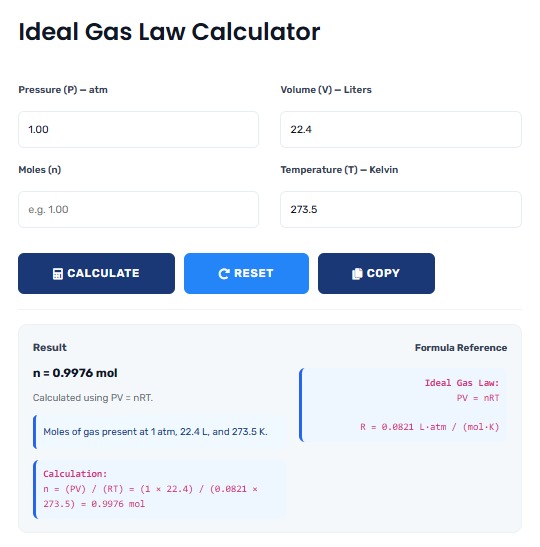
Understanding the Ideal Gas Law: PV = nRT
The Fundamental Equation:
PV = nRT
Where:
• P = Pressure (in Pascals, atm, bar, etc.)
• V = Volume (in liters, cubic meters, etc.)
• n = Number of moles of gas
• R = Universal gas constant (8.314 J/mol·K)
• T = Temperature (in Kelvin)
This simple yet powerful equation connects four key properties of gases. It tells us that for an ideal gas (a theoretical gas that follows certain assumptions), the product of pressure and volume is proportional to the number of moles and temperature. The gas constant R acts as the proportionality factor that makes the units work out correctly.
What Makes a Gas "Ideal"?
The Ideal Gas Assumptions:
- Negligible Volume: Gas particles are so small that their individual volumes don't matter compared to the container volume
- No Intermolecular Forces: Particles don't attract or repel each other (except during collisions)
- Perfectly Elastic Collisions: When particles collide, no energy is lost
- Random Motion: Particles move randomly in straight lines until they collide
- Average Kinetic Energy: The average kinetic energy is proportional to temperature
While no real gas perfectly meets these conditions, many gases behave nearly ideally at standard temperature and pressure, making the Ideal Gas Law incredibly useful for practical calculations.
Real-World Examples of Ideal Gas Law Applications
Example 1: Calculating Balloon Volume
Scenario: You inflate a balloon with 0.1 moles of helium at room temperature (298 K) and atmospheric pressure (1 atm). What volume will the balloon occupy?
Given:
• n = 0.1 moles
• T = 298 K
• P = 1 atm = 101325 Pa
• R = 8.314 J/mol·K
Calculation:
V = nRT/P
V = (0.1 × 8.314 × 298) / 101325
V = 247.8 / 101325
V = 0.00245 m³ = 2.45 liters
Practical Insight: This explains why helium balloons expand as they rise (lower atmospheric pressure) and contract when cooled.
Example 2: Determining Gas Pressure in a Container
Scenario: A 5-liter tank contains 0.2 moles of oxygen at 300 K. What pressure does the gas exert?
Given:
• n = 0.2 moles
• T = 300 K
• V = 5 L = 0.005 m³
• R = 8.314 J/mol·K
Calculation:
P = nRT/V
P = (0.2 × 8.314 × 300) / 0.005
P = 498.84 / 0.005
P = 99768 Pa ≈ 0.985 atm
Safety Application: Such calculations are crucial for designing safe gas storage containers and understanding pressure limits.
For related pressure calculations, check our Force Calculator.
The Universal Gas Constant (R) in Different Units
| Value of R | Units | When to Use | Example Applications |
|---|---|---|---|
| 8.314462618 | J/(mol·K) | SI units, scientific calculations | Physics problems, engineering designs |
| 0.082057 | L·atm/(mol·K) | Chemistry labs, atmospheric pressure | Laboratory experiments, gas collection |
| 62.363577 | L·Torr/(mol·K) | Medical applications, vacuum systems | Respiratory therapy, vacuum chambers |
| 1.987204 | cal/(mol·K) | Thermodynamics, heat calculations | Energy transfer, calorimetry |
Important: Our calculator automatically selects the correct R value based on your chosen units, eliminating conversion errors.
Historical Gas Laws: The Building Blocks
The Ideal Gas Law combines several historical discoveries:
Boyle's Law (1662): P₁V₁ = P₂V₂
At constant temperature, pressure and volume are inversely proportional.
Discovered by Robert Boyle using a J-shaped tube with mercury.
Charles's Law (1787): V₁/T₁ = V₂/T₂
At constant pressure, volume and temperature are directly proportional. Jacques
Charles experimented with balloons.
Gay-Lussac's Law (1808): P₁/T₁ = P₂/T₂
At constant volume, pressure and temperature are directly proportional. Joseph
Gay-Lussac studied gas reactions.
Avogadro's Law (1811): V₁/n₁ = V₂/n₂
At constant temperature and pressure, volume and moles are directly
proportional. Amedeo Avogadro proposed equal volumes contain equal molecules.
These individual laws are special cases of the comprehensive Ideal Gas Law that our calculator implements.
Step-by-Step Guide: How to Use the Ideal Gas Law Calculator
Complete Calculation Process
-
Identify Known Variables
- Determine which three of P, V, n, T you know
- Ensure you have consistent units
- Convert temperature to Kelvin if needed (K = °C + 273.15)
-
Input Values into Calculator
- Enter pressure (choose units: Pa, atm, bar, etc.)
- Enter volume (choose units: L, m³, mL, etc.)
- Enter moles or temperature as appropriate
- Leave the unknown field blank
-
Select Appropriate Units
- Choose consistent units or let calculator convert
- Our tool automatically adjusts R value for your units
- No manual unit conversion needed
-
Calculate and Interpret Results
- Click calculate or watch real-time results
- Review answer with proper units and precision
- Check if result makes physical sense
When Real Gases Deviate from Ideal Behavior
Limitations of the Ideal Gas Law
The Ideal Gas Law becomes less accurate when:
- High Pressure: Gas molecules get crowded, their volume matters
- Low Temperature: Molecules move slowly, intermolecular forces matter
- Large Molecules: Complex molecules have significant volume and forces
- Polar Gases: Molecules with uneven charge distributions attract each other
- Near Condensation: When gas is about to become liquid
Real Gas Corrections: For more accurate calculations under these conditions, scientists use modified equations like Van der Waals equation: [P + a(n/V)²] × [V - nb] = nRT, where 'a' and 'b' are correction factors specific to each gas.
Common Gas Properties Reference Table
| Gas | Molar Mass (g/mol) | Common Uses | Ideal Behavior | Van der Waals Constants |
|---|---|---|---|---|
| Hydrogen (H₂) | 2.016 | Fuel, balloons, industry | Very good | a=0.244, b=0.0266 |
| Helium (He) | 4.003 | Balloons, cooling, MRI | Excellent | a=0.0346, b=0.0238 |
| Nitrogen (N₂) | 28.01 | Atmosphere, food packaging | Good | a=1.390, b=0.0391 |
| Oxygen (O₂) | 32.00 | Breathing, combustion, medicine | Good | a=1.360, b=0.0318 |
| Carbon Dioxide (CO₂) | 44.01 | Carbonation, fire extinguishers | Fair (deviates at high P) | a=3.592, b=0.0427 |
Educational Applications and Learning Benefits
Why Students Should Master the Ideal Gas Law:
Conceptual Understanding: The Ideal Gas Law connects microscopic particle behavior to macroscopic measurements you can observe and measure.
Problem-Solving Skills: Learning to rearrange PV = nRT develops algebraic skills and logical thinking.
Laboratory Applications: Essential for designing experiments, calculating expected results, and analyzing data.
Foundation for Advanced Topics: Understanding ideal gases prepares you for thermodynamics, kinetics, and physical chemistry.
Real-World Connections: From weather patterns to car engines, gas laws explain everyday phenomena.
For additional science learning tools, explore our Physics Calculators.
Industrial and Technical Applications
Application: Scuba Diving Gas Planning
Problem: A scuba tank with 12 liters volume is filled to 200 atm at 20°C. How many moles of air does it contain, and what volume would this gas occupy at surface pressure (1 atm)?
Step 1: Calculate moles in tank
P = 200 atm = 20265000 Pa
V = 12 L = 0.012 m³
T = 20°C = 293 K
n = PV/RT = (20265000 × 0.012) / (8.314 × 293)
n = 243180 / 2437.0 = 99.8 moles
Step 2: Calculate surface volume
At surface: P = 101325 Pa, T = 293 K
V = nRT/P = (99.8 × 8.314 × 293) / 101325
V = 243000 / 101325 = 2.40 m³ = 2400 liters
Safety Implication: This calculation helps divers understand their air supply and decompression requirements.
Application: Hot Air Balloon Design
Problem: A hot air balloon needs to lift 500 kg (including basket, passengers, and balloon). Air inside is heated to 120°C while outside air is 20°C. What volume of heated air is needed?
Solution Approach:
1. Calculate density difference between hot and cold air
2. Use buoyancy principle: lift force = weight of displaced cold air - weight of
hot air
3. Solve for volume using Ideal Gas Law relationships
Key Insight: The Ideal Gas Law explains why heating air makes balloons rise (hot air is less dense) and why balloons expand as they ascend (lower atmospheric pressure).
For buoyancy and density calculations, try our calculators.
Common Calculation Mistakes to Avoid
Top Errors in Ideal Gas Law Calculations:
- Temperature in Celsius: Always convert to Kelvin (K = °C + 273.15)
- Inconsistent Units: Mixing different unit systems without proper conversion
- Wrong R Value: Using R value that doesn't match your units
- Forgetting Significant Figures: Over-reporting precision beyond measurement accuracy
- Algebra Errors: Incorrectly rearranging PV = nRT for the unknown
- Physical Impossibilities: Getting negative pressure or volume (check your signs)
- Unit Confusion: 1 L = 0.001 m³, not 1 m³; 1 atm = 101325 Pa, not 100000 Pa
Our Calculator Prevents These: Automatic unit conversion, correct R selection, and temperature handling eliminate these common errors.
Advanced Topics: Beyond the Ideal Gas Law
When You Need More Sophisticated Models:
Van der Waals Equation: [P + a(n/V)²] × [V - nb] = nRT
Accounts for molecular volume (b) and intermolecular forces (a). Better for high
pressure and low temperature.
Compressibility Factor (Z): PV = ZnRT
Z = 1 for ideal gases, ≠1 for real gases. Z charts show how different gases
deviate.
Virial Equation: PV = nRT[1 + B(T)(n/V) + C(T)(n/V)² + ...]
More accurate but more complex. Used in precise engineering calculations.
Equation of State: Various models (Peng-Robinson, Redlich-Kwong) for specific industrial applications like petroleum engineering.
Statistical Mechanics: Derives gas laws from molecular behavior using probability and quantum mechanics.
Interactive Learning: Experiment with Different Conditions
Try These Thought Experiments with Our Calculator:
Experiment 1: Pressure-Volume Relationship
Hold n and T constant. Double the volume - what happens to pressure? Halve the
volume - what happens to pressure? This demonstrates Boyle's Law.
Experiment 2: Temperature-Volume Relationship
Hold n and P constant. Increase temperature from 273K to 373K - how does volume
change? This demonstrates Charles's Law.
Experiment 3: Moles-Volume Relationship
Hold P and T constant. Double the moles - what happens to volume? This
demonstrates Avogadro's Law.
Experiment 4: Combined Effects
What happens if you double both pressure and temperature while keeping n
constant? (Hint: Volume stays the same!)
These interactive explorations help build intuition about gas behavior that goes beyond memorizing formulas.
Key Insight: The Ideal Gas Law is more than just an equation—it's a window into the molecular world. Every time you use PV = nRT, you're connecting measurable quantities (pressure, volume, temperature) to invisible molecular behavior (countless tiny particles moving and colliding). This fundamental connection between the macroscopic and microscopic is what makes the Ideal Gas Law so powerful and enduring in science education and practice.
For mathematical calculations related to gas mixtures, check our Percentage Calculator for concentration calculations.
Career Applications of Gas Law Knowledge
| Career Field | How Ideal Gas Law is Used | Example Tasks | Importance Level |
|---|---|---|---|
| Chemical Engineering | Reactor design, process optimization | Calculating gas flows, pressure drops, equipment sizing | Essential |
| Environmental Science | Air quality monitoring, pollution control | Modeling pollutant dispersion, calculating emission rates | Very High |
| Medical Research | Respiratory therapy, anesthesia | Calculating gas volumes in lungs, anesthetic mixtures | High |
| Meteorology | Weather prediction, climate modeling | Understanding atmospheric pressure changes, gas mixtures | High |
| Food Industry | Packaging, preservation | Modified atmosphere packaging, carbonation calculations | Medium-High |
| Aerospace Engineering | Spacecraft design, life support | Cabin pressure systems, oxygen supply calculations | Essential |
Quick Reference: Common Gas Law Problems and Solutions
Problem Type 1: Finding Volume
Given: Pressure, moles, temperature
Formula: V = nRT/P
Example: What volume does 2 moles of gas occupy at 1 atm and
273K?
Solution: V = (2 × 0.0821 × 273) / 1 = 44.8 L
Problem Type 2: Finding Pressure
Given: Volume, moles, temperature
Formula: P = nRT/V
Example: What pressure does 0.5 moles exert in a 10L container
at 300K?
Solution: P = (0.5 × 0.0821 × 300) / 10 = 1.23 atm
Problem Type 3: Finding Moles
Given: Pressure, volume, temperature
Formula: n = PV/RT
Example: How many moles in 22.4L at 1 atm and 273K?
Solution: n = (1 × 22.4) / (0.0821 × 273) = 1.00 mole
Problem Type 4: Finding Temperature
Given: Pressure, volume, moles
Formula: T = PV/nR
Example: What temperature gives 1 atm pressure for 1 mole in
22.4L?
Solution: T = (1 × 22.4) / (1 × 0.0821) = 273K
Frequently Asked Questions
Kelvin is an absolute temperature scale where 0 K represents absolute zero (no molecular motion). The Ideal Gas Law assumes direct proportionality between temperature and molecular kinetic energy, which only works with an absolute scale. Celsius and Fahrenheit have arbitrary zero points, so ratios like T₁/T₂ would give incorrect results. Always convert: K = °C + 273.15.
Under standard conditions (near room temperature and atmospheric pressure), the Ideal Gas Law is typically within 1-5% accuracy for most gases. Accuracy decreases at high pressures (above 10 atm), low temperatures (near condensation), or for polar gases like water vapor. For precise work under extreme conditions, use real gas equations like Van der Waals.
Yes! For mixtures, use Dalton's Law of Partial Pressures: Total pressure = sum of partial pressures. Each gas behaves independently, so P_total = P₁ + P₂ + P₃... = (n₁ + n₂ + n₃...)RT/V. Our calculator can handle mixture problems by using total moles (n_total = n₁ + n₂ + ...).
STP (Standard Temperature and Pressure) is 0°C (273.15K) and 1 atm. "Standard conditions" often means 25°C (298.15K) and 1 atm in chemistry. Always check which standard is being used. At STP, 1 mole of ideal gas occupies 22.4 L. At standard conditions (25°C), 1 mole occupies 24.5 L.
At higher altitudes, atmospheric pressure decreases (approximately 1 atm at sea level, 0.5 atm at 5500m). Temperature also changes. For balloons, tires, or any gas container, you must use the local atmospheric pressure in calculations, not sea-level pressure. This affects everything from weather balloons to baking at high elevations.
Helium has lower molar mass (4 g/mol) than air (approximately 29 g/mol). At the same temperature and pressure, equal volumes contain equal moles (Avogadro's Law), so helium weighs less. Buoyancy force depends on weight of displaced air minus weight of balloon contents. Lighter gas creates net upward force. Hot air balloons work similarly - heating air decreases its density.
