Molarity Calculator: Your Complete Guide to Solution Concentration Calculations
Molarity is one of the most fundamental concepts in chemistry, representing the concentration of a solution. Whether you're a student conducting experiments, a researcher preparing reagents, or a professional working with chemical solutions, understanding how to calculate molarity accurately is essential for success in any chemical endeavor.
Our Molarity Calculator simplifies this critical calculation, allowing you to determine solution concentrations quickly and accurately. By inputting basic parameters like mass, volume, and molecular weight, you can instantly calculate molarity, saving time and reducing errors in your chemical work.
Why molarity calculations matter in chemistry:
- Experimental Accuracy: Ensures reproducible results in laboratory work
- Safety Precautions: Proper concentrations prevent hazardous chemical reactions
- Educational Foundation: Essential for understanding chemical principles
- Industrial Applications: Critical for manufacturing and quality control
- Research Consistency: Maintains scientific rigor across experiments
This tool is part of our comprehensive suite of Chemistry Calculators designed to support your scientific work with precision and reliability.
What is Molarity and Why Does It Matter?
Understanding the Basics
Molarity (M) is defined as the number of moles of solute per liter of solution. It's one of the most common ways to express concentration in chemistry because it directly relates to the number of particles in a solution, which is crucial for predicting chemical behavior.
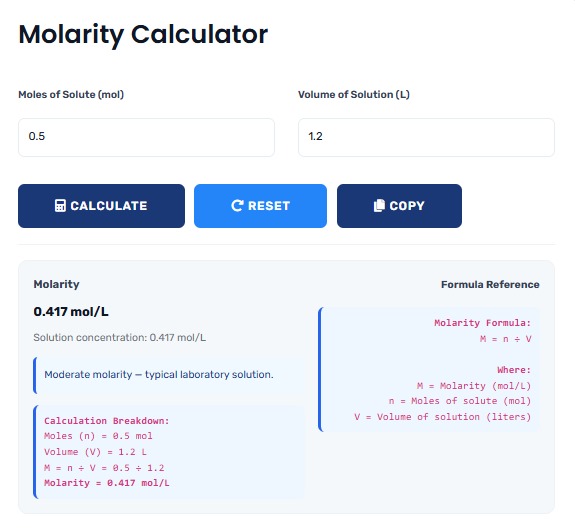
The formula is simple but powerful: M = moles of solute / liters of solution. This relationship allows chemists to precisely control reactions by knowing exactly how many reactant molecules are available.
For converting between different concentration units, check our Conversion Calculators suite.
Real-Life Molarity Calculation Scenarios
Student Lab: Preparing a Standard Solution
Maria, a chemistry student, needs to prepare 500 mL of 0.1 M sodium chloride (NaCl) solution for her laboratory experiment. She needs to calculate how much NaCl to weigh out.
Step-by-Step Calculation:
- Molecular weight of NaCl: 58.44 g/mol
- Desired molarity: 0.1 M
- Desired volume: 0.5 L (500 mL converted to liters)
- Moles needed: Molarity × Volume = 0.1 mol/L × 0.5 L = 0.05 moles
- Mass needed: Moles × Molecular weight = 0.05 mol × 58.44 g/mol = 2.922 grams
- Practical tip: Weigh 2.92 grams for practical accuracy
- Verification: Dissolve in water, then dilute to exactly 500 mL mark
Using our calculator, Maria simply inputs: mass = ? (unknown), molecular weight = 58.44, volume = 0.5, desired molarity = 0.1. The calculator instantly shows she needs 2.922 grams.
For related dilution calculations, try our Dilution Calculator.
Research Laboratory: Preparing Buffer Solutions
Dr. Chen, a biochemistry researcher, needs to prepare a phosphate buffer for protein experiments. The protocol requires 250 mL of 0.05 M sodium phosphate buffer.
Complex Buffer Calculation:
- Compound: Na₂HPO₄ (disodium hydrogen phosphate)
- Molecular weight: 141.96 g/mol (anhydrous)
- Required molarity: 0.05 M
- Volume: 0.25 L
- Moles needed: 0.05 × 0.25 = 0.0125 moles
- Mass needed: 0.0125 × 141.96 = 1.7745 grams
- Hydration consideration: If using hydrated form (Na₂HPO₄·7H₂O, MW 268.07)
- Hydrated mass needed: 0.0125 × 268.07 = 3.3509 grams
- Critical: Always check which form you're using!
This example shows why accurate molecular weight input is crucial. Our calculator handles both anhydrous and hydrated forms when you input the correct molecular weight.
For pH calculations in buffer solutions, use our pH Calculator.
Industrial Quality Control: Checking Acid Concentration
A quality control technician needs to verify that a shipment of hydrochloric acid meets the specification of 12.0 M concentration.
Concentration Verification:
- Sample taken: 10.0 mL of concentrated HCl
- Diluted to: 1000 mL (1:100 dilution)
- Titration result: Requires 24.5 mL of 1.00 M NaOH for neutralization
- Calculation: M₁V₁ = M₂V₂ (dilution formula)
- 24.5 mL × 1.00 M = 2450 mmol NaOH = mmol HCl in diluted sample
- Concentration of diluted HCl: 2450 mmol / 1000 mL = 2.45 M
- Original concentration: 2.45 M × 100 = 12.25 M
- Conclusion: Within acceptable range of 12.0 ± 0.5 M
While our calculator focuses on direct molarity calculations, understanding these verification methods is essential for comprehensive chemical work.
Essential Molarity Formulas and Calculations
Core Molarity Equations:
1. Basic Molarity Formula:
M = n / V
Where: M = molarity (mol/L), n = moles of solute, V = volume of solution (L)
2. Mass to Molarity Conversion:
M = (mass / MW) / V
Where: mass = grams of solute, MW = molecular weight (g/mol)
3. Molarity to Mass Calculation:
mass = M × V × MW
Used when you need to prepare a solution of specific molarity
4. Dilution Formula:
M₁V₁ = M₂V₂
Where: M₁ = initial molarity, V₁ = initial volume, M₂ = final molarity, V₂ =
final volume
Common Chemical Solutions and Their Typical Molarities
| Chemical Solution | Typical Molarity | Common Uses | Safety Notes | Storage Considerations |
|---|---|---|---|---|
| Hydrochloric Acid (HCl) | 1.0 M, 6.0 M, 12.0 M | pH adjustment, cleaning, digestion | Corrosive, use in fume hood | Store in acid cabinet |
| Sodium Hydroxide (NaOH) | 0.1 M, 1.0 M, 6.0 M | Titration, pH adjustment, cleaning | Corrosive, exothermic when dissolving | Plastic container, avoid CO₂ absorption |
| Sodium Chloride (NaCl) | 0.9% (0.154 M) | Physiological saline, buffer component | Generally safe | Room temperature |
| Ethanol (C₂H₅OH) | 70% (12.1 M), 95% (16.4 M) | Disinfection, extraction, solvent | Flammable, use away from flames | Flammable storage cabinet |
| Glucose (C₆H₁₂O₆) | 0.1 M, 0.5 M | Cell culture, biochemical studies | Generally safe | Refrigerate to prevent microbial growth |
Step-by-Step Guide to Using Our Molarity Calculator
How to Calculate Molarity in 4 Easy Steps
- Gather Your Information: You need at least three of these four: mass of solute, molecular weight, volume of solution, desired molarity
- Input Correct Values: Enter numbers with proper units (grams for mass, g/mol for molecular weight, liters for volume)
- Select Calculation Type: Choose whether you're calculating molarity from known mass or calculating mass needed for desired molarity
- Review Results: Check the calculated value and consider significant figures appropriate for your measurements
For molecular weight calculations of complex compounds, try our Molecular Weight Calculator.
Common Molarity Calculation Errors and How to Avoid Them
The Volume Confusion Error
Common mistake: Using solvent volume instead of final solution
volume.
Example: Adding 58.44 g NaCl to 1 L water gives more than 1 L
total volume.
Correct approach: Dissolve 58.44 g NaCl in less than 1 L water,
then dilute to exactly 1 L mark.
Key principle: Molarity uses FINAL solution volume, not solvent
volume added.
Molecular Weight Miscalculations
Many errors occur from incorrect molecular weight values. Common issues include:
- Forgetting hydration water in hydrated salts
- Incorrect atomic weights (using rounded values instead of precise ones)
- Miscounting atoms in complex formulas
- Confusing different forms of the same compound
Solution: Always verify molecular weights using reliable sources. For hydrated compounds, clearly specify the hydration state in your calculations.
For concentration calculations in reactions, use our Concentration Calculator.
Advanced Molarity Concepts
Working with Hydrated Compounds
Scenario: You need to prepare 250 mL of 0.2 M copper(II) sulfate solution using CuSO₄·5H₂O.
-
Identify Molecular Weights:
- CuSO₄ (anhydrous): 159.61 g/mol
- CuSO₄·5H₂O (pentahydrate): 249.69 g/mol
- Difference: The 5 water molecules add 90.08 g/mol
-
Calculate Moles Needed:
- Moles = Molarity × Volume = 0.2 mol/L × 0.25 L = 0.05 moles
-
Calculate Mass Needed:
- Using anhydrous: 0.05 mol × 159.61 g/mol = 7.98 g
- Using pentahydrate: 0.05 mol × 249.69 g/mol = 12.48 g
-
Practical Application:
- Weigh 12.48 g CuSO₄·5H₂O
- Dissolve in distilled water
- Transfer to 250 mL volumetric flask
- Dilute to the mark with distilled water
For reaction calculations involving these solutions, try our Reaction Yield Calculator.
Precision and Accuracy in Molarity Calculations
| Measurement Type | Typical Precision | Impact on Molarity | Best Practices | Equipment Needed |
|---|---|---|---|---|
| Mass Measurement | ±0.001 g (analytical balance) | Direct impact on moles calculation | Calibrate balance, use proper weighing technique | Analytical balance |
| Volume Measurement | ±0.05 mL (class A volumetric) | Affects final concentration | Use volumetric flasks, read at meniscus | Volumetric flasks |
| Molecular Weight | ±0.01 g/mol (standard values) | Systematic error if incorrect | Use IUPAC recommended atomic weights | Reference tables |
| Temperature Effects | Volume changes ~0.1%/°C | Minor for room temp variations | Standardize at 20°C for highest precision | Temperature control |
Special Considerations for Different Applications
Application-Specific Guidelines:
- Educational Labs: Focus on understanding principles over extreme precision
- Research Chemistry: High precision required for reproducible results
- Analytical Chemistry: Extreme precision for calibration standards
- Industrial Manufacturing: Balance precision with practical considerations
- Clinical Laboratories: Follow established protocols exactly
- Environmental Testing: Document all calculations for regulatory compliance
Always consider the purpose of your solution when deciding on the appropriate level of precision.
Practical Tips for Successful Solution Preparation
Tip 1: Always Add Solute to Solvent (for solids)
When dissolving solids, add them to about 80% of the final volume of solvent, dissolve completely, then dilute to the exact volume. This ensures complete dissolution and accurate final volume.
Tip 2: Consider Solubility Limits
Check that your desired concentration is physically possible. For example, you can't make a 10 M solution of NaCl because its solubility is only about 6 M at room temperature.
For gas solubility calculations, check our Ideal Gas Law Calculator.
Tip 3: Label Solutions Properly
Always label prepared solutions with: compound name, concentration (with units), date prepared, preparer's initials, and any special storage instructions. This prevents confusion and ensures safety.
Key Insight: Molarity calculations bridge the gap between the microscopic world of molecules and the macroscopic world of laboratory measurements. By mastering these calculations, you gain control over chemical reactions, ensure experimental reproducibility, and maintain laboratory safety. Whether you're preparing simple salt solutions or complex buffer systems, the principles remain the same: accurate measurements + correct calculations = reliable results.
For comprehensive science calculations, explore our full suite of Science Calculators.
Quick Reference: Common Molarity Values
Standard Laboratory Solutions:
- 1 M NaOH: 40.00 g/L (for general base solutions)
- 0.1 M HCl: 8.3 mL concentrated HCl/L (always add acid to water!)
- PBS (Phosphate Buffered Saline): 0.01 M phosphate, 0.137 M NaCl
- TAE buffer (DNA electrophoresis): 0.04 M Tris, 0.001 M EDTA
- LB media (bacterial growth): 0.1 M NaCl
Conversion Factors:
- 1 mM = 0.001 M = 1 × 10⁻³ M
- 1 μM = 0.000001 M = 1 × 10⁻⁶ M
- 1 nM = 0.000000001 M = 1 × 10⁻⁹ M
- Percent to molarity varies by compound density
Remember: Always verify concentrations with appropriate analytical methods when accuracy is critical!
Frequently Asked Questions
Molarity (M) is moles of solute per liter of solution. Normality (N) is equivalents per liter, which considers the reactive capacity of the solute. For acids and bases, normality equals molarity times the number of H⁺ or OH⁻ ions provided per molecule. Our calculator focuses on molarity, which is more commonly used in modern chemistry.
Molarity is temperature-dependent because volume changes with temperature. A solution prepared at 20°C will have slightly different molarity at 25°C due to thermal expansion/contraction. For highest precision, work at standard temperature (usually 20°C or 25°C) or specify the temperature. Pressure has negligible effect on liquid solutions.
Our calculator handles single solutes. For mixtures, you would calculate molarity for each component separately. Some advanced calculations consider total solute concentration, but this requires more complex treatment beyond basic molarity calculations.
Our calculator performs mathematically exact calculations based on your inputs. The accuracy of your final solution depends on the accuracy of your measurements (mass, volume) and the correctness of your molecular weight values. The calculator itself introduces no computational errors.
You must know exactly which hydration state you're using and use the correct molecular weight for that specific form. Common examples include sodium carbonate (Na₂CO₃ vs Na₂CO₃·10H₂O) and magnesium sulfate (MgSO₄ vs MgSO₄·7H₂O). Always check the bottle label or certificate of analysis.
Conversions depend on the specific units and the compound's density. For percent to molarity, you need density information. For ppm to molarity, you need molecular weight. Our calculator focuses on molarity calculations specifically. For comprehensive unit conversions, use our specialized conversion tools.
