Kinetic Energy Calculator: Master Physics with Precision Calculations
Understanding motion and energy is at the heart of physics, and kinetic energy represents one of the most fundamental concepts. Our Kinetic Energy Calculator is designed to make these calculations effortless, accurate, and educational. Whether you're a student tackling physics homework, a teacher preparing lessons, or a professional working with motion analysis, this tool provides instant solutions to the classic kinetic energy equation KE = ½mv².
This advanced calculator goes beyond simple computation—it helps you understand the relationships between mass, velocity, and energy. With automatic unit conversions, step-by-step solutions, and support for multiple calculation modes, it's the perfect companion for mastering physics concepts. Explore our full range of Science Calculators for comprehensive scientific tools.
What makes this kinetic energy calculator exceptional:
- Three-way calculations: Solve for energy, mass, or velocity with equal ease
- Educational focus: Step-by-step explanations help you learn, not just calculate
- Real-world applications: Practical examples from sports to engineering
- Mobile-friendly: Works perfectly on smartphones, tablets, and computers
- Completely free: No registration, no limits, just accurate physics calculations
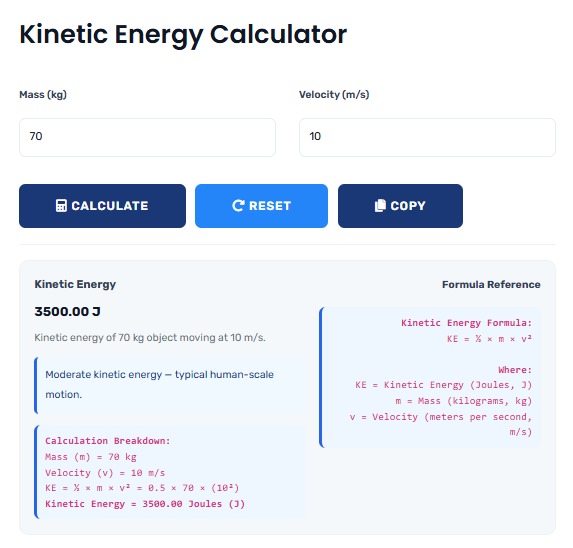
Understanding Kinetic Energy: The Energy of Motion
Kinetic energy is the energy possessed by an object due to its motion. It's a scalar quantity, meaning it has magnitude but no direction, and it depends on both the object's mass and the square of its velocity. This relationship makes kinetic energy calculations crucial for understanding everything from car crashes to sports physics.
The Fundamental Formula: KE = ½mv²
This simple yet powerful equation contains profound physics:
- KE (Kinetic Energy): Measured in Joules (J) - the energy of motion
- m (Mass): Measured in kilograms (kg) - the amount of matter
- v (Velocity): Measured in meters per second (m/s) - speed with direction
- The ½ factor: Comes from the integration of Newton's laws of motion
- v² (Velocity squared): This is why speed has such dramatic effects on energy
One Joule equals one kilogram-meter squared per second squared (1 J = 1 kg·m²/s²). For energy calculations in other contexts, try our Power Calculator.
Why Velocity Squared Matters
The squared velocity term (v²) in the kinetic energy formula has important implications:
- If you double an object's velocity, its kinetic energy increases by a factor of four (2² = 4)
- If you triple the velocity, the energy increases nine times (3² = 9)
- This explains why high-speed collisions are so much more destructive than low-speed ones
- It also shows why reducing speed is more effective than reducing weight for improving vehicle efficiency
Example: A car traveling at 60 mph has four times the kinetic energy of the same car traveling at 30 mph, not twice as much. This is crucial for understanding braking distances and collision forces.
Real-World Applications of Kinetic Energy
Case Study 1: Vehicle Safety Engineering
Scenario: Engineers designing crumple zones for a 1,500 kg car need to calculate the energy that must be absorbed in a 50 km/h (13.9 m/s) collision.
- Known values: m = 1500 kg, v = 13.9 m/s
- Calculation: KE = ½ × 1500 × (13.9)²
- Step-by-step: 13.9² = 193.21, ½ × 1500 = 750, 750 × 193.21 = 144,907.5 J
- Result: The crumple zone must absorb approximately 145,000 Joules of energy
This energy absorption requirement directly influences material selection and structural design. For related force calculations, use our Force Calculator.
Case Study 2: Sports Physics - Baseball Hit Analysis
Scenario: Analyzing a baseball (mass = 0.145 kg) hit with an exit velocity of 45 m/s (about 101 mph).
Calculation:
- KE = ½ × 0.145 × (45)²
- 45² = 2025
- ½ × 0.145 = 0.0725
- 0.0725 × 2025 = 146.8 Joules
Professional insight: This 147 Joules represents the energy transferred to the ball. Batters work to maximize this through technique and equipment. The ball then transfers this energy to whatever it hits—catcher's mitt, bat, or unfortunately, a player.
For calculating how this energy relates to work done, check our Work Calculator.
How to Use the Kinetic Energy Calculator
Step-by-Step Guide to Perfect Calculations
- Choose calculation type: Select whether you want to find Kinetic Energy, Mass, or Velocity
- Enter known values: Input two of the three variables with appropriate units
- Select units: Use dropdowns to choose from kg, g, lb, oz for mass and m/s, km/h, mph for velocity
- Calculate: Click calculate for instant results
- Review steps: Use "show steps" to understand the mathematical process
The calculator automatically handles unit conversions and formula rearrangements, ensuring accuracy even with complex inputs.
Calculation Modes Explained
| Mode | Input Required | Formula Used | Common Applications |
|---|---|---|---|
| Find Kinetic Energy | Mass + Velocity | KE = ½mv² | Collision analysis, energy requirements |
| Find Mass | Kinetic Energy + Velocity | m = 2KE/v² | Forensic analysis, object identification |
| Find Velocity | Kinetic Energy + Mass | v = √(2KE/m) | Speed estimation, performance analysis |
Comparative Energy Levels in Everyday Objects
| Object | Mass (kg) | Velocity (m/s) | Kinetic Energy (J) | Energy Comparison |
|---|---|---|---|---|
| Walking person | 70 | 1.4 | 68.6 | ≈ lifting 7 kg 1 meter |
| Cyclist | 80 (person + bike) | 6 | 1,440 | ≈ boiling 5 ml of water |
| Car (city speed) | 1,500 | 13.9 (50 km/h) | 144,908 | ≈ 40-watt bulb for 1 hour |
| Baseball (fast pitch) | 0.145 | 45 | 146.8 | ≈ dropping 15 kg 1 meter |
| Bullet (9mm) | 0.0075 | 360 | 486 | ≈ lifting 50 kg 1 meter |
Important Insight: Notice how a small, fast-moving bullet (486 J) has more kinetic energy than a walking person (68.6 J), demonstrating the dramatic effect of velocity. This explains why bullets cause such damage despite their small mass.
Educational Applications and Learning Benefits
For Students: Mastering Physics Concepts
This calculator serves as an excellent learning tool:
- Homework verification: Check your manual calculations instantly
- Concept reinforcement: See how changing variables affects results
- Unit conversion practice: Understand relationships between different measurement systems
- Real-world connections: Apply formulas to practical situations
- Exam preparation: Practice with varied problems and scenarios
Pair this with our Percentage Calculator for comprehensive math and science learning tools.
For Teachers: Classroom Integration
Educators can use this tool to:
- Create customized problem sets with instant answer checking
- Demonstrate concepts with live calculations during lessons
- Generate discussion about real-world physics applications
- Provide additional support for students struggling with algebra
- Create engaging demonstrations of energy conservation principles
The step-by-step feature is particularly valuable for showing the mathematical process behind the results.
Advanced Topics and Limitations
When KE = ½mv² Isn't Enough
While the classical kinetic energy formula works perfectly for everyday objects, there are important limitations:
Relativistic Effects: At speeds approaching light speed (300,000 km/s), Einstein's relativity requires a different formula: KE = (γ - 1)mc², where γ = 1/√(1 - v²/c²). Our calculator focuses on classical (non-relativistic) physics suitable for speeds under about 10% of light speed.
Rotational Kinetic Energy: Spinning objects require a different calculation: KE_rot = ½Iω², where I is moment of inertia and ω is angular velocity. For comprehensive physics analysis, explore our Physics Calculators collection.
Potential Energy Conversion: Remember that kinetic energy often converts from potential energy (like falling objects). The total mechanical energy (KE + PE) remains constant in conservative systems.
Energy Conservation in Real Systems
In practical situations, kinetic energy rarely exists in isolation. Consider a roller coaster:
- At the top: Maximum potential energy (PE = mgh), minimum kinetic energy
- Halfway down: Some PE converted to KE
- At the bottom: Minimum PE, maximum KE
- Total mechanical energy (PE + KE) remains approximately constant (ignoring friction)
This energy transformation is why the roller coaster speeds up as it descends and slows as it climbs. For energy-related calculations in chemical systems, see our Chemistry Calculators.
Professional and Industrial Applications
Engineering Design: Safety Systems
Kinetic energy calculations are crucial for:
- Automotive safety: Designing airbags, seatbelts, and crumple zones
- Industrial machinery: Calculating stopping distances and safety barriers
- Aerospace: Determining runway lengths and landing gear strength
- Sports equipment: Designing protective gear that can absorb impact energy
- Construction: Ensuring safety during demolition and material handling
Each application requires precise energy calculations to ensure safety and effectiveness. For construction-specific calculations, try our Concrete Volume Calculator.
Tips for Accurate Kinetic Energy Calculations
Best Practices for Reliable Results:
- Use consistent units: Convert all measurements to SI units (kg, m/s) or let the calculator handle conversions
- Consider direction: Remember kinetic energy is scalar, but velocity is vectorial
- Account for all mass: Include everything that's moving together
- Use precise measurements: Small errors in velocity create large errors in energy due to v²
- Check reasonable ranges: Verify that results make sense in context
- Consider energy transformations: Remember KE often comes from or converts to other energy forms
For mathematical calculations that complement physics work, use our Average Calculator for statistical analysis.
Final Thought: Kinetic energy calculations bridge theoretical physics and practical reality. From understanding why speeding is dangerous to designing safer vehicles and analyzing sports performance, this fundamental concept has far-reaching applications. Our calculator makes these calculations accessible to everyone, promoting scientific understanding and practical problem-solving skills. Remember that energy is never created or destroyed—only transformed. Understanding kinetic energy helps us track one important form of that ever-changing energy.
Quick Reference: Common Conversions and Equivalents
Velocity Conversions:
- 1 m/s = 3.6 km/h = 2.237 mph
- 1 km/h = 0.2778 m/s = 0.6214 mph
- 1 mph = 0.447 m/s = 1.609 km/h
Mass Conversions:
- 1 kg = 1000 g = 2.205 lb
- 1 lb = 0.4536 kg = 453.6 g
- 1 g = 0.001 kg = 0.002205 lb
Energy Equivalents:
- 1 Joule = 0.7376 foot-pounds
- 1 calorie = 4.184 Joules
- 1 kWh = 3.6 × 10⁶ Joules
- Food calorie (Cal) = 4184 Joules
Remember: Always double-check units before calculation, and use our calculator's conversion features for accuracy!
Frequently Asked Questions
This calculator specifically handles translational kinetic energy (straight-line motion). For rotating objects, you need to calculate rotational kinetic energy using KE_rot = ½Iω², where I is moment of inertia and ω is angular velocity. For basic rotational calculations, you might find our general Physics Calculators helpful, though we don't currently have a dedicated rotational energy calculator.
The ½ factor comes from the work-energy theorem and integration of Newton's second law. When you calculate the work needed to accelerate an object from rest to velocity v, integrating force over distance naturally produces the ½ factor. It's not arbitrary—it's mathematically derived from fundamental physics principles. This factor ensures that kinetic energy calculations correctly represent the energy required to achieve motion.
Air resistance converts kinetic energy into heat and sound, reducing the object's speed and therefore its kinetic energy over time. Our calculator gives you the instantaneous kinetic energy based on current mass and velocity. To account for air resistance in motion predictions, you'd need additional aerodynamic calculations. For real-world applications, the calculated kinetic energy represents the maximum energy available before air resistance effects.
For everyday speeds, yes—electrons in circuits move relatively slowly. However, for electrons in particle accelerators or atomic orbitals approaching significant fractions of light speed, you'd need relativistic calculations. Our calculator is accurate for speeds up to about 30,000 km/s (10% of light speed). For most practical applications including basic physics education, it works perfectly.
We use standard conversion factors with sufficient precision for educational and most professional applications. For example, we use 0.45359237 kg per pound for mass conversions and 0.44704 m/s per mph for velocity conversions. These provide accuracy to within 0.001% for most calculations, which is more than sufficient for physics problems, engineering estimates, and educational purposes.
Kinetic energy (½mv²) is a scalar quantity representing energy of motion, while momentum (mv) is a vector quantity representing quantity of motion. Energy is related to work and capacity to do work, while momentum is related to force and time. Both are conserved in different types of collisions: kinetic energy in elastic collisions, momentum in all collisions. Understanding both concepts gives a complete picture of motion physics.
