Momentum Calculator: Understanding Motion in Physics
Momentum is one of the most fundamental concepts in physics, describing the quantity of motion an object possesses. Whether you're a student learning Newton's laws, an engineer designing safety systems, or a physics enthusiast exploring how things move, understanding momentum is essential. Our Momentum Calculator makes these calculations quick, accurate, and accessible to everyone.
This powerful tool helps you compute momentum using the simple formula p = m × v (momentum = mass × velocity). But it goes beyond basic calculations—it helps you understand what those numbers mean in real-world contexts, from car crashes to sports impacts to planetary motion.
Why momentum calculations matter:
- Physics Education: Essential for understanding Newton's laws of motion
- Engineering Design: Critical for vehicle safety, machinery, and structural analysis
- Sports Science: Analyzing impacts in football, baseball, and other contact sports
- Everyday Understanding: Explaining why heavy objects are hard to stop
- Scientific Research: Studying collisions from subatomic particles to galaxies
For more physics tools, explore our comprehensive collection of Physics Calculators covering force, energy, acceleration, and more.
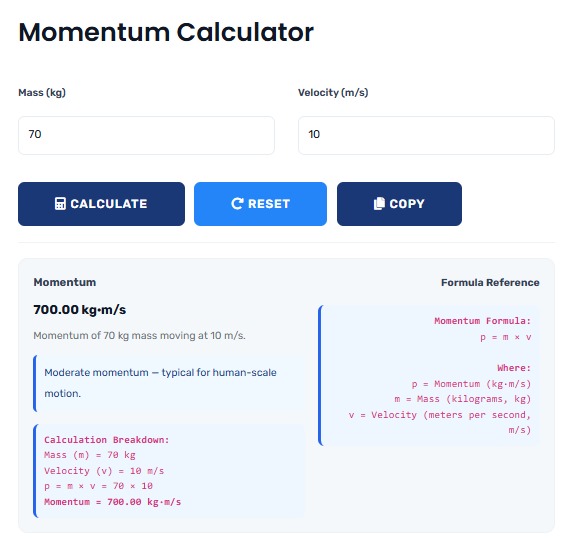
The Simple Yet Powerful Momentum Formula
Momentum (p) = Mass (m) × Velocity (v)
Where:
- p = momentum (kg·m/s or N·s)
- m = mass (kilograms)
- v = velocity (meters per second)
This deceptively simple formula explains why a slow-moving truck has more momentum than a fast-moving bicycle, and why stopping heavy objects requires more force over more time.
Real-World Momentum Scenarios
Car Safety: Why Momentum Matters in Crashes
Understanding momentum helps explain vehicle safety principles. Consider two vehicles in a collision:
Scenario Analysis:
- Sedan: Mass = 1500 kg, Speed = 60 km/h (16.67 m/s)
- Momentum = 1500 × 16.67 = 25,005 kg·m/s
- SUV: Mass = 2500 kg, Speed = 60 km/h (16.67 m/s)
- Momentum = 2500 × 16.67 = 41,675 kg·m/s
- Key insight: The SUV has 67% more momentum at the same speed
- Safety implication: More momentum means more energy to dissipate in a crash
- Design consideration: Heavier vehicles need stronger crumple zones
This calculation explains why vehicle weight significantly impacts crash dynamics and safety design requirements.
For force calculations related to impacts, use our Force Calculator.
Sports Physics: Football Tackle Analysis
Coaches and sports scientists use momentum calculations to analyze impacts and improve techniques:
Football Impact Analysis:
- Linebacker: Mass = 110 kg (242 lbs), Speed = 7 m/s (15.7 mph)
- Momentum = 110 × 7 = 770 kg·m/s
- Running back: Mass = 95 kg (209 lbs), Speed = 8 m/s (17.9 mph)
- Momentum = 95 × 8 = 760 kg·m/s
- Nearly equal momentum: 770 vs 760 kg·m/s
- Result: Stalemate collision with energy distributed
- Coaching insight: Slight advantages in mass or speed change outcomes
- Safety consideration: Higher momentum means higher impact force
These calculations help coaches understand why certain matchups favor specific players and how to train for optimal performance while minimizing injury risk.
For energy calculations in sports, try our Kinetic Energy Calculator.
Everyday Physics: Shopping Cart Momentum
Even simple everyday situations demonstrate momentum principles:
Shopping Cart Scenario:
- Empty cart: Mass = 20 kg, Walking speed = 1.5 m/s
- Momentum = 20 × 1.5 = 30 kg·m/s
- Loaded cart: Mass = 60 kg (with groceries), Same speed = 1.5 m/s
- Momentum = 60 × 1.5 = 90 kg·m/s
- Triple the momentum with same speed but triple mass
- Stopping distance: Loaded cart requires 3× more force to stop
- Real experience: Why loaded carts feel harder to stop or turn
This simple example shows how mass dramatically affects momentum even at low speeds, explaining everyday experiences through physics principles.
Conservation of Momentum: The Fundamental Principle
Law of Conservation of Momentum:
In an isolated system (no external forces), total momentum remains constant. This principle explains countless physical phenomena:
- Collisions: Car crashes, billiard balls, particle impacts
- Explosions: Fireworks, spacecraft separation, bursting balloons
- Recoil: Guns firing, cannons recoiling, push-off in sports
- Rocket Motion: Propulsion through momentum exchange
- Sports: Pool shots, baseball hits, football tackles
This conservation law is as fundamental as conservation of energy and helps predict outcomes in complex interactions.
Types of Collisions and Momentum Transfer
| Collision Type | Momentum Conservation | Energy Conservation | Real-World Examples | Mathematical Treatment |
|---|---|---|---|---|
| Elastic Collision | Conserved | Conserved | Billiard balls, superball bounces | Both momentum and energy equations |
| Inelastic Collision | Conserved | Not conserved | Car crashes, clay impacts | Momentum equations only |
| Perfectly Inelastic | Conserved | Maximum loss | Bullet embedding in wood | Objects stick together after impact |
| Explosion | Conserved (total = 0) | Not conserved | Fireworks, bursting balloons | Momentum sums to zero |
Momentum in Different Physics Contexts
1. Linear Momentum (Classical Physics)
The most familiar form: p = m × v. Applies to everyday objects at everyday speeds. Our calculator primarily handles linear momentum calculations.
2. Angular Momentum (Rotational Motion)
L = I × ω (angular momentum = moment of inertia × angular velocity). Explains spinning objects, gyroscopes, and planetary rotation.
3. Relativistic Momentum (High Speeds)
p = γ × m × v, where γ = 1/√(1-v²/c²). Necessary for objects approaching light speed. Significant in particle physics and astrophysics.
4. Quantum Mechanical Momentum
Momentum as a quantum operator. Fundamental in quantum mechanics with uncertainty principle implications: Δx × Δp ≥ ħ/2.
Practical Applications of Momentum Calculations
| Field | Application | Importance | Example Calculation | Tool Used |
|---|---|---|---|---|
| Automotive Engineering | Crash testing, safety design | Critical for passenger safety | Vehicle momentum at impact speeds | Momentum & Force Calculators |
| Aerospace | Spacecraft docking, orbital maneuvers | Precision navigation required | Momentum exchange in thrusters | Vector Momentum Tools |
| Sports Science | Impact analysis, equipment design | Performance optimization, injury prevention | Player momentum during tackles | Momentum & Energy Calculators |
| Construction | Demolition, pile driving | Efficiency and safety | Wrecking ball momentum | Basic Momentum Calculator |
| Education | Physics instruction, lab experiments | Fundamental concept mastery | Colliding carts on tracks | Interactive Momentum Tools |
Step-by-Step Guide to Using Our Momentum Calculator
5 Simple Steps to Calculate Momentum:
- Enter Mass: Input object's mass in kilograms (or select other units)
- Enter Velocity: Input speed in meters per second (direction matters for vectors)
- Choose Units: Select preferred units for input and output
- Calculate: Click calculate button for instant results
- Analyze: Review momentum value with contextual explanations
The calculator automatically handles unit conversions and provides educational insights about your results. For vector calculations, you can input velocity components separately.
Common Momentum Calculation Examples
Example 1: Baseball Pitch
Scenario: Fastball pitch at 95 mph (42.5 m/s), baseball mass = 0.145 kg
Calculation:
p = m × v = 0.145 kg × 42.5 m/s = 6.16 kg·m/s
Interpretation: The baseball carries 6.16 units of momentum toward home plate.
Example 2: Freight Train
Scenario: Train mass = 5,000,000 kg, Speed = 25 m/s (56 mph)
Calculation:
p = 5,000,000 kg × 25 m/s = 125,000,000 kg·m/s
Interpretation: Enormous momentum explains why trains need miles to stop.
For stopping distance calculations, use our Acceleration Calculator.
Example 3: Sprinting Athlete
Scenario: Sprinter mass = 70 kg, Speed = 10 m/s (22.4 mph)
Calculation:
p = 70 kg × 10 m/s = 700 kg·m/s
Interpretation: High momentum helps understand force in starting blocks and potential impact force.
Momentum vs. Kinetic Energy: Understanding the Difference
Key Differences:
- Momentum (p = m×v): Vector quantity, conserved in all collisions, measures "quantity of motion"
- Kinetic Energy (KE = ½mv²): Scalar quantity, not conserved in inelastic collisions, measures "energy of motion"
- Dependence on velocity: Momentum linear (v¹), Kinetic Energy squared (v²)
- Stopping force: Momentum relates to force over time (impulse), Energy relates to force over distance (work)
- Practical implication: Doubling speed doubles momentum but quadruples kinetic energy
Both concepts are essential but answer different physics questions. Our calculator helps you explore both relationships.
Impulse-Momentum Theorem
Impulse = Change in Momentum = Force × Time
J = Δp = F × Δt
This theorem connects force, time, and momentum change, explaining:
- Why airbags increase collision time to reduce force
- Why follow-through increases in sports
- Why crumple zones work in vehicles
- Why catching a ball involves giving with the hands
The longer the time over which momentum changes, the smaller the average force required.
Historical Development of Momentum Concepts
Timeline of Momentum Understanding:
- 14th Century: Jean Buridan's "impetus" theory - early momentum concept
- 17th Century: Galileo's studies of motion and inertia
- 1687: Newton's Principia - formal definition p = m×v
- 18th Century: Conservation principles developed by Leibniz and others
- 19th Century: Vector nature established, angular momentum developed
- 20th Century: Relativistic and quantum momentum formulations
- 21st Century: Computational tools make calculations accessible
This historical progression shows how a simple concept became fundamental to all physics.
Advanced Topics: Beyond Basic Momentum
1. Vector Nature of Momentum
Momentum has direction: p = m × v (where v is a vector). This explains why head-on collisions are more severe than rear-end collisions at same speeds.
2. Center of Mass Motion
Total momentum of system equals total mass × velocity of center of mass. System center of mass moves as if all mass were concentrated there with all external forces applied there.
3. Rocket Equation
Δv = v_exhaust × ln(m_initial/m_final). Derives from momentum conservation as rocket ejects mass backward to move forward.
4. Four-Momentum in Relativity
Combines energy and momentum into single four-vector conserved in all reference frames. Essential for particle physics.
Teaching and Learning Resources
Classroom Activities Using Momentum Calculations
Activity 1: Collision Analysis Lab
Use the calculator to predict outcomes before physical experiments with carts or
balls.
Activity 2: Sports Physics Project
Calculate momenta of different athletes or equipment and relate to performance.
Activity 3: Vehicle Safety Design
Explore how mass and speed affect crash forces and safety requirements.
Activity 4: Historical Physics
Replicate calculations from Newton's time with modern tools.
For comprehensive science education tools, explore our Science Calculators collection.
Key Insight: Momentum is more than just a physics formula—it's a fundamental principle that explains motion in our universe. From the smallest particles to the largest galaxies, momentum conservation governs interactions. Understanding momentum helps us design safer vehicles, play better sports, and comprehend the physical world more deeply. Our calculator makes these insights accessible to everyone, from students to professionals to curious minds.
Quick Reference: Common Momentum Values
Everyday Objects:
- Walking person (70 kg at 1.4 m/s): 98 kg·m/s
- Cyclist (80 kg at 6 m/s): 480 kg·m/s
- Car (1500 kg at 25 m/s): 37,500 kg·m/s
- Baseball pitch (0.145 kg at 42 m/s): 6.1 kg·m/s
Sports Impacts:
- Football tackle: 700-900 kg·m/s
- Boxing punch: 15-25 kg·m/s
- Golf drive: 3-5 kg·m/s (ball only)
- Sprinting start: 500-800 kg·m/s
Vehicles:
- Train locomotive: 10+ million kg·m/s
- Airplane at takeoff: 1-2 million kg·m/s
- Ship: 100+ million kg·m/s
Remember: These are approximate values—use our calculator for precise calculations!
Frequently Asked Questions
In the SI system, momentum is measured in kilogram-meters per second (kg·m/s). Sometimes Newton-seconds (N·s) are used, which are equivalent: 1 kg·m/s = 1 N·s. Our calculator supports multiple unit systems and conversions between them.
Momentum has both magnitude and direction because velocity is a vector. Direction matters—a car moving east at 60 km/h has different momentum than one moving west at 60 km/h. This vector nature explains why head-on collisions are more severe than rear-end collisions at the same speed difference.
Force equals the rate of change of momentum (Newton's second law: F = Δp/Δt). This means force applied over time changes momentum. The impulse-momentum theorem (FΔt = Δp) connects force, time, and momentum change, explaining why airbags and crumple zones reduce injury by increasing collision time.
Inertia is an object's resistance to changes in motion (related to mass alone). Momentum is the quantity of motion an object has (mass × velocity). Inertia is a property; momentum is a measure. A stationary object has inertia but zero momentum.
Yes, momentum can be negative because it's a vector quantity. Negative momentum simply means motion in the opposite direction from whatever you've defined as positive. For example, if east is positive, a car moving west has negative momentum.
In an explosion, the total momentum before is zero (object at rest). After explosion, fragments fly in all directions, but their vector sum equals zero. For every piece with momentum in one direction, there's another with equal momentum in the opposite direction. Our calculator can help verify these conservation principles.
Momentum is conserved in ALL collisions (elastic and inelastic). What's not conserved in inelastic collisions is kinetic energy. Some energy converts to heat, sound, or deformation, but the total momentum before equals total momentum after. This makes momentum calculations particularly useful for analyzing crashes and impacts.
