Potential Energy Calculator: Your Complete Guide to Energy Calculations
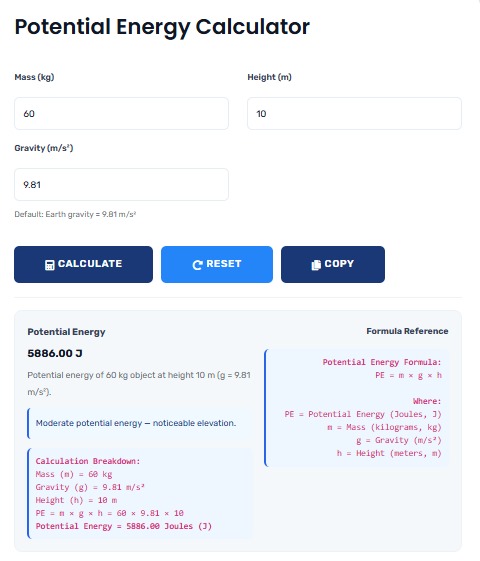
Understanding potential energy is fundamental to physics, engineering, and countless real-world applications. Our Potential Energy Calculator simplifies complex calculations, making it easy for students, teachers, and professionals to determine stored energy in various systems.
Whether you're studying for exams, designing mechanical systems, or simply curious about the physics behind everyday phenomena, this powerful tool provides accurate results instantly. As part of our comprehensive science calculators collection, it helps you solve gravitational potential energy problems without manual calculations.
Why this calculator is essential for physics work:
- Time-saving: Instant calculations versus minutes of manual work
- Accuracy: Eliminates common calculation errors
- Educational: Helps understand energy concepts visually
- Versatile: Solves for any variable in the energy equation
- Professional: Useful for engineering and design applications
From homework verification to professional design validation, our calculator delivers reliable results with precision and ease. For more physics tools, explore our full collection of physics calculators.
Understanding Potential Energy: The Basics
What is Potential Energy?
Potential energy is stored energy that an object possesses due to its position, condition, or state. Think of it as "energy waiting to happen" - like a book on a shelf that could fall, or a drawn bow that could release an arrow.
This energy isn't actively doing work but has the potential to be converted into kinetic energy (energy of motion) when released. Understanding this concept is crucial for everything from roller coaster design to renewable energy systems.
Types of Potential Energy Explained
| Type | Description | Everyday Example | Formula |
|---|---|---|---|
| Gravitational | Energy due to height in gravity field | Water at top of waterfall | PE = m × g × h |
| Elastic | Energy stored in stretched/compressed objects | Stretched rubber band | PE = ½ × k × x² |
| Chemical | Energy in molecular bonds | Battery, food | Varies by reaction |
| Nuclear | Energy in atomic nuclei | Nuclear power plants | E = mc² |
| Electrical | Energy of charged particles | Charged capacitor | PE = q × V |
Our calculator focuses on gravitational potential energy, the most common type in introductory physics. For biological energy calculations, check our biology calculators.
The Gravitational Potential Energy Formula
PE = m × g × h
Where:
- PE = Potential Energy (Joules, J)
- m = Mass (kilograms, kg)
- g = Gravitational acceleration (9.81 m/s² on Earth)
- h = Height above reference (meters, m)
How Our Potential Energy Calculator Works
Step-by-Step Calculation Process
-
Input Validation:
- Checks all entered values for consistency
- Validates unit compatibility
- Prevents calculation errors from invalid data
-
Unit Conversion:
- Converts all inputs to standard units automatically
- Handles metric and imperial systems
- Maintains precision through conversions
-
Mathematical Calculation:
- Applies the PE = m × g × h formula
- Uses double-precision arithmetic for accuracy
- Calculates intermediate values if needed
-
Result Presentation:
- Displays answer in multiple energy units
- Shows appropriate significant figures
- Provides clear, easy-to-understand results
Real-World Applications and Examples
Example 1: Textbook on a Shelf
Scenario: A 2 kg physics textbook placed on a 1.5 meter high shelf.
Calculation: PE = 2 kg × 9.81 m/s² × 1.5 m = 29.43 Joules
Interpretation: This energy would be converted to kinetic energy if the book falls, potentially causing damage or injury depending on what it hits.
Practical insight: This is why heavy objects on high shelves can be dangerous - they store significant energy.
Example 2: Water Behind a Dam
Scenario: 1000 kg of water held 50 meters above a turbine in a hydroelectric dam.
Calculation: PE = 1000 kg × 9.81 m/s² × 50 m = 490,500 Joules (490.5 kJ)
Interpretation: This massive energy storage is why hydroelectric power is so effective - water weight and height combine to store enormous energy.
Scale perspective: A typical hydroelectric plant might have millions of kilograms of water at similar heights, storing gigajoules of energy.
For energy conversion calculations, try our Kinetic Energy Calculator.
Example 3: Roller Coaster Design
Scenario: Designing the first hill of a roller coaster carrying a 500 kg car to 30 meters height.
Calculation: PE = 500 kg × 9.81 m/s² × 30 m = 147,150 Joules (147.15 kJ)
Interpretation: This stored energy determines the maximum speed the coaster can achieve as it descends. The conversion from potential to kinetic energy creates the thrilling ride experience.
Design consideration: Engineers must calculate this precisely to ensure safe speeds and forces on passengers.
Educational Benefits for Students
Why Students Love Our Calculator:
- Homework Verification: Check answers instantly
- Concept Reinforcement: See how changing variables affects energy
- Exam Preparation: Practice with various scenarios
- Visual Learning: Understand abstract concepts through numbers
- Error Identification: Spot calculation mistakes quickly
- Time Management: Focus on understanding, not arithmetic
For additional math support in physics calculations, use our Percentage Calculator for related problems.
Professional Applications
| Profession | Application | Importance | Typical Calculations |
|---|---|---|---|
| Civil Engineering | Dam design, structural loads | Safety, efficiency | Water energy storage, load impacts |
| Mechanical Engineering | Machine design, energy systems | Performance, safety | Counterweights, elevator systems |
| Architecture | Building design, material handling | Structural integrity | Material lifts, crane operations |
| Physics Research | Experimental setup, theory verification | Accuracy, validation | Energy measurements, predictions |
| Education | Curriculum development, demonstrations | Effective teaching | Example problems, lab activities |
Advanced Features of Our Calculator
Beyond Basic Calculations:
- Variable Solving: Calculate mass, height, or gravity if energy is known
- Multiple Units: Input and output in various unit systems
- Planetary Gravity: Adjust for Moon, Mars, or other celestial bodies
- Precision Control: Results with appropriate significant figures
- Error Checking: Identifies impossible or unrealistic inputs
- History Feature: Compare multiple calculations
Common Calculation Scenarios
Determining Required Height
Problem: You need 1000 Joules from a 10 kg weight in a gravity-powered clock. How high must it be lifted?
Solution using calculator: h = PE ÷ (m × g) = 1000 ÷ (10 × 9.81) = 10.19 meters
Practical application: This calculation helps design systems where potential energy drives mechanisms.
Comparing Planetary Energy
Problem: How much energy does a 5 kg object store at 2 meters height on Earth vs. Mars?
Earth calculation: PE = 5 × 9.81 × 2 = 98.1 Joules
Mars calculation: PE = 5 × 3.71 × 2 = 37.1 Joules (Mars gravity = 3.71 m/s²)
Insight: The same object stores 2.64 times more energy on Earth due to stronger gravity.
Measurement Units and Conversions
| Variable | Supported Units | Conversion Factors | Common Uses |
|---|---|---|---|
| Mass | kg, g, lb, oz, ton | 1 kg = 2.20462 lb | Physics (kg), Engineering (lb) |
| Height | m, cm, mm, ft, in | 1 m = 3.28084 ft | Science (m), Construction (ft) |
| Gravity | m/s², ft/s² | 1 m/s² = 3.28084 ft/s² | International (m/s²), US (ft/s²) |
| Energy | J, kJ, ft-lb, cal | 1 J = 0.737562 ft-lb | Science (J), Engineering (ft-lb) |
Technical Implementation and Accuracy
Ensuring Mathematical Precision:
- Double Precision Arithmetic: Minimizes rounding errors
- Validated Constants: Precise gravitational and conversion values
- Error Checking: Identifies impossible scenarios (negative mass, etc.)
- Unit Consistency: Automatic normalization to prevent unit errors
- Significant Figures: Appropriate precision based on input accuracy
For force calculations related to potential energy, try our Force Calculator.
Advantages Over Manual Calculation
Why Use a Calculator Instead of Manual Methods?
Common Manual Calculation Errors:
- Unit Conversion Mistakes: Forgetting to convert cm to m or lb to kg
- Decimal Placement Errors: Misplacing decimal points in calculations
- Formula Misapplication: Using wrong formula or rearranging incorrectly
- Arithmetic Mistakes: Simple addition, multiplication, or division errors
- Significant Figure Issues: Incorrect precision in final answers
Our calculator eliminates all these error sources while providing instant results.
Integration with Physics Curriculum
Alignment with Educational Standards: Our potential energy calculator supports learning objectives across physics curricula worldwide. From introductory mechanics courses to advanced physics programs, it helps students master fundamental energy concepts while developing problem-solving skills. The tool's versatility makes it suitable for different teaching approaches, from traditional instruction to inquiry-based learning and flipped classroom models.
Getting the Most from Your Calculations
Tips for Effective Use:
- Always double-check inputs: Even with calculator accuracy, garbage in = garbage out
- Understand the context: Know what your numbers represent in real-world terms
- Use appropriate precision: Match your input precision to your measurement accuracy
- Check reasonableness: Does the answer make physical sense?
- Document your work: Note inputs, assumptions, and results for future reference
- Explore variations: Try "what if" scenarios to deepen understanding
Energy Conservation and Conversion
The Energy Transformation Principle
Fundamental Concept: Potential energy often converts to kinetic energy and vice versa. A falling object loses potential energy but gains kinetic energy. The total mechanical energy (PE + KE) remains constant in ideal systems without friction or air resistance.
Calculator Application: Use our potential energy calculator with a kinetic energy calculator to explore energy conservation in falling objects, pendulum swings, or roller coaster designs.
Real-World Limitation: In practical systems, some energy always converts to heat due to friction, so total mechanical energy decreases over time.
Conclusion: Mastering Energy Calculations
Our Potential Energy Calculator is more than just a computational tool—it's an educational resource, a professional aid, and a gateway to understanding fundamental physics principles. By simplifying complex calculations while maintaining mathematical rigor, it supports learning, verification, and application across diverse contexts.
Whether you're a student tackling homework problems, a teacher preparing lessons, or a professional validating designs, this tool provides reliable, accurate results that save time and prevent errors. The ability to solve for any variable in the energy equation makes it exceptionally versatile for various problem types.
As part of our comprehensive calculator collection, it exemplifies how digital tools can enhance understanding and efficiency in scientific work. By focusing on concepts rather than calculation mechanics, users develop deeper insight into the physical world and its energy relationships.
Remember: While calculators provide numerical answers, true understanding comes from knowing what those numbers mean. Use this tool not just to get answers, but to explore relationships, test hypotheses, and build intuition about energy in our universe.
Frequently Asked Questions
Potential energy is stored energy due to position or condition (like a raised weight), while kinetic energy is energy of motion (like a falling weight). They often convert between each other - as potential energy decreases during a fall, kinetic energy increases.
This calculator specifically handles gravitational potential energy (PE = m × g × h). For elastic potential energy (PE = ½ × k × x² for springs), you would need different calculations. However, the conceptual understanding of stored energy applies to both types.
9.81 m/s² is the standard value for gravitational acceleration at Earth's surface, accurate for most calculations. Actual gravity varies slightly with location (9.78 at equator to 9.83 at poles), but 9.81 is precise enough for educational and many practical purposes. The calculator allows adjustment if you need different values.
The calculator handles mixed units automatically. Just select "feet" for height and "kilograms" for mass - it will convert internally to consistent units before calculating. This eliminates common unit conversion errors that occur in manual calculations.
Different fields use different energy units. Joules are standard in physics, foot-pounds in some engineering fields, calories in chemistry and nutrition. Showing multiple units makes the results useful across disciplines and helps with unit familiarity and conversion practice.
Yes! Simply adjust the gravity value. For the Moon, use 1.62 m/s²; for Mars, 3.71 m/s²; for Jupiter, 24.79 m/s². The same formula applies - only the gravity value changes. This makes the calculator useful for physics problems involving different celestial bodies.
