Modulo Calculator: Mastering Remainder Operations for Programming, Math & Security
The modulo operation—finding the remainder after division—is one of the most powerful yet misunderstood mathematical operations. From programming loops and game development to cryptography and cybersecurity, modulo calculations are everywhere in our digital world. Understanding and mastering modulo operations can help you write better code, solve complex problems, and even secure digital systems.
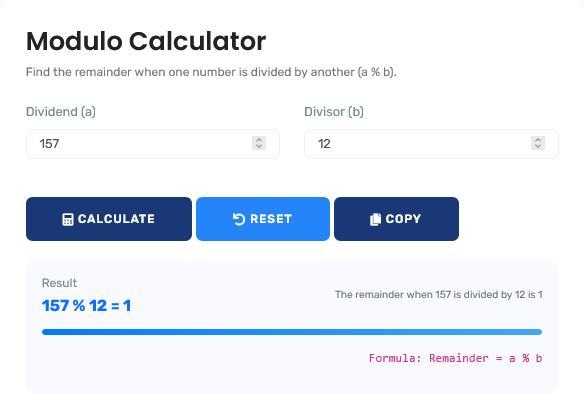
Whether you're a student learning programming basics, a developer debugging circular logic, or someone curious about how digital security works, this modulo calculator provides instant, accurate results with clear explanations. It handles everything from simple division remainders to complex modular arithmetic used in encryption algorithms.
Why modulo operations matter in practical applications:
- Programming: Array indexing, circular buffers, and loop control
- Game Development: Wrapping screen positions and animation cycles
- Cybersecurity: Encryption algorithms and hash functions
- Mathematics: Number theory, divisibility rules, and pattern analysis
- Everyday Computing: Time calculations, calendar functions, and data validation
Our modulo calculator makes these calculations effortless. For related mathematical operations, check our Division Calculator for foundational division concepts.
Understanding Modulo: The Clock Analogy
The easiest way to understand modulo is to think about a clock. On a 12-hour clock, what time is it 15 hours after 8 o'clock? You don't say "23 o'clock"—you wrap around: 8 + 15 = 23, and 23 mod 12 = 11. So it's 11 o'clock.
Clock Arithmetic Examples
- 8 + 15 = 23 → 23 mod 12 = 11 (11 o'clock)
- 9 + 8 = 17 → 17 mod 12 = 5 (5 o'clock)
- 11 + 25 = 36 → 36 mod 12 = 0 (12 o'clock)
- What about negative? 2 hours before 3 o'clock: 3 - 2 = 1, but 2 hours before 1 o'clock: (1 - 2) mod 12 = -1 mod 12 = 11
This "wrap-around" behavior is exactly what modulo provides. It's not just for clocks—it's for any situation where things repeat or cycle. For converting time units, use our Hours to Minutes Converter.
Real-World Modulo Applications
Programming: Array Indexing and Circular Buffers
Imagine you have an array of 7 days: ["Mon", "Tue", "Wed", "Thu", "Fri", "Sat", "Sun"]. You want to find what day it will be 100 days from Monday.
Without modulo (wrong): Monday + 100 = index 100 → Array out of bounds!
With modulo (correct): (0 + 100) mod 7 = 100 mod 7 = 2 → Wednesday
Circular buffer implementation:
// Simple circular buffer example
int buffer[10];
int write_index = 0;

void add_to_buffer(int value) {
    buffer[write_index] = value;
    write_index = (write_index + 1) % 10;  // Wrap around after 10 elements
}
The modulo operation ensures the index always stays within bounds, creating an infinite loop through the array. For more programming-related calculations, try our MB to GB Converter.
Game Development: Screen Wrapping
In a space shooter game, when a spaceship flies off the right edge of a 1000-pixel wide screen, it should reappear on the left edge.
Problem: Ship at x-position 980, moving 50 pixels right
Naive solution: 980 + 50 = 1030 → off screen!
Modulo solution: (980 + 50) mod 1000 = 1030 mod 1000 = 30
Result: Ship appears at position 30 on left side
2D wrapping formula:
- New x = (old_x + move_x) mod screen_width
- New y = (old_y + move_y) mod screen_height
Cybersecurity: Even and Odd Detection (Parity)
One of the simplest yet most useful applications: determining if a number is even or odd.
Rule: n mod 2 = 0 → even, n mod 2 = 1 → odd
Applications:
- Memory alignment: Even addresses for certain data types
- Error detection: Parity bits in data transmission
- Alternating patterns: Striped backgrounds, checkerboards
- Load balancing: Alternate between servers
Code example:
// Check if number is even
bool is_even(int n) {
    return (n % 2) == 0;  // Modulo 2 operation
}

// Alternate between two options
for (int i = 0; i < 10; i++) {
    if (i % 2 == 0) {
        // Even iteration
    } else {
        // Odd iteration
    }
}
For percentage calculations in data analysis, use our Percentage Calculator.
Finance: Credit Card Validation (Luhn Algorithm)
Your credit card number isn't random—it contains a check digit calculated using modulo 10.
Luhn Algorithm steps:
- Starting from the rightmost digit (check digit), double every second digit
- If doubling results in a number greater than 9, add the digits together
- Sum all digits
- Valid if total mod 10 = 0
Example: Card number 4556 7375 8689 9855
- Process digits...
- Sum = 70
- 70 mod 10 = 0 → Valid card number
This simple modulo check catches most typing errors. Every time you make an online purchase, this calculation happens..
Modulo Formulas and Mathematical Properties
Essential Modulo Mathematics:
1. Basic Definition:
a mod n = remainder when a divided by n
Example: 17 mod 5 = 2 because 17 ÷ 5 = 3 remainder 2
2. Modular Arithmetic Rules:
(a + b) mod n = [(a mod n) + (b mod n)] mod n
(a × b) mod n = [(a mod n) × (b mod n)] mod n
This allows working with smaller numbers
3. Negative Numbers:
Different conventions exist:
• Mathematical: -7 mod 5 = 3 (always non-negative)
• Programming: -7 % 5 = -2 in some languages
4. Modular Exponentiation:
a^b mod n calculated efficiently without huge intermediates
Critical for cryptography
Common Modulo Operations Table
| Operation | Example | Result | Explanation | Practical Use |
|---|---|---|---|---|
| Basic Modulo | 17 mod 5 | 2 | 17 ÷ 5 = 3 remainder 2 | Division remainders |
| Even/Odd Check | 42 mod 2 | 0 | Even numbers mod 2 = 0 | Parity checking |
| Time Calculation | 28 mod 12 | 4 | 4 hours after 12 cycles | Clock arithmetic |
| Array Index | 47 mod 10 | 7 | Index 7 in array of size 10 | Circular buffers |
| Day of Week | 365 mod 7 | 1 | 365 days = 52 weeks + 1 day | Calendar calculations |
Modulo vs Remainder: Understanding the Difference
Key Distinction:
For positive numbers, modulo and remainder are identical. For negative numbers, they differ:
Example: -7 divided by 5
- Remainder: -7 = (-2) × 5 + 3 → remainder 3
- Modulo (math): Always returns 0 ≤ result < n
-7 mod 5 = 3 (since -7 = (-2) × 5 + 3) - Programming % operator: Varies by language
• Python: -7 % 5 = 3
• C/Java: -7 % 5 = -2
Practical advice: Know which convention your programming language uses. When in doubt, use: ((a % n) + n) % n to always get mathematical modulo.
Step-by-Step: How to Calculate Modulo Manually
Method 1: Division Approach
Example: Calculate 47 mod 8
- Divide: 47 ÷ 8 = 5.875
- Find integer quotient: 8 × 5 = 40 (largest multiple ≤ 47)
- Subtract: 47 - 40 = 7
- Result: 47 mod 8 = 7
Method 2: Repeated Subtraction
Example: Calculate 23 mod 6
- 23 - 6 = 17
- 17 - 6 = 11
- 11 - 6 = 5
- 5 < 6, so stop
- Result: 23 mod 6 = 5
Method 3: For Negative Numbers
Example: Calculate -13 mod 5 (mathematical)
- Add multiples of 5 until you get a non-negative number
- -13 + 5 = -8
- -8 + 5 = -3
- -3 + 5 = 2
- Result: -13 mod 5 = 2
For quick verifications of manual calculations, use our Addition Calculator.
Advanced Topics: Modular Arithmetic and Cryptography
Modular Exponentiation for Cryptography
In RSA encryption, we need to calculate numbers like 7^100 mod 13. Calculating 7^100 first gives a 85-digit number! Instead, we use modular exponentiation.
Step-by-step: 7^100 mod 13
- 7^1 mod 13 = 7
- 7^2 mod 13 = (7 × 7) mod 13 = 49 mod 13 = 10
- 7^4 mod 13 = (10 × 10) mod 13 = 100 mod 13 = 9
- 7^8 mod 13 = (9 × 9) mod 13 = 81 mod 13 = 3
- 7^16 mod 13 = (3 × 3) mod 13 = 9
- 7^32 mod 13 = (9 × 9) mod 13 = 3
- 7^64 mod 13 = (3 × 3) mod 13 = 9
- 100 = 64 + 32 + 4
- 7^100 mod 13 = (9 × 3 × 10) mod 13 = 270 mod 13 = 10
This method keeps numbers small while calculating huge powers. For exponent calculations, use our Exponents Calculator.
Chinese Remainder Theorem Application
The Chinese Remainder Theorem solves systems like: Find x such that:
x ≡ 2 (mod 3)
x ≡ 3 (mod 5)
x ≡ 2 (mod 7)
Solution:
- M = 3 × 5 × 7 = 105
- M₁ = 105 ÷ 3 = 35, M₂ = 105 ÷ 5 = 21, M₃ = 105 ÷ 7 = 15
- Find inverses: 35⁻¹ mod 3 = 2, 21⁻¹ mod 5 = 1, 15⁻¹ mod 7 = 1
- x = (2×35×2 + 3×21×1 + 2×15×1) mod 105
- x = (140 + 63 + 30) mod 105 = 233 mod 105 = 23
Check: 23 mod 3 = 2, 23 mod 5 = 3, 23 mod 7 = 2 ✓
This theorem speeds up RSA decryption by 4x and solves many engineering problems.
Programming Language Modulo Differences
| Language | Operator | -7 % 5 | Convention | Notes |
|---|---|---|---|---|
| Python | % | 3 | Mathematical modulo | Always returns result with same sign as divisor |
| JavaScript | % | -2 | Remainder | Returns result with same sign as dividend |
| Java/C/C++ | % | -2 | Remainder | Sign follows dividend |
| Ruby | % | 3 | Mathematical modulo | Like Python |
| Excel | MOD() | 3 | Mathematical modulo | MOD(-7,5) = 3 |
Important: When porting code between languages, test modulo operations with negative numbers. The different conventions can cause subtle bugs. Our calculator shows both conventions to help you understand the differences.
Modulo Calculator Features
What makes our modulo calculator special:
- Handles any size numbers: From small integers to cryptographic-scale numbers
- Shows step-by-step solutions: Learn as you calculate
- Supports both conventions: Mathematical modulo and programming remainder
- Modular exponentiation: Calculates a^b mod n efficiently
- Negative number support: Clear handling of all cases
- Completely free: No limits, no registration, no ads
- Works offline: All calculations happen in your browser
Common Modulo Pitfalls and How to Avoid Them
Pitfall 1: Assuming Modulo Works Like Division
Wrong: Thinking 13 mod 4 = 3.25 (modulo returns integer remainder, not decimal)
Correct: 13 mod 4 = 1 (integer remainder)
Remember: Modulo gives remainder, division gives quotient.
Pitfall 2: Forgetting About Zero
Problem: What is n mod 1? What is 0 mod n?
Solutions:
- n mod 1 = 0 for all integers n (everything divides evenly by 1)
- 0 mod n = 0 for all n ≠ 0 (0 divided by anything is 0 remainder 0)
- n mod 0 is undefined (division by zero)
Pitfall 3: Modulo with Floating-Point Numbers
Problem: Most programming languages allow 7.5 % 2.5, but the results can be surprising due to floating-point precision.
Better approach: For precise calculations, convert to integers first, or use specialized decimal arithmetic libraries.
For decimal conversions, use our Fraction to Decimal Converter.
Practical Exercises to Master Modulo
Try these exercises to build modulo intuition:
Exercise 1: Day of the Week
Today is Wednesday (day 3 in 0-6 range). What day will it be in 100 days?
Hint: (3 + 100) mod 7 = ?
Exercise 2: Circular List
You have a list of 8 items. Starting at index 5, move forward 12 positions.
Where do you end up?
Hint: (5 + 12) mod 8 = ?
Exercise 3: Even/Odd Pattern
What pattern do you see in n mod 2 for n = 0, 1, 2, 3, 4, 5?
Hint: 0, 1, 0, 1, 0, 1...
Exercise 4: Time Calculation
If it's 9 AM now, what time will it be in 30 hours?
Hint: (9 + 30) mod 12 = ? (remember 12, not 0)
Exercise 5: Negative Modulo
Calculate -17 mod 5 using the mathematical convention.
Hint: Add multiples of 5 until non-negative
Related Mathematical Tools
For comprehensive mathematical work, combine this modulo calculator with our other specialized tools:
- Division Calculator: Understand the division that modulo complements
- Exponents Calculator: Calculate powers before modulo operations
- Percentage Calculator: Related concept of parts per hundred
Final Insight: Modulo operations are the unsung heroes of computing. They enable everything from the simplest "every other" pattern to the most complex cryptographic security. Understanding modulo isn't just about calculating remainders—it's about thinking in cycles, patterns, and boundaries. Whether you're writing a game, securing data, or just trying to figure out what day of the week your birthday falls on next year, modulo is your tool. Bookmark this calculator—you'll be surprised how often you need it once you start recognizing modulo opportunities in your work and projects.
Quick Reference: Common Modulo Patterns
Useful modulo values to recognize:
- mod 2: Even (0) or odd (1)
- mod 10: Last digit of a number
- mod 100: Last two digits
- mod 3 or 9: Digital root properties
- mod 4: Last two bits in binary
- mod 7: Days of the week
- mod 12: Hours on a clock
- mod 24: Military time
- mod 60: Minutes or seconds
Remember: When n mod m = 0, n is divisible by m. This is a quick divisibility test!
Frequently Asked Questions
Modulo gives you the remainder after division. Think of it as "what's left over" when you divide. Example: 14 divided by 4 is 3 with remainder 2, so 14 mod 4 = 2. It's like asking "if I have 14 items and put them in groups of 4, how many are left after making complete groups?"
Division gives you the quotient (how many times it fits), modulo gives you the remainder (what's left over). For 17 ÷ 5: division gives 3.4 (or integer division gives 3), modulo gives 2 (the remainder). They're complementary operations—together they give you the complete picture of the division.
Traditional mathematical modulo is defined for integers. Most programming languages extend it to floating-point numbers, but results can be affected by precision issues. For example, 7.5 % 2.5 should be 0, but floating-point rounding might give a very small number instead. For reliable results with non-integers, consider multiplying by a power of 10 to work with integers, then dividing back.
Modular arithmetic is a system of arithmetic for integers where numbers "wrap around" upon reaching a certain value (the modulus). It's also called "clock arithmetic" because it works like hours on a clock (12 wraps to 1). In modular arithmetic, we say two numbers are congruent modulo n if their difference is a multiple of n. For example, 14 ≡ 2 (mod 12) because 14-2=12, which is a multiple of 12.
For mathematical modulo (always non-negative): Add the modulus repeatedly until you get a non-negative number. Example: -7 mod 5 = ? Add 5: -7+5=-2, add 5 again: -2+5=3, so -7 mod 5 = 3. For programming remainder (sign follows dividend): -7 % 5 = -2 in languages like C/Java. Our calculator shows both conventions.
Different languages adopted different conventions early in their development. Some (Python, Ruby) use mathematical modulo (result has same sign as divisor), others (C, Java, JavaScript) use remainder (result has same sign as dividend). Neither is "wrong"—they're different definitions. The key is knowing which convention your language uses and being consistent. When writing portable code, you might need to add n to negative results: result = (a % n + n) % n.
