Concentration Calculator: Master Solution Calculations for Chemistry and Lab Work
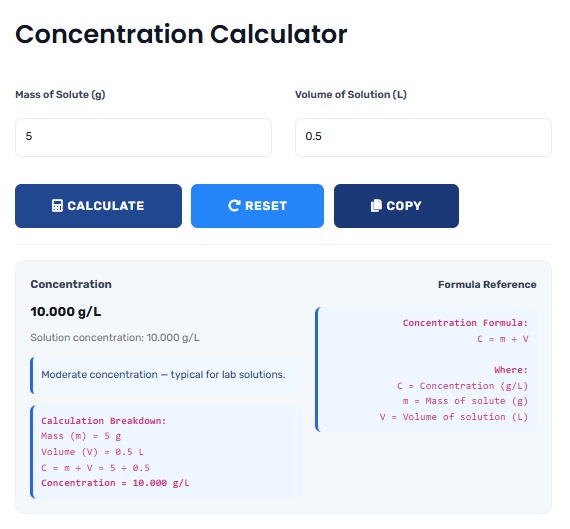
Whether you're a student learning chemistry basics, a researcher preparing laboratory solutions, or a professional working in pharmaceuticals or manufacturing, calculating solution concentrations accurately is essential. Concentration calculations form the foundation of reproducible experiments, consistent product quality, and successful chemical processes.
Our Concentration Calculator simplifies these calculations, providing accurate conversions between molarity, mass percentage, and other concentration units. This tool eliminates common calculation errors and saves time in laboratory preparation, educational settings, and industrial applications. Understanding solution concentrations is crucial for everything from classroom experiments to pharmaceutical formulations and environmental testing.
Essential applications of concentration calculations:
- Laboratory Research: Preparing precise solutions for experiments and analysis
- Chemistry Education: Teaching students fundamental concentration concepts
- Pharmaceutical Manufacturing: Formulating medications with exact active ingredient concentrations
- Industrial Processes: Maintaining consistent solution concentrations in manufacturing
- Environmental Science: Analyzing pollutant concentrations in water and soil samples
Our calculator handles multiple concentration units and conversion methods. For other scientific calculations, explore our complete Science Calculators collection.
Understanding Chemical Concentration: The Basics
Chemical concentration describes how much solute is dissolved in a solvent. It's a fundamental concept in chemistry that determines how solutions behave in reactions, analyses, and applications. Concentration can be expressed in multiple ways, each useful for different purposes.
Key Concentration Concepts:
- Molarity (M): Moles of solute per liter of solution - most common in laboratory work
- Mass Percentage (% w/w): Mass of solute per 100g of solution - intuitive and practical
- Molality (m): Moles of solute per kilogram of solvent - used in colligative properties
- Normality (N): Gram equivalent weight per liter - useful for titration calculations
- Parts Per Million (ppm): Micro concentrations for environmental and trace analysis
Real-World Concentration Calculation Scenarios
University Lab: Preparing a Standard Solution
Maria, a chemistry student, needs to prepare 500 mL of 0.1 M sodium chloride (NaCl) solution for her laboratory experiment. She needs to calculate how much NaCl to weigh out.
Laboratory Calculation:
- Desired concentration: 0.1 M (moles per liter)
- Desired volume: 500 mL = 0.5 L
- Molar mass of NaCl: 58.44 g/mol
- Moles needed: Concentration × Volume = 0.1 mol/L × 0.5 L = 0.05 moles
- Mass needed: Moles × Molar mass = 0.05 mol × 58.44 g/mol = 2.922 grams
- Practical step: Weigh 2.92 grams NaCl, dissolve in water, dilute to 500 mL mark
- Verification: Concentration = 2.92g ÷ 58.44 g/mol ÷ 0.5 L = 0.0999 M ✓
This accurate calculation ensures Maria's experiment will produce reliable, reproducible results. Small errors in concentration can lead to significant errors in experimental outcomes.
For related chemistry calculations, try our Molarity Calculator.
Pharmaceutical Lab: Formulating a Medication
A pharmaceutical technician needs to prepare 100 mL of a 2% w/v lidocaine solution for topical anesthesia. The medication must be precisely formulated for safety and effectiveness.
Pharmaceutical Calculation:
- Concentration: 2% w/v = 2 grams per 100 mL
- Total volume: 100 mL
- Mass needed: (2 g ÷ 100 mL) × 100 mL = 2.00 grams lidocaine
- Preparation: Dissolve 2.00 g lidocaine in approximately 80 mL sterile water
- Final adjustment: Add water to reach exactly 100 mL final volume
- Quality check: Verify concentration through density measurement or analytical testing
- Safety consideration: ±5% concentration tolerance allowed for this application
In pharmaceutical applications, concentration accuracy directly affects medication safety and efficacy. Over-concentration can cause adverse effects, while under-concentration reduces effectiveness.
For dilution calculations, use our Dilution Calculator.
Environmental Testing: Analyzing Water Quality
An environmental scientist needs to prepare calibration standards for lead analysis in drinking water. The standards must cover concentrations from 1 ppm to 50 ppm.
Environmental Analysis Calculation:
- Stock solution: 1000 ppm lead standard
- Target concentrations: 1, 5, 10, 25, 50 ppm
- Dilution formula: C₁V₁ = C₂V₂
- For 50 ppm from 1000 ppm stock: (1000 ppm) × V₁ = (50 ppm) × (100 mL)
- Volume of stock needed: V₁ = (50 × 100) ÷ 1000 = 5.00 mL
- Preparation: Pipette 5.00 mL stock into volumetric flask, dilute to 100 mL
- Serial dilution: Use each standard to prepare the next lower concentration
- Accuracy requirement: ±2% for regulatory compliance testing
Accurate standard preparation is critical for environmental testing, as calibration errors lead to incorrect pollutant concentration reports with potential regulatory consequences.
For conversion between concentration units, use our Conversion Calculators.
Concentration Formulas and Calculation Methods
Essential Concentration Formulas:
1. Molarity (M):
M = moles of solute ÷ liters of solution
Most common in laboratory chemistry
2. Mass Percentage (% w/w):
% = (mass of solute ÷ total mass of solution) × 100%
Intuitive for practical applications
3. Conversion Between Molarity and Percentage:
M = (% × density × 10) ÷ molar mass
% = (M × molar mass × 100) ÷ (density × 1000)
4. Dilution Calculations:
C₁V₁ = C₂V₂ (initial concentration × initial volume = final concentration ×
final volume)
Fundamental for preparing solutions from stock
Common Concentration Units Comparison
| Unit | Definition | Typical Applications | Advantages | Limitations |
|---|---|---|---|---|
| Molarity (M) | moles solute / liter solution | Laboratory chemistry, stoichiometry | Directly relates to chemical reactions | Temperature dependent (volume changes) |
| Molality (m) | moles solute / kg solvent | Colligative properties, precise work | Temperature independent | Less convenient for volume measurements |
| Mass % (% w/w) | g solute / 100g solution | Industrial, pharmaceutical formulations | Easy to understand and measure | Not directly related to reaction stoichiometry |
| Volume % (% v/v) | mL solute / 100mL solution | Liquid mixtures, beverages, fuels | Convenient for liquids | Temperature dependent, not additive |
| Parts Per Million (ppm) | mg solute / kg solution | Environmental, trace analysis | Good for very low concentrations | Easy to confuse with other "parts per" units |
Step-by-Step Guide to Concentration Calculations
5-Step Process for Accurate Concentration Calculations:
- Identify what you know: Current concentration, desired concentration, available volumes or masses
- Choose appropriate formula: Based on units and available information
- Convert units if necessary: Ensure all measurements use consistent units
- Perform calculation carefully: Pay attention to significant figures
- Verify reasonableness: Does the result make sense in context?
Following this systematic approach prevents common errors. For mathematical calculations, use our Percentage Calculator.
Common Concentration Calculation Mistakes
The "Volume vs Mass" Confusion Error
Common error: Using volume when mass is required, or vice
versa.
Example: Calculating % w/w but using volume measurements
instead of mass.
Impact: Significant concentration errors, especially with dense
solutions.
Solution: Always verify whether your formula requires mass or
volume measurements.
Forgetting Temperature Effects
Molarity changes with temperature because volume changes with temperature. A solution prepared at 20°C will have different molarity at 25°C due to thermal expansion.
Example: 1.000 M NaCl solution at 20°C becomes approximately
0.998 M at 25°C.
Practical impact: For most laboratory work, this small
difference is acceptable. For precise analytical work, temperature control is
essential.
Alternative: Use molality for temperature-independent
concentration expressions.
For calculations involving temperature conversions, use our Temperature Converter.
Advanced Concentration Calculations
Case: Preparing a Buffer Solution with Multiple Components
Scenario: Preparing 1 liter of phosphate buffer (pH 7.4) containing 10 mM sodium phosphate and 150 mM sodium chloride.
-
Calculate phosphate component:
- Desired concentration: 10 mM = 0.010 M
- Volume: 1.000 L
- Molar mass NaH₂PO₄: 119.98 g/mol
- Molar mass Na₂HPO₄: 141.96 g/mol
- For pH 7.4, use appropriate ratio of acid to salt (typically 1:4 for this pH)
-
Calculate NaCl component:
- Desired concentration: 150 mM = 0.150 M
- Molar mass NaCl: 58.44 g/mol
- Mass needed: 0.150 mol/L × 1.000 L × 58.44 g/mol = 8.766 g
-
Total solution preparation:
- Dissolve calculated masses in approximately 800 mL distilled water
- Adjust pH to exactly 7.4 using acid or base as needed
- Dilute to final volume of 1.000 L in volumetric flask
- Verify final concentrations through measurement if possible
For pH calculations, try our pH Calculator.
Concentration Ranges in Different Applications
| Application Field | Typical Concentration Range | Common Units | Accuracy Requirements | Special Considerations |
|---|---|---|---|---|
| Analytical Chemistry | 10⁻⁹ M to 1 M | M, ppm, ppb | High (±0.1-1%) | Calibration standards, trace analysis |
| Pharmaceuticals | 0.1% to 10% w/v | % w/v, mg/mL | Very high (±0.5-2%) | Regulatory compliance, patient safety |
| Biochemistry | 1 µM to 100 mM | mM, µM, nM | Medium (±1-5%) | Enzyme kinetics, binding studies |
| Industrial Manufacturing | 1% to 50% w/w | % w/w, g/L | Medium (±2-5%) | Process control, cost optimization |
| Environmental Testing | ppb to ppm levels | ppm, ppb, µg/L | High (±1-3%) | Regulatory limits, public health |
Practical Tips for Laboratory Concentration Work
Best Practices for Accurate Concentration Calculations:
- Use volumetric glassware: For precise volume measurements
- Record temperatures: Note temperature during preparation and use
- Check solubility: Ensure your calculated mass will actually dissolve
- Consider hygroscopicity: Some chemicals absorb water from air
- Account for purity: Use actual purity percentage in calculations
- Document completely: Record all calculations and preparation steps
- Verify independently: Have someone check critical calculations
- Use appropriate significant figures: Don't overstate precision
Proper documentation and verification are essential for reproducible scientific work.
Special Considerations in Concentration Calculations
Hydrated Salts and Water of Crystallization
When using hydrated salts like CuSO₄·5H₂O, you must account for the water molecules in molar mass calculations.
Example: Preparing 0.1 M CuSO₄ solution
• Anhydrous CuSO₄ molar mass: 159.61 g/mol
• Pentahydrate CuSO₄·5H₂O molar mass: 249.69 g/mol
• Mass for 1 L of 0.1 M solution:
- Using anhydrous: 15.961 g
- Using pentahydrate: 24.969 g
Key point: Using wrong form gives incorrect concentration
Concentrated Stock Solutions
Many laboratories use concentrated stock solutions (e.g., 10× or 100× concentrates) for convenience and stability.
Example: Preparing 500 mL of 1× TBE buffer from 10× stock
Using C₁V₁ = C₂V₂:
(10×) × V₁ = (1×) × (500 mL)
V₁ = (1 × 500) ÷ 10 = 50 mL
Procedure: Mix 50 mL 10× stock with 450 mL distilled water
For more dilution calculations, use our Dilution Calculator.
Educational Applications and Learning Tools
Teaching Concentration Concepts:
Concentration calculations are fundamental to chemistry education. Our calculator supports learning by:
- Providing instant feedback on calculation attempts
- Showing step-by-step solutions for complex problems
- Allowing exploration of "what-if" scenarios
- Demonstrating relationships between different concentration units
- Helping students develop intuition for concentration magnitudes
Educators can use this tool to create practice problems, verify student calculations, and demonstrate real-world applications of concentration concepts.
Industrial and Manufacturing Applications
Quality Control in Beverage Production
A beverage manufacturer needs to maintain consistent sugar concentration across production batches.
Calculation: Target 10% w/v sucrose solution
• Batch size: 1000 L
• Required sucrose: 10 g/100 mL = 100 g/L
• Total sucrose: 100 g/L × 1000 L = 100,000 g = 100 kg
• Quality check: Measure density or refractive index to verify
concentration
• Tolerance: ±0.2% for consistent taste and regulatory
compliance
In industrial settings, concentration control affects product consistency, cost, and regulatory compliance.
Key Insight: Concentration calculations bridge theoretical chemistry and practical applications. Whether in education, research, or industry, accurate concentration determination enables reproducible results, consistent quality, and reliable science. Mastering these calculations develops chemical intuition and practical problem-solving skills essential for success in chemistry-related fields. For additional chemistry tools, explore our complete Chemistry Calculators collection.
Quick Reference: Common Concentration Values
Everyday Solutions:
- Table salt solution (for gargle): 0.9% w/v NaCl (isotonic)
- Vinegar: 5% acetic acid
- Hydrogen peroxide (household): 3% H₂O₂
- Rubbing alcohol: 70% isopropanol
- Bleach (household): 5-6% sodium hypochlorite
Biological and Medical Solutions:
- Physiological saline: 0.9% NaCl (154 mM)
- Glucose (IV solution): 5% dextrose (278 mM)
- PBS buffer: 137 mM NaCl, 2.7 mM KCl, 10 mM phosphate
- TAE buffer (DNA electrophoresis): 40 mM Tris, 20 mM acetate, 1 mM EDTA
Remember: Always verify concentrations from reliable sources for specific applications!
Frequently Asked Questions
Molarity (M) is moles of solute per liter of solution, while molality (m) is moles of solute per kilogram of solvent. Molarity changes with temperature (because volume changes), while molality doesn't. Use molarity for most laboratory work, molality for precise measurements or colligative property calculations.
You need the solution density and solute molar mass. Formula: Molarity = (Percentage × Density × 10) ÷ Molar mass. Our calculator handles this conversion automatically when you provide the necessary parameters.
• Laboratory chemistry: Molarity (easy
stoichiometry)
• Industrial formulations: Mass percentage (easy
weighing)
• Environmental analysis: ppm or ppb (trace levels)
• Biochemistry: mM or µM (biological
concentrations)
• Education: Start with percentage, progress to
molarity
Accuracy requirements vary:
• Qualitative experiments: ±10% often acceptable
• Quantitative research: ±1-2% typically needed
• Analytical standards: ±0.1-0.5% for calibration
• Pharmaceuticals: ±0.5-2% for regulatory
compliance
Always consider your specific application requirements.
You must use the correct molar mass including water molecules. For example, CuSO₄·5H₂O has molar mass 249.69 g/mol, while anhydrous CuSO₄ is 159.61 g/mol. Using the wrong form gives incorrect concentration. Always check chemical formula and hydration state.
Serial dilutions involve repeatedly diluting a solution. Common approach: Take 1 mL stock, add 9 mL solvent for 10× dilution. Repeat with diluted solution for further dilution. Formula: Final concentration = Initial concentration × (dilution factor)^n where n is number of dilution steps. Our calculator can handle these sequential calculations.
