pH Calculator: Your Complete Guide to Acidity and Basicity Measurements
Understanding pH is fundamental to chemistry, biology, environmental science, and countless everyday applications. From maintaining a healthy aquarium to brewing the perfect cup of coffee, from laboratory research to industrial processes, pH measurement plays a crucial role. Our pH Calculator makes these calculations quick, accurate, and accessible to everyone.
pH (potential of Hydrogen) measures how acidic or basic a solution is on a scale from 0 to 14. A pH of 7 is neutral (pure water), values below 7 indicate acidity, and values above 7 indicate basicity. Each whole number change represents a tenfold difference in acidity or basicity.
Why pH matters in everyday life:
- Health & Nutrition: Body pH balance, digestive health, food preservation
- Home & Garden: Pool maintenance, soil testing, aquarium care
- Food & Beverage: Brewing, cooking, wine making, cheese production
- Science & Education: Laboratory experiments, chemical analysis, research
- Industry & Environment: Water treatment, manufacturing, pollution control
Our pH calculator helps you understand and calculate pH values accurately. For related chemical calculations, explore our comprehensive Chemistry Calculators collection.
The pH Scale: Understanding Acidity and Basicity
The Complete pH Spectrum
The pH scale ranges from 0 (highly acidic) to 14 (highly basic), with 7 as neutral:
| pH Range | Description | Common Examples | Everyday Applications |
|---|---|---|---|
| 0-2 | Strongly Acidic | Battery acid, stomach acid | Industrial cleaning, digestion |
| 3-5 | Moderately Acidic | Vinegar, orange juice, soda | Cooking, cleaning, beverages |
| 6 | Slightly Acidic | Milk, urine, rainwater | Health monitoring, agriculture |
| 7 | Neutral | Pure water, blood | Reference point, biology |
| 8-9 | Slightly Basic | Seawater, baking soda | Cooking, cleaning, marine life |
| 10-11 | Moderately Basic | Milk of magnesia, soap | Medicine, cleaning, textiles |
| 12-14 | Strongly Basic | Bleach, drain cleaner, lye | Cleaning, manufacturing |
Key Point: Each pH unit represents a 10-fold change in acidity. pH 4 is 10 times more acidic than pH 5, and 100 times more acidic than pH 6.
Real-Life pH Calculation Scenarios
Home Brewing: Perfecting Your Beer's pH
John, an amateur brewer, needed to adjust his brewing water to achieve the ideal pH of 5.2-5.6 for optimal enzyme activity and flavor extraction during mashing.
Brewing pH Analysis:
- Starting water pH: 7.8 (too basic for brewing)
- Target pH range: 5.2-5.6
- Water volume: 5 gallons (19 liters)
- Adjustment needed: Lower pH by 2.2-2.6 units
- Acid choice: Food-grade lactic acid
- Calculation: 1 mL lactic acid lowers 1 gallon by ~0.1 pH unit
- Acid needed: (2.4 ÷ 0.1) × 5 = 120 mL lactic acid
- Result: Perfect mash pH, improved flavor, better efficiency
Using pH calculations, John achieved professional-quality beer at home. The proper pH ensured optimal enzyme activity, better sugar extraction, and perfect flavor development.
For other science calculations, check our Science Calculators.
Aquarium Maintenance: Creating Healthy Water Conditions
Sarah noticed her tropical fish were stressed and discovered her aquarium water had drifted to pH 8.2, while her fish species prefer pH 6.5-7.0.
Aquarium pH Analysis:
- Current pH: 8.2 (too basic for tropical fish)
- Target pH: 6.8 (middle of ideal range)
- Tank size: 30 gallons (114 liters)
- pH difference: 1.4 units too high
- Safe adjustment rate: 0.2 pH units per day maximum
- Peat moss method: 1 cup peat lowers 10 gallons by ~0.3 pH
- Peat needed: (1.4 ÷ 0.3) × 3 = 14 cups peat moss
- Gradual adjustment: 7 days to reach target safely
- Result: Healthy, active fish, proper breeding conditions
Gradual pH adjustment prevented shock to the fish while creating their ideal environment. Regular pH monitoring became part of Sarah's maintenance routine.
For conversion needs, use our Liter to Gallon Converter.
Gardening: Optimizing Soil pH for Plant Health
Robert's blue hydrangeas weren't producing their characteristic blue flowers. Soil testing revealed pH 7.5, while blue hydrangeas need acidic soil (pH 5.2-5.5) for blue coloration.
Soil pH Analysis:
- Current soil pH: 7.5 (neutral to slightly basic)
- Target pH: 5.3 (ideal for blue hydrangeas)
- Garden area: 4×6 feet = 24 square feet
- Soil depth: 12 inches (1 foot)
- Soil volume: 24 cubic feet
- Elemental sulfur needed: 1.2 lbs per 10 sq ft lowers pH by 1 unit
- Sulfur calculation: (2.2 ÷ 1) × 2.4 = 5.28 lbs elemental sulfur
- Application: Mix into top 6 inches, water thoroughly
- Timeline: 2-3 months for full effect
By calculating and applying the right amount of soil acidifier, Robert transformed his pink hydrangeas to vibrant blue the following season.
pH Formulas and Calculations
Essential pH Calculation Formulas:
1. Basic pH Formula:
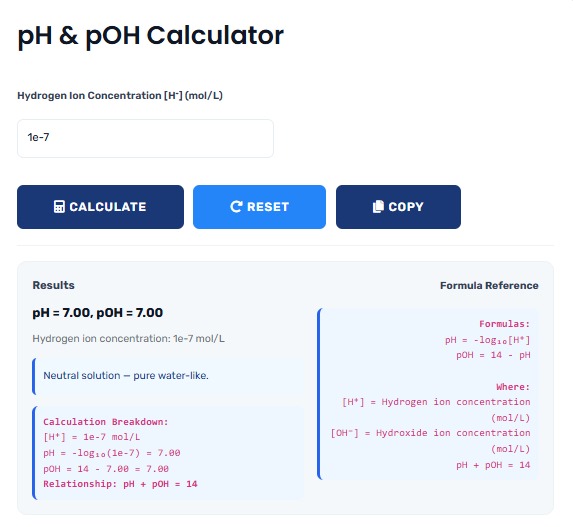
pH = -log₁₀[H⁺]
Where [H⁺] is hydrogen ion concentration in moles per liter
2. pOH Relationship:
pH + pOH = 14 (at 25°C)
pOH = -log₁₀[OH⁻]
3. Strong Acid pH:
pH = -log(concentration of acid)
For HCl 0.01 M: pH = -log(0.01) = 2
4. Strong Base pH:
pOH = -log(concentration of base)
pH = 14 - pOH
For NaOH 0.001 M: pOH = 3, pH = 11
5. Weak Acid pH (Approximation):
pH = ½pKa - ½log[C]
Where pKa = -log(Ka), Ka = acid dissociation constant
pH Measurement Methods Comparison
| Method | Accuracy | Cost | Best For | Limitations |
|---|---|---|---|---|
| Digital pH Meter | ±0.01 pH units | $$-$$$ | Laboratory, precise measurements | Requires calibration, maintenance |
| pH Test Strips | ±0.5 pH units | $ | Quick checks, field testing | Less precise, color interpretation |
| Liquid Indicators | ±0.2 pH units | $ | Educational, approximate measurements | Subject to color blindness issues |
| Our pH Calculator | Theoretically precise | Free | Planning, predictions, learning | Theoretical vs actual differences |
Common Substances and Their pH Values
| Substance | Typical pH | Acidity/Basicity | Common Uses | Safety Notes |
|---|---|---|---|---|
| Battery Acid | 0.5 | Extremely Acidic | Car batteries, industrial | Corrosive, wear protection |
| Lemon Juice | 2.0-2.6 | Highly Acidic | Cooking, cleaning, preserving | Can erode tooth enamel |
| Vinegar | 2.4-3.4 | Acidic | Cooking, cleaning, pickling | Generally safe, dilute for cleaning |
| Black Coffee | 4.8-5.1 | Mildly Acidic | Beverage, mild stimulant | May cause acid reflux |
| Milk | 6.5-6.7 | Slightly Acidic | Nutrition, cooking | Generally safe, may sour |
| Pure Water | 7.0 | Neutral | Drinking, reference standard | Safe, essential for life |
| Blood | 7.35-7.45 | Slightly Basic | Biological fluid | Critical for health |
| Baking Soda Solution | 8.3 | Basic | Cooking, cleaning, antacid | Generally safe, may upset stomach |
| Ammonia Solution | 11.6 | Strongly Basic | Cleaning, fertilizer | Toxic fumes, use ventilation |
| Bleach | 12.6 | Very Basic | Disinfecting, whitening | Corrosive, never mix with acids |
The Science Behind pH Calculation
Understanding Hydrogen Ion Concentration:
- Acids: Donate H⁺ ions (protons) in solution
- Bases: Accept H⁺ ions or donate OH⁻ ions
- pH Scale: Logarithmic scale measuring H⁺ concentration
- Neutral Point: [H⁺] = [OH⁻] = 10⁻⁷ M at 25°C
- Temperature Effect: Neutral pH changes with temperature
The logarithmic nature means small pH changes represent large concentration changes. pH 4 has 10 times more H⁺ ions than pH 5, and 100 times more than pH 6.
Importance of pH in Different Fields
| Field | Ideal pH Range | Why It Matters | Consequences of Wrong pH | Measurement Frequency |
|---|---|---|---|---|
| Human Blood | 7.35-7.45 | Enzyme function, oxygen transport | Acidosis/Alkalosis, organ failure | Medical testing as needed |
| Swimming Pool | 7.2-7.8 | Disinfectant effectiveness, comfort | Eye/skin irritation, algae growth | Daily during swim season |
| Soil for Vegetables | 6.0-7.0 | Nutrient availability, plant health | Poor growth, nutrient deficiencies | Seasonally, before planting |
| Aquarium (Freshwater) | 6.5-7.5 | Fish health, biological filtration | Fish stress, disease, death | Weekly, after water changes |
| Beer Brewing (Mash) | 5.2-5.6 | Enzyme activity, flavor extraction | Poor efficiency, off-flavors | Each brewing session |
pH Adjustment Techniques and Calculations
Safety First: Important Precautions
Always remember: When adjusting pH, add acids to water (never
water to concentrated acids).
Wear protection: Gloves, goggles, and proper ventilation are
essential.
Add gradually: Make small adjustments and re-measure
frequently.
Know your chemicals: Some pH adjusters are more potent than
others.
Emergency preparation: Have neutralizing agents and water
available.
Common pH Adjusters and Their Strength
Different chemicals have different effects on pH. Here's a comparison:
| Adjuster | Type | Strength | Typical Use | Safety Level |
|---|---|---|---|---|
| Citric Acid | pH Down | Mild | Food, beverages, gentle cleaning | Very Safe |
| Vinegar | pH Down | Moderate | Home cleaning, cooking, gardening | Safe |
| Muriatic Acid | pH Down | Strong | Pools, concrete cleaning | Dangerous (handle with care) |
| Baking Soda | pH Up | Mild | Cooking, antacid, gentle cleaning | Very Safe |
| Washing Soda | pH Up | Moderate | Laundry, heavy cleaning | Caution Needed |
| Lye (Sodium Hydroxide) | pH Up | Strong | Drain cleaning, soap making | Very Dangerous (extreme care) |
For dilution calculations when using concentrated chemicals, try our Dilution Calculator.
Step-by-Step pH Calculation Guide
How to Calculate and Adjust pH: Practical Example
Scenario: You have 100 liters of water at pH 8.0, need pH 7.0 for a specific application.
-
Determine pH Change Needed:
- Current pH: 8.0
- Target pH: 7.0
- Change needed: Lower by 1.0 pH unit
-
Calculate H⁺ Concentration Change:
- pH 8.0: [H⁺] = 10⁻⁸ = 0.00000001 M
- pH 7.0: [H⁺] = 10⁻⁷ = 0.0000001 M
- Increase needed: 10 times more H⁺ ions
-
Choose Acid and Calculate Amount:
- Using 1M hydrochloric acid (HCl)
- Each mL 1M HCl adds 0.001 moles H⁺
- Current H⁺ in 100L: 0.00000001 × 100,000 = 0.001 moles
- Target H⁺: 0.0000001 × 100,000 = 0.01 moles
- Additional H⁺ needed: 0.009 moles
- Acid volume: 0.009 ÷ 1 = 0.009 L = 9 mL
-
Apply and Verify:
- Add 9 mL acid slowly with mixing
- Wait 15 minutes for equilibrium
- Measure pH, adjust further if needed
For concentration calculations, use our Molarity Calculator.
pH in Biological Systems
The Critical Role of pH in Living Organisms:
| Biological System | Optimal pH | Function | pH Regulation |
|---|---|---|---|
| Human Blood | 7.35-7.45 | Oxygen transport, enzyme function | Lungs, kidneys, buffers |
| Stomach | 1.5-3.5 | Protein digestion, pathogen killing | Gastric acid secretion |
| Small Intestine | 6.0-7.4 | Nutrient absorption | Bicarbonate secretion |
| Plant Cell Cytoplasm | 7.0-7.5 | Metabolic reactions | Membrane transporters |
| Lysosomes | 4.5-5.0 | Cellular digestion | Proton pumps |
Buffer Systems: Biological systems use buffers (like bicarbonate in blood) to maintain stable pH despite acid/base challenges from metabolism, diet, and environment.
Advanced pH Concepts
Beyond Basic pH: Advanced Topics
pKa and Buffer Capacity:
- pKa: pH where acid is 50% dissociated
- Buffer Range: pKa ± 1 pH unit
- Buffer Capacity: Resistance to pH change
- Henderson-Hasselbalch Equation: pH = pKa + log([base]/[acid])
Temperature Effects:
- Neutral pH changes with temperature (6.14 at 100°C)
- pKw (water dissociation constant) changes with temperature
- pH meters often have automatic temperature compensation
Ionic Strength Effects:
- High salt concentrations affect H⁺ activity
- Activity coefficients differ from concentrations
- Important in seawater, biological fluids
Key Insight: pH is more than a number - it's a window into chemical behavior. Understanding pH helps you make better coffee, grow healthier plants, maintain cleaner pools, and even understand your own body better. The logarithmic scale means small changes matter greatly. Regular monitoring and careful adjustment lead to better results in all pH-sensitive activities.
Quick Reference: pH Measurement Tips
For Accurate pH Measurements:
- Calibrate regularly: pH meters need frequent calibration with fresh buffers
- Temperature matters: Measure at consistent temperature or use compensation
- Clean electrodes: Rinse with distilled water between measurements
- Store properly: Keep pH electrode in storage solution when not in use
- Mix samples: Ensure homogeneous samples before measurement
- Wait for stability: Allow reading to stabilize (30-60 seconds typically)
- Check expiration: pH buffers and strips have limited shelf life
Common Mistakes to Avoid:
- Using expired buffers or test strips
- Not rinsing electrode between samples
- Measuring temperature-sensitive samples at wrong temperature
- Assuming all water is pH 7 (tap water varies widely)
- Making large pH adjustments too quickly
Frequently Asked Questions
pH stands for "potential of Hydrogen" or "power of Hydrogen." It measures the concentration of hydrogen ions (H⁺) in a solution. The "p" comes from the German word "potenz" meaning power, and H is the chemical symbol for hydrogen.
Yes, although uncommon in everyday situations. Concentrated strong acids can have negative pH values (like 10M HCl has pH ≈ -1). Concentrated strong bases can exceed pH 14. However, the standard 0-14 scale covers most common solutions encountered in daily life, laboratories, and industry.
Temperature affects pH in several ways: The dissociation constant of water (Kw) changes with temperature, so neutral pH changes (7.0 at 25°C, but 6.14 at 100°C). Chemical reaction rates increase with temperature. pH meter readings include temperature compensation for accurate measurements. Always note temperature when reporting pH values.
pH measures how acidic or basic a solution is right now (the intensity of acidity). Alkalinity measures how much acid a solution can neutralize (the capacity to resist pH change). A solution can have high pH but low alkalinity (easily changed) or moderate pH with high alkalinity (resists change). Both are important in water chemistry.
Calibration frequency depends on usage: For critical laboratory work, calibrate daily or before each use. For regular monitoring (pools, aquariums), calibrate weekly. For occasional use, calibrate each time you use it. Always calibrate with at least two buffer solutions (typically pH 4.01 and 7.01 or 10.01) that bracket your expected measurement range.
Our calculator works well for common acids, bases, and simple solutions. For complex mixtures, biological fluids, or solutions with multiple buffering systems, theoretical calculations become more complex. In such cases, direct measurement with a calibrated pH meter is more reliable. The calculator is excellent for planning, education, and understanding pH principles.
