Acceleration Calculator: Measure How Quickly Speed Changes
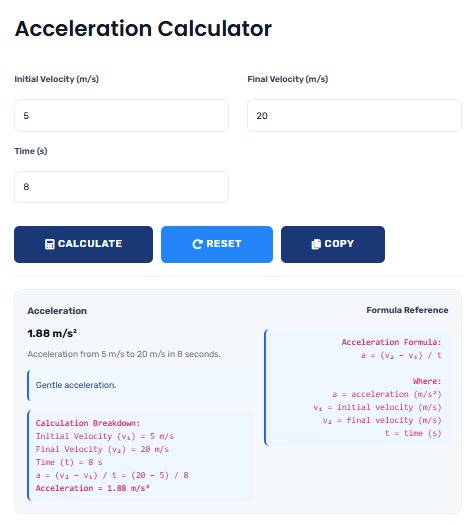
Acceleration is everywhere in our daily lives - from the moment a car speeds up from a stoplight to the thrilling drop of a roller coaster. Our Acceleration Calculator makes understanding this fundamental physics concept simple and accessible for students, teachers, engineers, and anyone curious about motion.
Whether you're studying physics, analyzing vehicle performance, or just curious about how quickly things can change speed, this tool provides accurate calculations instantly. No more complex manual formulas or unit conversion headaches - just enter your values and get precise results.
Why understanding acceleration matters:
- Physics Education: Essential for understanding Newton's laws of motion
- Engineering Design: Critical for vehicle safety and performance
- Sports Science: Analyzing athlete performance in sprints and jumps
- Everyday Life: Understanding car performance, amusement rides, and more
- Safety Analysis: Calculating stopping distances and impact forces
Our acceleration calculator is part of our comprehensive Science Calculators collection, designed to make complex physics calculations simple.
What Exactly Is Acceleration?
Simple Definition: Acceleration measures how quickly velocity changes. It's not just about speeding up - slowing down (deceleration) and changing direction also involve acceleration.
Key Points:
- Positive acceleration = speeding up
- Negative acceleration = slowing down
- Zero acceleration = constant speed
- Acceleration has both magnitude AND direction
- Measured in meters per second squared (m/s²) or feet per second squared (ft/s²)
Real-World Acceleration Examples
Car Acceleration: From 0 to 60 mph
A sports car goes from 0 to 60 mph (26.8 m/s) in 3.5 seconds. How quickly is it accelerating?
Calculation:
- Initial velocity: 0 m/s
- Final velocity: 26.8 m/s
- Time: 3.5 seconds
- Acceleration = (26.8 - 0) ÷ 3.5 = 7.66 m/s²
- In g-forces: 7.66 ÷ 9.8 = 0.78g
- What this means: You feel about 78% of your body weight pushed back into the seat
This acceleration is impressive but far from extreme. Compare this with our Force Calculator to see how much force produces this acceleration.
Emergency Braking: Stopping Safely
A car traveling at 60 mph (26.8 m/s) needs to stop quickly. With good brakes, it can decelerate at 8 m/s².
Stopping Analysis:
- Initial velocity: 26.8 m/s
- Final velocity: 0 m/s
- Deceleration: -8 m/s² (negative acceleration)
- Time to stop: (0 - 26.8) ÷ (-8) = 3.35 seconds
- Stopping distance: Average velocity × time = 13.4 × 3.35 = 44.9 meters
- Safety insight: This is why following distance matters - you need almost 45 meters to stop
Understanding deceleration is crucial for safe driving. For more physics calculations, explore our Physics Calculators.
Free Fall: Gravity's Acceleration
An object dropped from height accelerates due to gravity at approximately 9.8 m/s² (ignoring air resistance).
Free Fall Analysis:
- Acceleration: 9.8 m/s² downward
- After 1 second: Velocity = 9.8 m/s, Distance fallen = 4.9 meters
- After 2 seconds: Velocity = 19.6 m/s, Distance fallen = 19.6 meters
- After 3 seconds: Velocity = 29.4 m/s, Distance fallen = 44.1 meters
- Key point: Velocity increases linearly, distance increases with time squared
This constant acceleration is why falling objects gain speed quickly. For energy calculations, try our Kinetic Energy Calculator.
Three Ways to Calculate Acceleration
Method 1: Using Velocity and Time (Most Common)
Acceleration = (Final Velocity - Initial Velocity) ÷ Time
a = (vf - vi) ÷ t
Method 2: Using Distance and Time
Acceleration = 2 × (Distance - Initial Velocity × Time) ÷ Time²
a = 2 × (d - vi × t) ÷ t²
Method 3: Using Force and Mass (Newton's Second Law)
Acceleration = Force ÷ Mass
a = F ÷ m
Common Acceleration Values Reference
| Scenario | Acceleration | In g-forces | Description | Experience |
|---|---|---|---|---|
| Earth's Gravity | 9.8 m/s² | 1g | Standard gravitational pull | Normal weight feeling |
| Elevator Starting Up | 1-2 m/s² | 0.1-0.2g | Mild upward acceleration | Slightly heavier feeling |
| Car Acceleration | 3-4 m/s² | 0.3-0.4g | Typical 0-60 mph in 7-10s | Pushed back in seat |
| Sports Car | 6-8 m/s² | 0.6-0.8g | 0-60 mph in 3.5-5s | Strong push back |
| Roller Coaster Drop | 30-40 m/s² | 3-4g | Maximum thrill ride forces | Very intense, breath may catch |
| Formula 1 Braking | 40-50 m/s² | 4-5g | Extreme deceleration | Violent forward push |
| Space Shuttle Launch | 29 m/s² | 3g | Maximum during ascent | Very heavy, difficult to move |
Types of Acceleration in Physics
| Type | Definition | Example | Formula | Everyday Experience |
|---|---|---|---|---|
| Linear Acceleration | Change in speed along straight line | Car speeding up on highway | a = Δv/Δt | Pushed back in car seat |
| Centripetal Acceleration | Change in direction (circular motion) | Car turning corner | a = v²/r | Leaning in turn |
| Angular Acceleration | Change in rotation speed | Spinning faster | α = Δω/Δt | Merry-go-round speeding up |
| Gravitational Acceleration | Acceleration due to gravity | Falling object | g = 9.8 m/s² | Weightlessness feeling in drop |
| Tangential Acceleration | Speed change in circular motion | Carousel speeding up | at = r × α | Increasing spin force |
How to Use Our Acceleration Calculator
Step-by-Step Guide:
- Choose your method: Velocity-time, distance-time, or force-mass
- Enter values: Fill in the known quantities
- Select units: Ensure consistent units (all metric or all imperial)
- Calculate: Click to get instant results
- Interpret: Read acceleration value and any additional information
- Apply: Use results for your project, homework, or analysis
For converting between different units, use our KMH to MILES Converter.
Practical Applications of Acceleration Calculations
Case Study: Designing Safer Cars
Problem: Car manufacturers need to know acceleration capabilities for safety ratings and performance specifications.
-
Acceleration Testing:
- Measure 0-60 mph time: 6.2 seconds
- Convert to m/s: 60 mph = 26.8 m/s
- Calculate: a = 26.8 ÷ 6.2 = 4.32 m/s²
- Result: Moderate acceleration suitable for family sedan
-
Braking Analysis:
- Measure stopping from 60 mph: 120 feet (36.6 meters)
- Calculate deceleration: a = v² ÷ (2 × d) = 26.8² ÷ (2 × 36.6) = 9.81 m/s²
- Result: Excellent braking - can stop in 1g deceleration
-
Safety Implications:
- Higher acceleration helps merge safely onto highways
- Strong deceleration prevents collisions
- These calculations inform safety ratings and marketing
For financial calculations related to vehicle ownership, try our Auto Loan Calculator.
Human Tolerance to Acceleration
| Acceleration Level | Duration Tolerable | Physical Effects | Training Required | Typical Scenario |
|---|---|---|---|---|
| 1-2g (9.8-19.6 m/s²) | Indefinite | Mild discomfort, heavy feeling | None | Elevator, mild amusement ride |
| 3-4g (29.4-39.2 m/s²) | Several minutes | Labored breathing, facial distortion | Minimal | Roller coaster, fighter jet turn |
| 5-6g (49-58.8 m/s²) | 10-30 seconds | Gray vision, possible blackout | Basic G-training | Fighter jet maneuver |
| 7-8g (68.6-78.4 m/s²) | 5-10 seconds | Loss of vision, high blackout risk | Advanced training | High-performance aircraft |
| 9g+ (88.2+ m/s²) | 2-5 seconds | Loss of consciousness likely | Specialized training + suit | Emergency aircraft maneuver |
Safety Warning: Understanding G-Forces
Important Safety Information: High acceleration forces can be dangerous. Always:
- Follow safety guidelines on amusement rides
- Wear proper restraints in vehicles
- Listen to your body - stop if you feel unwell
- Never attempt to experience high g-forces without proper training and equipment
- Consult professionals for extreme acceleration activities
Safety should always come first when dealing with acceleration forces.
Advanced Acceleration Concepts
Beyond Basic Acceleration:
- Jerk: Rate of change of acceleration (how quickly acceleration changes)
- Proper Acceleration: Acceleration felt by an object (what accelerometers measure)
- Coordinate Acceleration: Acceleration relative to a chosen coordinate system
- Relativistic Acceleration: Acceleration effects at near-light speeds
- Tidal Acceleration: Difference in acceleration across an object (causes tides)
While our calculator focuses on classical Newtonian acceleration, understanding these advanced concepts provides deeper physics insight.
Acceleration in Sports and Athletics
Sprint Start Analysis
Scenario: A sprinter accelerates from blocks to maximum speed in 4 seconds, reaching 10 m/s.
Calculations:
1. Average acceleration: (10 - 0) ÷ 4 = 2.5 m/s²
2. Peak acceleration: Higher initially, perhaps 4-5 m/s² in first second
3. Force exerted: Assuming 70 kg sprinter, F = m × a = 70 × 2.5 = 175 N
average
4. Comparison: Much lower than vehicle acceleration but impressive for human
power
Training implications: Improving starting acceleration shaves critical time off sprints. Strength training and technique work can increase initial acceleration.
For health and fitness calculations, explore our Calorie Intake Calculator.
Key Insight: Acceleration is about change - how quickly things speed up, slow down, or change direction. Understanding acceleration helps us design safer vehicles, train better athletes, build thrilling rides, and appreciate the physics of everyday motion. Whether you're a student learning physics, an engineer designing systems, or just curious about how things move, understanding acceleration opens a window into the fundamental workings of our physical world.
Historical Perspective on Acceleration
Galileo's Discoveries: In the 16th century, Galileo Galilei made groundbreaking discoveries about acceleration through his experiments with inclined planes. He demonstrated that all objects accelerate equally under gravity (ignoring air resistance), contradicting Aristotle's belief that heavier objects fall faster.
Newton's Contribution: Isaac Newton formalized acceleration mathematics in his laws of motion (1687). His second law (F = ma) directly relates force, mass, and acceleration, providing the foundation for classical mechanics.
Modern Understanding: Today, acceleration is fundamental to physics, engineering, transportation, space exploration, and countless technologies from smartphones (with accelerometers) to medical devices.
Quick Reference: Acceleration Formulas and Units
Basic Formulas:
- From velocity: a = (vf - vi) ÷ t
- From distance: a = 2 × (d - vit) ÷ t²
- From force: a = F ÷ m (Newton's Second Law)
- Circular motion: a = v² ÷ r (centripetal)
Common Units:
- SI: meters per second squared (m/s²)
- Imperial: feet per second squared (ft/s²)
- Gravitational: g (1g = 9.80665 m/s²)
- Automotive: 0-60 mph time (indirect measure)
Conversion Factors:
1 m/s² = 3.28084 ft/s²
1 g = 9.80665 m/s² = 32.174 ft/s²
Frequently Asked Questions
Velocity tells you how fast you're going and in what direction. Acceleration tells you how quickly your velocity is changing. If velocity is "speed with direction," acceleration is "how quickly that speed/direction changes." Our calculator helps you find acceleration from various inputs.
Yes! Negative acceleration (often called deceleration) means slowing down. If you're moving forward and brake, you experience negative acceleration. In physics, acceleration includes both speeding up and slowing down - it's all about the rate of velocity change.
The "per second squared" comes from the definition: acceleration = (velocity change) ÷ time. Velocity is measured in m/s (meters per second). Dividing m/s by s (seconds) gives m/s². It means "meters per second, per second" - how many meters per second your speed changes each second.
First convert 60 mph to m/s: 60 mph × 0.447 = 26.8 m/s. Then divide by time in seconds. Example: 0-60 in 6 seconds gives 26.8 ÷ 6 = 4.47 m/s². Our calculator automates this conversion.
Gravitational acceleration varies: Moon = 1.62 m/s² (0.17g), Mars = 3.71 m/s² (0.38g), Jupiter = 24.79 m/s² (2.53g). Earth's 9.8 m/s² is in the middle. This affects everything from how high you can jump to how objects fall. For astronomy calculations, try our Astronomy Calculators.
Modern smartphone accelerometers are surprisingly accurate, typically within ±0.1 m/s² for most applications. They use micro-electromechanical systems (MEMS) technology. While not lab-grade, they're sufficient for fitness tracking, gaming, and basic motion detection. For precise scientific work, dedicated instruments are better.
The highest survived acceleration was by Colonel John Stapp in rocket sled tests: 46.2g (453 m/s²) for about 1 second. However, sustained high g-forces are dangerous. Fighter pilots with training and special suits can handle 8-9g briefly. Unprotected humans lose consciousness around 5g sustained. Always prioritize safety with acceleration forces.
Air resistance creates drag force opposing motion. For falling objects, it causes acceleration to decrease until reaching terminal velocity (zero net acceleration). For vehicles, it limits top speed and reduces acceleration at higher speeds. Our calculator assumes negligible air resistance unless specified otherwise. For real-world applications, aerodynamic factors must be considered.
