Power Calculator: Calculate Energy Transfer Rates Instantly
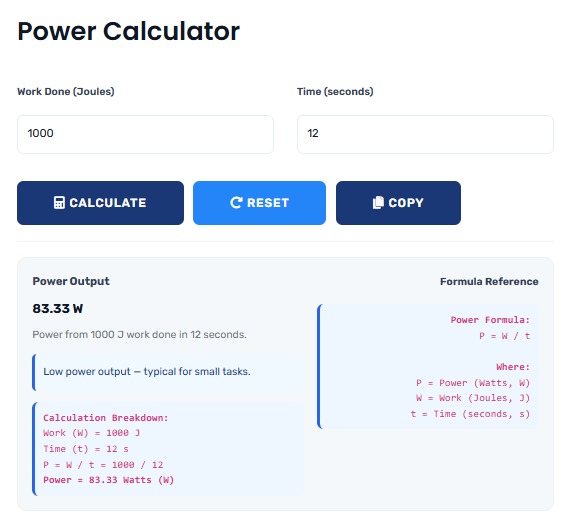
Understanding power calculations is essential for physics, engineering, and everyday energy applications. Our Power Calculator provides instant, accurate calculations for determining the rate of energy transfer or work done in various systems.
Whether you're a student learning physics concepts, an engineer designing systems, or a homeowner calculating electrical needs, this tool makes power calculations simple and accurate. Power is one of the most fundamental concepts in physics and engineering, representing how quickly energy is transferred or work is performed.
Common applications of power calculations:
- Electrical Systems: Calculating power consumption of appliances and devices
- Mechanical Engineering: Determining motor and engine power requirements
- Physics Education: Learning fundamental energy and work relationships
- Home Energy: Estimating electricity usage and costs
- Renewable Energy: Calculating solar panel or wind turbine output
Our calculator simplifies complex physics formulas into easy-to-use calculations. For related energy calculations, check our Kinetic Energy Calculator.
Understanding Power: The Basics
What is Power?
Power is the rate at which work is done or energy is transferred. In simple terms, it measures how fast something is happening. Higher power means energy is being transferred more quickly.
Key Concepts:
- Work: Energy transferred when a force moves an object
- Energy: The capacity to do work
- Time: The duration over which work is done
- Rate: How quickly something happens
Real-Life Power Scenarios
Home Appliances: Calculating Electricity Usage
Sarah wants to calculate how much power her new air conditioner uses and what it will cost to run. The AC is rated at 1500 watts and she runs it 8 hours daily during summer.
Power Calculation Analysis:
- Air conditioner power rating: 1500 watts
- Daily usage: 8 hours
- Daily energy consumption: 1500 W × 8 h = 12,000 watt-hours = 12 kWh
- Electricity cost: $0.15 per kWh
- Daily cost: 12 kWh × $0.15 = $1.80
- Monthly cost (30 days): $1.80 × 30 = $54.00
- Key insight: Power rating tells you the rate of energy use
- Energy saving: Reducing usage by 2 hours saves $13.50 monthly
Understanding power consumption helps Sarah budget her electricity costs and make informed decisions about appliance usage.
Car Engine: Mechanical Power Output
Mike is comparing two cars and wants to understand their power ratings. Car A has 200 horsepower, Car B has 180 horsepower.
Power Comparison Analysis:
- Car A: 200 horsepower
- Car B: 180 horsepower
- Conversion: 1 horsepower = 746 watts
- Car A power: 200 × 746 = 149,200 watts = 149.2 kW
- Car B power: 180 × 746 = 134,280 watts = 134.3 kW
- Difference: 149.2 - 134.3 = 14.9 kW more power
- Performance impact: Higher power means faster acceleration
- Fuel efficiency: More power often means lower fuel efficiency
Power ratings help Mike understand vehicle performance characteristics beyond just horsepower numbers.
For converting between power units, use our Power Calculator.
Solar Panel System: Renewable Energy Generation
Robert is installing solar panels and needs to calculate their power output to meet his home's energy needs.
Solar Power Analysis:
- Solar panel rating: 300 watts per panel
- Number of panels: 20
- Total system power: 300 W × 20 = 6,000 watts = 6 kW
- Daily sunlight hours: 5 hours (average)
- Daily energy generation: 6 kW × 5 h = 30 kWh
- Home energy needs: 25 kWh daily
- Excess power: 5 kWh daily can be sold back to grid
- System efficiency: Real output about 80% of rated power
Power calculations help Robert design a solar system that meets his energy requirements efficiently.
For energy-related calculations, try our Energy Calculator.
Power Formulas and Calculations
Essential Power Formulas:
1. Basic Power Formula:
P = W ÷ t (Power = Work ÷ Time)
Where: P = Power (watts), W = Work (joules), t = Time (seconds)
2. Electrical Power Formula:
P = V × I (Power = Voltage × Current)
Where: P = Power (watts), V = Voltage (volts), I = Current (amperes)
3. Mechanical Power Formula:
P = F × v (Power = Force × Velocity)
Where: P = Power (watts), F = Force (newtons), v = Velocity (m/s)
4. Alternative Formula:
P = E ÷ t (Power = Energy ÷ Time)
Where: P = Power (watts), E = Energy (joules), t = Time (seconds)
Power Units and Conversions
| Unit | Symbol | Equivalent | Common Uses | Conversion Factor |
|---|---|---|---|---|
| Watt | W | 1 joule/second | Standard SI unit, small devices | 1 W = 1 J/s |
| Kilowatt | kW | 1,000 watts | Household appliances, motors | 1 kW = 1000 W |
| Megawatt | MW | 1,000,000 watts | Power plants, large industries | 1 MW = 1,000,000 W |
| Horsepower | hp | 746 watts | Engines, motors, vehicles | 1 hp = 746 W |
| British Thermal Unit/hour | BTU/h | 0.293 watts | Heating and cooling systems | 1 BTU/h = 0.293 W |
Common Power Ratings in Daily Life
| Device/System | Typical Power Rating | Energy Use (Hourly) | Monthly Cost* | Power Saving Tips |
|---|---|---|---|---|
| LED Light Bulb | 9-15 watts | 0.009-0.015 kWh | $0.30-$0.50 | Use motion sensors, turn off when not needed |
| Laptop Computer | 50-100 watts | 0.05-0.10 kWh | $2.00-$4.00 | Use power saving mode, unplug charger |
| Refrigerator | 100-200 watts | 0.10-0.20 kWh | $10.00-$20.00 | Keep coils clean, maintain proper temperature |
| Air Conditioner | 1000-1500 watts | 1.0-1.5 kWh | $45.00-$67.50 | Use programmable thermostat, maintain filters |
| Electric Oven | 2000-5000 watts | 2.0-5.0 kWh | Varies with use | Cook multiple items, use residual heat |
*Based on 5 hours daily use at $0.15/kWh
How to Calculate Power Step by Step
4-Step Power Calculation Process:
- Identify known values: Determine what information you have (work, time, voltage, current, etc.)
- Choose correct formula: Select the appropriate power formula based on available values
- Ensure unit consistency: Convert all values to consistent units (watts, joules, seconds)
- Calculate and interpret: Perform the calculation and understand what the result means
This systematic approach ensures accurate power calculations every time. For force calculations, use our Force Calculator.
Common Power Calculation Mistakes
The "Confusing Power and Energy" Error
Common mistake: Thinking power and energy are the same
thing.
Reality: Power is the RATE of energy use, energy is the TOTAL
amount used.
Example: A 100-watt bulb (power) uses 100 watt-hours of energy
in one hour.
Key difference: Power = watts, Energy = watt-hours (or joules).
Incorrect Unit Conversions
Many errors occur when converting between power units or when mixing units in calculations.
Common error: Using horsepower in one part of calculation and
watts in another without conversion.
Correct approach: Convert all values to consistent units before
calculating:
1. Convert 2 horsepower to watts: 2 × 746 = 1,492 watts
2. Convert 30 minutes to seconds: 30 × 60 = 1,800 seconds
3. Now calculate work: Work = Power × Time = 1,492 W × 1,800 s = 2,685,600
joules
For time conversions, use our Hours to Minutes Converter.
Electrical Power Applications
Case: Calculating Home Circuit Load
Scenario: You want to determine if a kitchen circuit can handle all appliances running simultaneously.
-
List Appliance Power Ratings:
- Refrigerator: 150 watts
- Microwave: 1200 watts
- Toaster: 800 watts
- Coffee Maker: 900 watts
- Total: 150 + 1200 + 800 + 900 = 3,050 watts
-
Check Circuit Capacity:
- Standard kitchen circuit: 20 amps at 120 volts
- Maximum power: P = V × I = 120 V × 20 A = 2,400 watts
-
Analysis:
- Required: 3,050 watts
- Available: 2,400 watts
- Overload: 650 watts (27% over capacity)
- Solution: Don't run all appliances simultaneously or upgrade circuit
Mechanical Power in Action
| Mechanical System | Power Range | Force Involved | Velocity/Speed | Efficiency Factors |
|---|---|---|---|---|
| Bicycle Rider | 100-300 watts | Pedal force: 200-400 N | 15-30 km/h | Rider fitness, bike condition, terrain |
| Car Engine | 50-500 kW | Torque at wheels | Vehicle speed | Engine efficiency, transmission, load |
| Elevator Motor | 10-50 kW | Weight of elevator + passengers | 1-3 m/s ascent rate | Counterweights, motor efficiency, cable friction |
| Wind Turbine | 1-5 MW (large) | Wind force on blades | Blade tip speed | Wind speed, turbine design, generator efficiency |
| Human Heart | 1-2 watts | Blood pressure force | Blood flow rate | Health, fitness, cardiovascular efficiency |
Power in Renewable Energy Systems
Calculating Renewable System Power:
Solar Power System:
Total Power = Panel Power × Number of Panels × Efficiency
Example: 300W panels × 20 panels × 0.85 efficiency = 5,100 watts
Wind Turbine System:
Power = 0.5 × Air Density × Area × Wind Speed³ × Efficiency
Example: 0.5 × 1.225 × 100 m² × (10 m/s)³ × 0.35 = 21,437 watts
Hydroelectric System:
Power = Density × Gravity × Height × Flow Rate × Efficiency
Example: 1000 × 9.8 × 10 m × 2 m³/s × 0.85 = 166,600 watts
Understanding these calculations helps design efficient renewable energy systems.
Power Efficiency and Conservation
Example: Improving Home Energy Efficiency
Current Situation:
- Old refrigerator: 200 watts, runs 12 hours daily = 2.4 kWh daily
- Incandescent bulbs: 60 watts each × 10 bulbs × 5 hours = 3 kWh daily
- Total: 5.4 kWh daily × $0.15 = $0.81 daily = $24.30 monthly
After Efficiency Improvements:
- New refrigerator: 100 watts, runs 8 hours daily = 0.8 kWh daily
- LED bulbs: 9 watts each × 10 bulbs × 5 hours = 0.45 kWh daily
- Total: 1.25 kWh daily × $0.15 = $0.1875 daily = $5.63 monthly
Savings: $24.30 - $5.63 = $18.67 monthly savings
Annual savings: $18.67 × 12 = $224.04
Key insight: Reducing power requirements saves energy and money.
For financial calculations on energy savings, use our ROI Calculator.
Power in Physics Education
Teaching Power Concepts:
Simple Demonstrations:
- Climbing stairs: Calculate power output based on weight, height, and time
- Lifting books: Measure work done and power generated
- Running vs walking: Compare power output at different speeds
Classroom Activities:
- Calculate power of different athletes (sprinters vs marathon runners)
- Compare power ratings of various vehicles
- Design energy-efficient devices with specific power requirements
Learning Outcomes: Students understand the relationship between work, energy, time, and power through practical examples.
Key Insight: Power calculations bridge theoretical physics and practical applications. Understanding power helps you make informed decisions about energy use, appliance purchases, and system design. Whether you're calculating electrical bills, designing mechanical systems, or studying physics concepts, power is a fundamental measurement that connects energy, time, and work. For comprehensive science calculations, explore our Science Calculators collection.
Quick Reference: Power Calculation Examples
Example 1: Basic Power Calculation
Work: 500 joules, Time: 10 seconds
Power = 500 J ÷ 10 s = 50 watts
Example 2: Electrical Power
Voltage: 120 volts, Current: 5 amps
Power = 120 V × 5 A = 600 watts
Example 3: Mechanical Power
Force: 50 newtons, Velocity: 4 m/s
Power = 50 N × 4 m/s = 200 watts
Example 4: Horsepower Conversion
2 horsepower = 2 × 746 = 1,492 watts
Example 5: Energy to Power
Energy: 1000 joules, Time: 2 seconds
Power = 1000 J ÷ 2 s = 500 watts
Remember: Always use consistent units and check your calculations!
Frequently Asked Questions
Power is the rate at which energy is used or transferred, measured in watts. Energy is the total amount used, measured in watt-hours or joules. Think of it this way: Power is how fast you're using energy, energy is how much you've used total. Our calculator helps convert between these related concepts.
Use the formula P = V × I (Power = Voltage × Current). For example, a device running on 120 volts drawing 2 amps uses 240 watts (120 × 2 = 240). Our calculator handles these electrical power calculations automatically.
One watt equals one joule of energy used per second. It's about the same power as a small Christmas tree light bulb. Most household devices use watts (or kilowatts = 1000 watts) to show their power consumption rate.
1. Replace incandescent bulbs with LEDs (saves 80-90% power)
2. Use energy-efficient appliances (look for Energy Star rating)
3. Turn off devices when not in use (avoid standby power)
4. Use power strips to completely cut power to devices
5. Regular maintenance of HVAC systems improves efficiency
Horsepower is a traditional unit from the steam engine era that's still used for vehicles. One horsepower equals about 746 watts. While watts are the scientific standard, horsepower remains popular for vehicles because people are familiar with it for comparing engine performance.
Manufacturer power ratings are usually maximum values. Real-world usage
often differs due to:
1. Efficiency losses (heat, friction, resistance)
2. Variable loads (devices don't always run at full power)
3. Environmental factors (temperature, altitude)
4. Age and condition of equipment
Our calculator gives theoretical values; actual measurements may vary by
10-20%.
Yes, you can estimate solar needs by:
1. Calculate your daily energy use (from electricity bills)
2. Convert to power requirements considering sunlight hours
3. Account for system efficiency (typically 80-85%)
4. Add margin for future needs (usually 20% extra)
Our calculator helps with the power calculations; consult solar
professionals for system design.
