Speed Calculator: Calculate Speed, Distance, and Time Instantly
Whether you're planning a road trip, analyzing athletic performance, or solving physics problems, understanding speed calculations is essential. Our Speed Calculator makes it easy to calculate speed, distance, or time when you know any two of these three variables.
Speed calculation is one of the most fundamental concepts in physics and everyday life. From determining how long your commute will take to calculating running pace for a marathon, speed calculations help us plan, analyze, and understand motion in our world.
Common applications of speed calculations:
- Travel Planning: Estimate arrival times for road trips and flights
- Athletic Training: Calculate running, cycling, or swimming paces
- Physics Education: Solve kinematics problems and understand motion
- Logistics: Plan delivery routes and estimate transit times
- Everyday Decisions: Determine if you'll be late or need to leave earlier
Our calculator handles all the math for you. For related physics calculations, check our Physics Calculators collection.
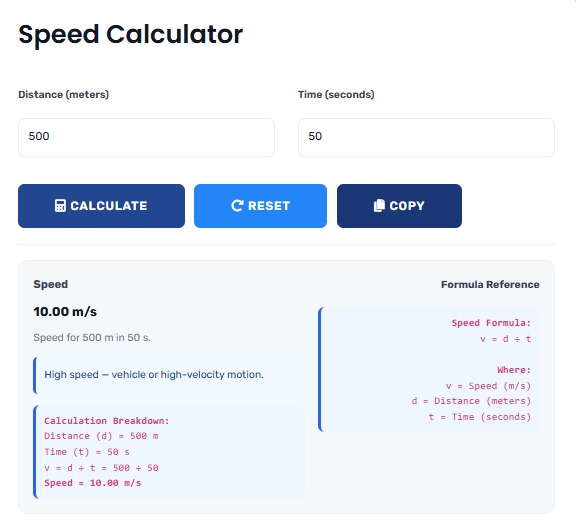
Understanding the Speed-Distance-Time Relationship
The Fundamental Formula:
Speed = Distance ÷ Time
Rearranged Formulas:
Distance = Speed × Time
Time = Distance ÷ Speed
These three equations form the complete relationship. Knowing any two values lets you calculate the third.
Real-World Speed Calculation Examples
Road Trip Planning
You're planning a 450-kilometer road trip and want to know how long it will take if you average 90 km/h.
Calculation:
- Distance: 450 km
- Speed: 90 km/h
- Time = Distance ÷ Speed = 450 ÷ 90 = 5 hours
- Result: The trip will take 5 hours at that speed
- Practical consideration: Add time for breaks, traffic, and fuel stops
This calculation helps you plan departure times and schedule breaks. If you want to arrive by 3 PM, you need to leave by 10 AM.
Marathon Training Pace
A runner wants to complete a marathon (42.195 km) in 4 hours. What pace do they need to maintain?
Calculation:
- Distance: 42.195 km
- Time: 4 hours
- Speed = Distance ÷ Time = 42.195 ÷ 4 = 10.55 km/h
- Convert to pace: 60 minutes ÷ 10.55 km/h = 5.68 minutes per km
- Final pace: 5 minutes 41 seconds per kilometer
- Training implication: Need to train at this pace or faster
This calculation helps athletes set realistic goals and training targets. Maintaining 5:41 per km for 42 km is challenging but achievable with proper training.
For fitness-related calculations, try our BMR Calculator.
Physics Problem: Projectile Motion
In a physics problem, a ball travels 50 meters in 2.5 seconds. What is its average speed?
Calculation:
- Distance: 50 meters
- Time: 2.5 seconds
- Speed = Distance ÷ Time = 50 ÷ 2.5 = 20 m/s
- Convert to km/h: 20 m/s × 3.6 = 72 km/h
- Physics context: This is the average speed, not necessarily constant
- Additional analysis: Could calculate acceleration if initial/final speeds known
Understanding these calculations helps students grasp fundamental physics concepts that apply to everything from sports to vehicle design.
For more physics tools, explore our Kinetic Energy Calculator.
Common Speed Units and Conversions
| Unit | Commonly Used In | Conversion Factor | Example | Typical Application |
|---|---|---|---|---|
| km/h (kilometers per hour) | Most countries worldwide | 1 km/h = 0.621 mph | Highway speed: 100 km/h | Road travel, weather reports |
| mph (miles per hour) | USA, UK, others | 1 mph = 1.609 km/h | Highway speed: 60 mph | US road signs, athletics |
| m/s (meters per second) | Scientific, physics | 1 m/s = 3.6 km/h | Sound speed: 343 m/s | Physics problems, engineering |
| knots (nautical mph) | Maritime, aviation | 1 knot = 1.852 km/h | Cruise ship: 20 knots | Shipping, sailing, aviation |
| min/km or min/mile | Athletics, running | Pace units | Running pace: 5:30 min/km | Running, cycling, training |
Speed vs. Velocity: Understanding the Difference
Key Distinctions:
Speed (Scalar Quantity):
- Only has magnitude (how fast)
- Examples: 60 km/h, 5 m/s, 8 mph
- Always positive or zero
- What this calculator measures
Velocity (Vector Quantity):
- Has both magnitude AND direction
- Examples: 60 km/h north, 5 m/s upward
- Can be positive or negative
- Includes directional information
Practical Example: Driving around a circular track at constant speed gives changing velocity (direction changes) but constant speed.
Types of Speed in Physics and Real Life
| Type of Speed | Definition | Example | How to Calculate | Practical Use |
|---|---|---|---|---|
| Average Speed | Total distance ÷ total time | Trip: 300 km in 4 hours = 75 km/h | What this calculator provides | Trip planning, performance analysis |
| Instantaneous Speed | Speed at a specific moment | Speedometer reading: 65 mph now | Measured at an instant | Driving, speed limits |
| Constant Speed | Unchanging speed over time | Cruise control set to 70 mph | Speed remains the same | Efficient driving, conveyors |
| Variable Speed | Changing speed over time | City driving: 0-50-30-0 km/h | Speed changes frequently | Urban driving, most real motion |
| Relative Speed | Speed relative to another object | Car A at 100 km/h, Car B at 80 km/h in same direction = 20 km/h relative speed | Difference between two speeds | Overtaking, collision analysis |
Step-by-Step Calculation Guide
How to Calculate Speed
-
Measure Distance:
- Use appropriate units: km, miles, meters
- Be precise for accurate results
- Example: 150 kilometers
-
Measure Time:
- Use consistent units: hours, minutes, seconds
- Convert to decimal if needed (30 min = 0.5 hours)
- Example: 2.5 hours
-
Apply Formula:
- Speed = Distance ÷ Time
- 150 km ÷ 2.5 hours = 60 km/h
- Check: Reasonable for highway travel
-
Consider Context:
- Is this average or instantaneous?
- Are there stops or speed changes?
- How accurate are your measurements?
Common Speed Calculation Mistakes to Avoid
Unit Confusion Errors
Common error: Mixing different units without conversion.
Example mistake: Distance in miles (60) ÷ time in minutes (30)
= 2 "miles per minute" (incorrect).
Correct approach: Convert time to hours: 30 minutes = 0.5
hours, then 60 miles ÷ 0.5 hours = 120 mph.
Solution: Always use consistent units or convert first.
Forgetting to Account for Stops
A common planning error is calculating speed based only on moving time, not total time including stops.
Example: 300 km road trip with 4 hours driving + 1 hour
stops.
Incorrect: 300 km ÷ 4 hours = 75 km/h (only driving time)
Correct: 300 km ÷ 5 hours = 60 km/h (total time including
stops)
Impact: 15 km/h difference affects arrival time by 1 hour on
this trip.
For time-related calculations, use our Time Duration Calculator.
Speed in Different Contexts
Everyday Speed References:
Walking Speeds:
- Average walk: 5 km/h (3.1 mph)
- Brisk walk: 6.5 km/h (4 mph)
- Power walk: 7.5 km/h (4.7 mph)
Running Speeds:
- Jogging: 8-10 km/h (5-6 mph)
- Running: 10-13 km/h (6-8 mph)
- Sprinting: 24-28 km/h (15-17 mph)
Vehicle Speeds:
- City driving: 30-50 km/h (19-31 mph)
- Highway: 100-120 km/h (62-75 mph)
- High-speed train: 250-320 km/h (155-199 mph)
- Commercial jet: 900 km/h (560 mph)
Advanced Speed Calculations
Calculating with Multiple Segments
A trip has three segments: 60 km at 80 km/h, 40 km at 60 km/h, and 100 km at 100 km/h. What's the overall average speed?
Step 1: Calculate times for each segment:
Segment 1: 60 km ÷ 80 km/h = 0.75 hours
Segment 2: 40 km ÷ 60 km/h = 0.667 hours
Segment 3: 100 km ÷ 100 km/h = 1 hour
Step 2: Calculate totals:
Total distance: 60 + 40 + 100 = 200 km
Total time: 0.75 + 0.667 + 1 = 2.417 hours
Step 3: Calculate overall average speed:
200 km ÷ 2.417 hours = 82.75 km/h
Key insight: Overall average speed is NOT the simple average of the three speeds (80, 60, 100 average to 80). It's weighted by the distance traveled at each speed.
Relative Speed Problems
Two trains approach each other on parallel tracks. Train A moves east at 80 km/h, Train B moves west at 100 km/h. What's their relative speed?
Moving toward each other: Add speeds: 80 + 100 = 180 km/h
relative speed.
Moving in same direction: Subtract: 100 - 80 = 20 km/h relative
speed (if Train B is behind Train A).
Practical application: Relative speed determines how quickly they meet or how long it takes to overtake. This is crucial for railway scheduling and safety.
For force and motion calculations, try our Force Calculator.
Speed Calculation Tools and Methods
| Method/Tool | How It Works | Accuracy | Best For | Limitations |
|---|---|---|---|---|
| Manual Calculation | Using formula with measured distance/time | High (if careful) | Simple problems, education | Error-prone, time-consuming |
| Speed Calculator | Automated calculation from inputs | Very High | Quick results, complex scenarios | Depends on input accuracy |
| GPS/Speedometer | Direct measurement of instantaneous speed | High | Real-time speed monitoring | Doesn't calculate average directly |
| Timing Gates | Electronic timing over known distance | Very High | Athletics, scientific measurement | Expensive, setup required |
| Radar/Lidar | Doppler effect measurement | Extremely High | Law enforcement, sports | Specialized equipment needed |
Historical Perspective on Speed
Evolution of Speed Measurement:
Ancient Methods: Early humans estimated speed by comparing to walking/running speeds. The concept of standardized units didn't exist.
17th-18th Century: Development of accurate timekeeping (pendulum clocks) enabled precise speed measurement for the first time.
19th Century: Railways created need for precise speed measurement and scheduling. Speedometers were invented (1848 by Charles Babbage).
20th Century: Automobiles popularized speed measurement for general public. Radar speed guns introduced (1947).
21st Century: GPS provides precise speed measurement accessible to everyone via smartphones.
Our calculator continues this tradition of making accurate speed calculation accessible to all.
Practical Applications Beyond Travel
Unexpected Uses of Speed Calculations:
- Economics: Calculating productivity rates (units per hour)
- Manufacturing: Determining production line speeds
- Computer Science: Measuring data transfer rates (Mbps)
- Biology: Calculating growth rates of plants/animals
- Finance: Determining rate of investment growth
- Medicine: Calculating medication administration rates
- Cooking: Determining mixing or cooking rates
The speed formula (rate = quantity ÷ time) applies to any situation where you measure how quickly something happens.
Key Insight: Speed calculation is one of the most versatile and widely applicable mathematical concepts. Whether you're planning a trip, analyzing athletic performance, solving physics problems, or optimizing processes, understanding how to calculate speed from distance and time (or vice versa) provides valuable insights for decision-making. The relationship between distance, time, and speed forms the foundation for understanding motion in our world.
Quick Reference: Common Speed Calculations
Standard Formulas:
- Speed = Distance ÷ Time
- Distance = Speed × Time
- Time = Distance ÷ Speed
Unit Conversion Factors:
- 1 km/h = 0.6214 mph
- 1 mph = 1.6093 km/h
- 1 m/s = 3.6 km/h
- 1 knot = 1.852 km/h
Useful Approximations:
- Walking speed: 5 km/h or 3 mph
- Running speed: 12 km/h or 7.5 mph
- Cycling speed: 20 km/h or 12.5 mph
- City driving: 40 km/h or 25 mph
- Highway driving: 100 km/h or 60 mph
Remember: Always use consistent units in your calculations!
Frequently Asked Questions
Average speed is total distance divided by total time for an entire journey. Instantaneous speed is the speed at a specific moment, like what your speedometer shows right now. This calculator calculates average speed.
Convert time to hours first: minutes ÷ 60 = hours. Example: 30 minutes = 0.5 hours. Then use Speed = Distance (km) ÷ Time (hours) to get km/h. Our calculator handles these conversions automatically.
Yes! Distance = Speed × Time. Example: 80 km/h for 2.5 hours = 80 × 2.5 = 200 km. Our calculator can perform this reverse calculation when needed.
In most cities, average driving speed including stops is 20-40 km/h (12-25 mph). This accounts for traffic lights, congestion, and lower speed limits. Highway driving averages 80-110 km/h (50-68 mph).
Runners calculate pace (minutes per km or mile) which is the inverse of speed. A 5:00 min/km pace equals 12 km/h. They use these calculations to predict finish times, set training paces, and track improvement.
Meters per second (m/s) is the SI unit for speed, making it consistent with other scientific measurements. It's more convenient for physics calculations involving acceleration, force, and energy. 1 m/s = 3.6 km/h.
For most trip planning, estimating to the nearest 5-10 km/h is sufficient. However, for precise scheduling (catching flights, meetings), more accurate calculations are important. Always add buffer time for unexpected delays.
