Time Duration Calculator: Calculate Exact Time Intervals Instantly
Time is our most valuable resource, and accurately tracking it can mean the difference between meeting deadlines and missing opportunities. A Time Duration Calculator is your digital assistant for precisely measuring intervals between any two points in time - whether it's tracking work hours, planning events, or calculating travel durations.
Manual time calculations can be frustrating and error-prone, especially when dealing with different time formats, time zones, or complex intervals. Our Time Duration Calculator eliminates these challenges by providing instant, accurate results in hours, minutes, and seconds - all with just a few clicks.
Why precise time tracking matters:
- Professional Productivity: Accurate billing, project tracking, and meeting management
- Academic Success: Exam timing, study sessions, and assignment deadlines
- Personal Organization: Event planning, travel scheduling, and daily routines
- Financial Accuracy: Hourly billing, overtime calculations, and time-based contracts
- Health Management: Medication schedules, treatment durations, and fitness tracking
Our calculator is part of a comprehensive suite of time management tools. For calculating age or date differences, explore our Age Calculator and Date Difference Calculator.
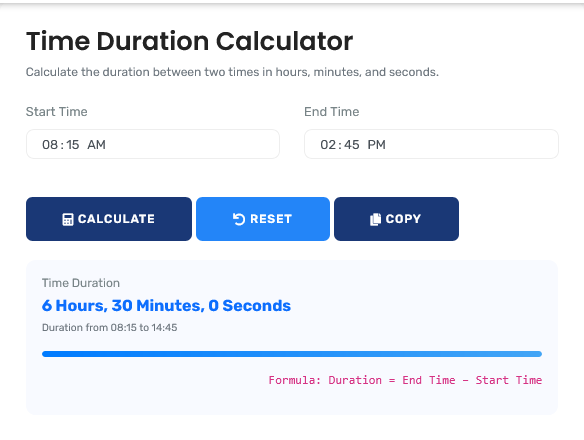
Real-World Time Duration Scenarios
Project Management: Tracking Work Hours
Sarah, a freelance graphic designer, needs to accurately track her work hours for client billing. She starts working at 9:15 AM and finishes at 5:45 PM, with a 45-minute lunch break. Manual calculation could lead to billing errors.
Work Hour Analysis:
- Start time: 9:15 AM
- End time: 5:45 PM
- Total interval: 8 hours 30 minutes
- Lunch break: 45 minutes
- Net work time: 7 hours 45 minutes
- Hourly rate: $65/hour
- Total earnings: 7.75 × $65 = $503.75
- Manual calculation risk: Miscounting minutes could result in $10-20 billing error
- Solution: Instant calculation with 100% accuracy
Using the Time Duration Calculator ensures Sarah bills clients correctly and maintains professional credibility. The 7-hour 45-minute calculation would be challenging manually, especially with the AM/PM conversion.
For tracking multiple projects, combine with our Addition Calculator for cumulative time tracking.
Travel Planning: Flight Connections
Mike is booking an international flight with a layover. His first flight arrives at 14:30 (2:30 PM), and his connecting flight departs at 16:45 (4:45 PM). He needs to know if he has enough time to clear customs and transfer terminals.
Layover Analysis:
- Arrival time: 14:30 (24-hour format)
- Departure time: 16:45 (24-hour format)
- Total layover: 2 hours 15 minutes
- Time needed: Customs (45 min) + Terminal transfer (30 min) + Buffer (30 min) = 1 hour 45 minutes
- Available time: 2 hours 15 minutes
- Margin: 30 minutes comfortable buffer
- Risk: Manual miscalculation could cause missed flight
- Benefit: Precise calculation enables confident booking
The Time Duration Calculator's 24-hour format support makes international travel planning seamless. The 2-hour 15-minute calculation is instantly clear, eliminating time format confusion.
For converting between time zones, use our Hours to Minutes Converter for precise scheduling.
Fitness Training: Workout Intervals
Robert is following a high-intensity interval training (HIIT) program that requires precise timing: 45 seconds of intense exercise followed by 15 seconds of rest, repeated for 20 minutes total.
Workout Timing Analysis:
- Interval duration: 45 seconds work + 15 seconds rest = 60 seconds per cycle
- Total workout: 20 minutes = 1,200 seconds
- Number of cycles: 1,200 ÷ 60 = 20 cycles
- Total work time: 20 × 45 seconds = 900 seconds = 15 minutes
- Total rest time: 20 × 15 seconds = 300 seconds = 5 minutes
- Manual challenge: Tracking 45-second intervals while exercising
- Solution: Pre-calculate exact intervals using calculator
Precise timing is crucial for HIIT effectiveness. The Time Duration Calculator helps Robert plan his workout structure accurately before starting his session.
For other fitness calculations, try our BMR Calculator for metabolic rate analysis.
How Time Duration Calculations Work
Time Duration Calculation Formulas:
1. Basic Time Difference:
Duration = End Time - Start Time
Example: 14:30 - 09:15 = 5 hours 15 minutes
2. With Break Deduction:
Net Duration = (End Time - Start Time) - Break Duration
Example: (17:45 - 09:15) - 00:45 = 7 hours 45 minutes
3. 24-Hour Format Conversion:
2:30 PM = 14:30
11:45 PM = 23:45
Add 12 hours to PM times (except 12 PM = 12:00)
4. Decimal Time Conversion:
1 hour 30 minutes = 1.5 hours
45 minutes = 0.75 hours
Divide minutes by 60 for decimal hours
Time Format Comparison Guide
| Time Format | Example | Best For | Calculation Method | Common Use Cases |
|---|---|---|---|---|
| 12-Hour (AM/PM) | 9:15 AM, 2:30 PM | Everyday conversations, US/UK settings | Convert to 24-hour for calculations | Appointments, meetings, social events |
| 24-Hour (Military) | 09:15, 14:30 | Professional settings, international | Direct calculation possible | Transportation, healthcare, military |
| Decimal Hours | 3.75 hours | Payroll, billing, scientific | Minutes ÷ 60 = decimal hours | Time tracking, billing, project management |
| Minutes Only | 225 minutes | Precise timing, scientific | Hours × 60 + minutes = total minutes | Cooking, experiments, presentations |
Common Time Duration Applications
| Industry/Use | Typical Calculations | Accuracy Needed | Common Errors | Our Calculator Solution |
|---|---|---|---|---|
| Freelance/Business | Work hours, meeting durations, project timelines | ±1 minute | AM/PM confusion, break miscalculations | Automatic format handling, break deduction |
| Education | Exam timing, class periods, study sessions | ±5 minutes | Time zone differences, schedule conflicts | Clear interval display, multiple format support |
| Healthcare | Medication intervals, treatment durations, shift changes | ±1 minute critical | 24-hour format errors, overlapping schedules | Precise minute-level calculations |
| Transportation | Travel times, layovers, schedules | ±5 minutes | Time zone changes, daylight saving | Time zone awareness, clear duration display |
| Events | Event timing, speaker slots, transitions | ±2 minutes | Schedule gaps, overtime miscalculations | Easy adjustment, instant recalculation |
Advanced Time Calculation Techniques
4-Step Professional Time Calculation Method:
- Standardize Format: Convert all times to 24-hour format for consistency
- Convert to Minutes: Change hours and minutes to total minutes (hours × 60 + minutes)
- Calculate Difference: Subtract start minutes from end minutes
- Convert Back: Convert total minutes back to hours and minutes format
This method ensures accuracy even for complex calculations. Our calculator automates all these steps instantly. For mathematical calculations involving time, use our Multiplication Calculator.
Common Time Calculation Mistakes
The "AM/PM Confusion" Error
Common mistake: Forgetting that 2:00 PM is 14:00, not 2:00.
Example error: Calculating 2:00 PM to 4:00 PM as 2 hours
instead of 14:00 to 16:00 = 2 hours (correct).
Worse error: Calculating 11:00 PM to 1:00 AM as 10 hours
(wrong) instead of 23:00 to 01:00 = 2 hours (correct).
Our solution: Automatic AM/PM to 24-hour conversion eliminates
this common error.
Day Boundary Errors
Calculating time intervals that cross midnight is particularly challenging. For example, calculating duration from 11:00 PM to 2:00 AM next day.
Common error: 11:00 to 2:00 = 9 hours (wrong - doesn't account
for day change)
Correct calculation: From 23:00 to 24:00 = 1 hour, plus 00:00
to 02:00 = 2 hours, total = 3 hours
Our calculator solution: Handles day boundaries automatically.
Simply enter times with their dates if needed, or use the overnight calculation
feature.
For date-based calculations, use our Date Difference Calculator.
Time Duration in Different Contexts
Case: Conference Schedule Planning
Scenario: Planning a one-day conference with 8 speakers, each with specific time slots, breaks, and networking sessions.
-
Speaker Time Allocation:
- Keynote: 9:00 AM - 10:30 AM (1.5 hours)
- Morning break: 10:30 AM - 11:00 AM (30 minutes)
- Session 1: 11:00 AM - 12:30 PM (1.5 hours)
- Lunch: 12:30 PM - 1:30 PM (1 hour)
-
Afternoon Schedule:
- Session 2: 1:30 PM - 3:00 PM (1.5 hours)
- Afternoon break: 3:00 PM - 3:30 PM (30 minutes)
- Session 3: 3:30 PM - 5:00 PM (1.5 hours)
- Networking: 5:00 PM - 6:00 PM (1 hour)
-
Total Conference Duration:
- Start: 9:00 AM, End: 6:00 PM = 9 hours total
- Presentation time: 1.5 + 1.5 + 1.5 = 4.5 hours
- Break time: 0.5 + 1 + 0.5 = 2 hours
- Networking: 1 hour
- Buffer time: 1.5 hours (unaccounted but needed)
For financial planning of such events, use our ROI Calculator.
Time Tracking Tools Comparison
| Tool Type | Best For | Accuracy | Ease of Use | Cost |
|---|---|---|---|---|
| Manual Calculation | Quick estimates, simple intervals | Low-Medium | Difficult for complex calculations | Free (but error-prone) |
| Basic Calculator | Simple arithmetic with time | Medium | Requires format conversion | Free |
| Spreadsheet Formulas | Repetitive calculations, data sets | High | Steep learning curve | Free with software |
| Our Time Duration Calculator | All use cases, especially complex intervals | Very High | Extremely easy | Free |
| Professional Software | Enterprise time tracking | Very High | Complex setup | $10-$100/month |
Special Time Calculation Considerations
Important Factors in Time Calculations:
- Daylight Saving Time: Some regions change clocks twice yearly
- Time Zones: Crucial for international scheduling
- Leap Seconds: Occasionally added to coordinate universal time
- Business Hours: Consider working days and hours
- Cultural Differences: Different time perception and punctuality norms
- Seasonal Variations: Daylight hours affect scheduling in some industries
While our calculator handles basic time differences perfectly, for time zone conversions specifically, specialized tools may be needed.
Time Duration Calculation Examples
Example 1: Cooking Multiple Dishes
Scenario: Preparing a meal with different cooking times that must be ready simultaneously.
Dishes:
1. Roast: 2 hours 15 minutes
2. Vegetables: 45 minutes
3. Sauce: 30 minutes
4. Dessert: 1 hour
Timing Strategy:
Start roast at 4:00 PM (ready at 6:15 PM)
Start vegetables at 5:30 PM (ready at 6:15 PM)
Start sauce at 5:45 PM (ready at 6:15 PM)
Start dessert at 5:00 PM (ready at 6:00 PM, can rest 15 minutes)
Key: All main dishes ready at 6:15 PM, dessert ready at 6:00 PM.
Example 2: Student Study Schedule
Scenario: A student has 4 subjects to study with limited time before exams.
Available time: 6:00 PM - 10:00 PM = 4 hours = 240 minutes
Subject allocation:
Math: 25% = 60 minutes
Science: 30% = 72 minutes
English: 20% = 48 minutes
History: 25% = 60 minutes
Schedule:
6:00-7:00 PM: Math (60 min)
7:00-7:10 PM: Break (10 min)
7:10-8:22 PM: Science (72 min)
8:22-8:32 PM: Break (10 min)
8:32-9:20 PM: English (48 min)
9:20-9:30 PM: Break (10 min)
9:30-10:30 PM: History (60 min) - extends slightly
For percentage calculations in scheduling, use our Percentage Calculator.
Key Insight: Time duration calculations are foundational to effective time management in every aspect of life. Whether you're billing clients, planning travel, scheduling events, or managing daily routines, accurate time calculations prevent errors, reduce stress, and improve outcomes. The few seconds spent using our calculator can save hours of manual calculation and prevent costly mistakes. For countdowns to specific events, check our Countdown Calculator.
Quick Reference: Time Conversion Factors
Basic Time Conversions:
- 1 hour = 60 minutes = 3,600 seconds
- 1 minute = 60 seconds
- 1 day = 24 hours = 1,440 minutes = 86,400 seconds
- 1 week = 168 hours = 10,080 minutes = 604,800 seconds
Decimal Time Conversions:
- 15 minutes = 0.25 hours
- 30 minutes = 0.5 hours
- 45 minutes = 0.75 hours
- 1 hour 20 minutes = 1.333 hours
- 2 hours 45 minutes = 2.75 hours
Common Time Durations:
- Standard work day: 8 hours
- Typical meeting: 30-60 minutes
- Movie runtime: 1.5-2.5 hours
- Flight (NY to LA): 5-6 hours
- Sleep recommendation: 7-9 hours
Tip: Bookmark this page for quick access to these reference points during your time calculations!
Frequently Asked Questions
Yes, our Time Duration Calculator handles overnight calculations perfectly. Simply enter the start time and end time, even if they're on different days. The calculator automatically calculates the correct duration, accounting for the day change. For example, 11:00 PM to 2:00 AM calculates as 3 hours, not 21 hours.
Absolutely! Our calculator supports both 12-hour (AM/PM) and 24-hour (military) time formats. You can enter times in either format, and the calculator will process them correctly. This flexibility makes it useful for international users and various professional contexts.
Our calculator provides 100% mathematical accuracy for time calculations. It handles hours, minutes, and seconds with precision. However, it's important to note that it calculates mathematical time intervals, not necessarily "clock time" which can be affected by time zones, daylight saving, or leap seconds in real-world applications.
Yes, you can calculate net time by subtracting breaks. Simply calculate the total duration from start to end, then subtract any break periods. Many users calculate work hours this way: total time minus lunch breaks equals net work time. Our calculator makes this easy with its precise subtraction capabilities.
There's no practical limit. You can calculate durations from seconds to years. The calculator handles any time interval you need to measure. For very long durations (months or years), you might want to use our Date Difference Calculator for more precise calendar-based calculations.
Yes, many professionals use our calculator for time tracking and billing. It provides precise decimal hour conversions (like 1 hour 30 minutes = 1.5 hours) which are essential for accurate billing. However, for complex payroll with multiple rates, overtime, and deductions, specialized payroll software would be more appropriate.
