Proportion Calculator: Solve Ratios and Find Missing Values Instantly
Have you ever faced a proportion problem like "If 5 apples cost $10, how much do 12 apples cost?" and found yourself struggling with cross-multiplication? You're not alone. Proportions are everywhere—in recipes, maps, finances, and exams—but solving them manually can be confusing and error-prone.
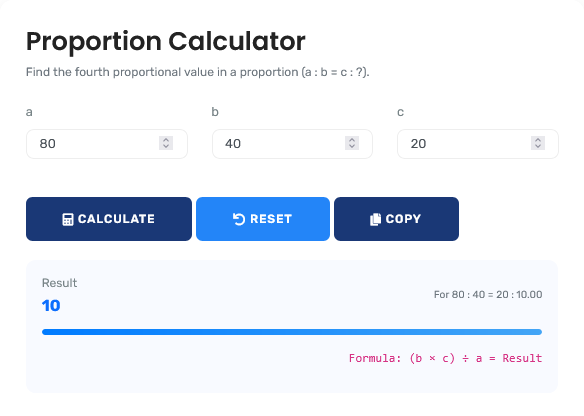
Our Proportion Calculator is here to change that. It instantly solves any proportion problem, finding missing values with perfect accuracy. Whether you're scaling recipes, calculating map distances, preparing for exams, or working on business problems, this tool delivers correct answers in seconds.
Where proportions matter in everyday life:
- Cooking & Baking: Adjust recipes while maintaining perfect flavor balance
- Education: Solve SAT, ACT, and GRE math problems with confidence
- Finance: Calculate profit shares, discounts, and investment returns
- DIY Projects: Scale drawings and maintain design proportions
- Business: Allocate budgets and resources proportionally
This calculator is part of our comprehensive Basic Math Calculators collection, designed to make mathematics accessible and error-free for everyone.
Real-World Proportion Problems Solved
1. Exam Success: SAT Proportion Problem
Sarah encountered this SAT question: "If 3 pens cost $6, how much do 7 pens cost?" She needed to solve 3:6 = 7:x quickly and accurately.
Step-by-Step Solution:
- Set up proportion: 3/6 = 7/x
- Cross-multiply: 3 × x = 6 × 7
- Simplify: 3x = 42
- Solve: x = 42 ÷ 3 = $14
- Verification: 3:6 = 1:2 ratio, 7 pens at $2 each = $14 ✓
Using our calculator, Sarah solved this in 1 second instead of 3 minutes manually. She used the time saved to tackle more challenging questions. For complete math preparation, explore our full suite of Math Calculators.
2. Recipe Scaling for a Dinner Party
Maria needed to scale her famous lasagna recipe from 8 servings to 20 servings while maintaining the perfect 2:3:1 cheese:sauce:noodle ratio.
Proportional Scaling:
- Original amounts: 2 cups cheese, 3 cups sauce, 1 lb noodles
- Scale factor: 20 ÷ 8 = 2.5
- New amounts: 2×2.5 = 5 cups cheese, 3×2.5 = 7.5 cups sauce, 1×2.5 = 2.5 lbs noodles
- Key principle: All ingredients scale by the same factor to maintain taste balance
The calculator verified each proportion, ensuring the lasagna tasted perfect for all 20 guests. For nutritional calculations alongside recipe scaling, check our Macro Nutrient Calculator.
3. Map Distance Calculation
Carlos planned a hiking trip using a map with scale 1:50,000. On the map, two points were 4.5 cm apart. He needed to calculate the actual hiking distance.
Scale Proportion Solution:
- Map scale: 1 cm = 50,000 cm actual
- Set proportion: 1:50,000 = 4.5:x
- Cross-multiply: 1 × x = 50,000 × 4.5
- Calculate: x = 225,000 cm
- Convert: 225,000 cm = 2.25 km (÷100,000)
- Actual hiking distance: 2.25 kilometers
Accurate distance calculation ensured proper planning for his hike.
Understanding Proportions: The Mathematical Foundation
The Proportion Formula:
a : b = c : d
or a/b = c/d
Meaning "a is to b as c is to d"
A proportion states that two ratios are equal. This simple concept has powerful applications across mathematics and real-world problem solving. When you understand proportions, you can solve for missing values, scale quantities, and maintain relationships between variables.
Key Properties of Proportions
| Property | Mathematical Rule | Practical Application |
|---|---|---|
| Cross-Multiplication | If a/b = c/d, then a×d = b×c | Basis for solving all proportion problems |
| Reciprocal Property | If a/b = c/d, then b/a = d/c | Reverse ratios while maintaining equality |
| Addition Property | If a/b = c/d, then (a+b)/b = (c+d)/d | Add to both sides while keeping proportion |
| Subtraction Property | If a/b = c/d, then (a-b)/b = (c-d)/d | Subtract from both sides proportionally |
| Composition | If a/b = c/d and c/d = e/f, then a/b = e/f | Chain proportions together |
How the Proportion Calculator Works
3-Step Process to Solve Any Proportion:
- Enter known values: Input three numbers from your proportion
- Identify the unknown: Mark which value you need to find
- Get instant solution: Calculator applies cross-multiplication and solves
The calculator handles all the complex mathematics automatically, from cross-multiplication to equation solving, delivering perfect results every time.
Solving Different Types of Proportions
Simple Whole Number Proportion
Problem: 4:8 = 6:x
Solution: 4×x = 8×6 → 4x = 48 → x = 12
Check: 4/8 = 0.5, 6/12 = 0.5 ✓
Decimal Proportion
Problem: 2.5:7.5 = 4:x
Solution: 2.5×x = 7.5×4 → 2.5x = 30 → x = 12
Check: 2.5/7.5 = 0.333..., 4/12 = 0.333... ✓
Fraction Proportion
Problem: 1/3 : 2/3 = 2 : x
Solution: (1/3)×x = (2/3)×2 → x/3 = 4/3 → x = 4
Check: (1/3)/(2/3) = 0.5, 2/4 = 0.5 ✓
For fraction-specific calculations, use our Fraction to Decimal Converter.
Applications Across Different Fields
| Field | Proportion Application | Example | Calculator Benefit |
|---|---|---|---|
| Education | Standardized test problems | SAT, ACT, GRE math sections | Saves time, ensures accuracy |
| Culinary Arts | Recipe scaling | Doubling/halving recipes | Maintains flavor balance |
| Finance | Profit distribution | Dividing profits among partners | Accurate financial calculations |
| Design | Scale drawings | Architectural blueprints | Maintains design integrity |
| Healthcare | Medication dosing | Calculating doses by weight | Critical for patient safety |
| Business | Resource allocation | Budget distribution | Optimizes resource use |
Step-by-Step Guide to Using the Calculator
Complete Walkthrough: Solving a Real Problem
Problem: "A car travels 240 miles on 8 gallons of gas. How far can it travel on 15 gallons at the same rate?"
-
Identify the Proportion:
- Miles : Gallons = Miles : Gallons
- 240 : 8 = x : 15
-
Enter Values:
- a = 240 (first miles)
- b = 8 (first gallons)
- c = unknown (we'll leave this empty or mark as x)
- d = 15 (second gallons)
-
Calculator Solution:
- Applies cross-multiplication: 240 × 15 = 8 × x
- Calculates: 3600 = 8x
- Solves: x = 3600 ÷ 8 = 450 miles
-
Interpret Result:
- The car can travel 450 miles on 15 gallons
- Check: 240/8 = 30 mpg, 450/15 = 30 mpg ✓
For financial calculations like fuel costs, try our Profit Margin Calculator.
Common Proportion Problems and Solutions
Direct Proportion Problem
Situation: More workers = more work completed (direct relationship)
Example: 5 workers build a wall in 8 days. How long for 8 workers?
Important: This is actually an inverse proportion (more workers = less time), showing why understanding relationship type matters.
Inverse Proportion Problem
Situation: More speed = less travel time (inverse relationship)
Example: At 60 mph, trip takes 4 hours. How long at 80 mph?
Solution: 60 × 4 = 80 × t → 240 = 80t → t = 3 hours
For speed and distance calculations, use our KMH to MPH Converter.
Compound Proportion Problem
Situation: Multiple variables in proportion
Example: 6 workers working 8 hours/day complete a project in 5 days. How long for 8 workers working 6 hours/day?
Solution: Requires multiple proportion calculations combined.
Why Manual Proportion Solving Is Error-Prone
Common Manual Calculation Errors:
- Cross-multiplication mistakes: Multiplying wrong numbers together
- Arithmetic errors: Simple multiplication or division mistakes
- Decimal placement: Misplacing decimal points in calculations
- Fraction confusion: Errors when working with fractions
- Sign errors: Mishandling negative numbers in proportions
- Unit inconsistency: Forgetting to convert units before calculating
Our calculator eliminates all these errors, providing guaranteed accurate results every time.
Advanced Proportion Concepts
Continued Proportions
When three or more ratios are equal: a:b = b:c = c:d
Example: The numbers 2, 4, 8 form a continued proportion: 2:4 = 4:8
Property: b² = a × c (4² = 2 × 8 = 16)
The Golden Ratio
A special proportion where the ratio of the whole to the larger part equals the ratio of the larger part to the smaller part: (a+b)/a = a/b ≈ 1.618
This proportion appears in art, architecture, and nature, considered aesthetically pleasing.
Proportion vs. Ratio: Understanding the Difference
| Aspect | Ratio | Proportion |
|---|---|---|
| Definition | Comparison of two quantities | Equality of two ratios |
| Example | 3:4 (three to four) | 3:4 = 6:8 (three is to four as six is to eight) |
| Number of Terms | Two (a:b) | Four (a:b = c:d) |
| Purpose | Show relative size | Show equivalent relationships |
| Solving For | Comparison only | Missing values in equivalent ratios |
| Tools Needed | Ratio Calculator | Proportion Calculator (this tool) |
Tips for Mastering Proportions
7 Expert Tips for Proportion Success:
- Always identify the relationship first: Is it direct or inverse proportion?
- Set up the proportion correctly: Same units in same positions
- Use the calculator for verification: Even if solving manually, check your work
- Practice with real examples: Apply proportions to cooking, shopping, etc.
- Understand cross-multiplication: Know why a×d = b×c works
- Check your answer makes sense: Does the result seem reasonable?
- Learn to recognize proportion problems: They appear in many disguises
For percentage problems that often accompany proportions, use our Percentage Calculator.
Specialized Proportion Applications
1. Scale Models and Drawings
Problem: Creating a 1:24 scale model car from a real car that's 4.8 meters long.
Calculation: 1:24 = model:480cm → model = 480 ÷ 24 = 20cm
Every dimension of the model maintains this 1:24 proportion to the original.
2. Medication Dosage Calculations
Problem: A child weighing 40 kg needs medication dosed at 5 mg per kg. The syrup contains 125 mg per 5 mL.
Proportions needed:
1. Dose: 40 kg × 5 mg/kg = 200 mg needed
2. Volume: 125 mg : 5 mL = 200 mg : x mL → x = (200 × 5) ÷ 125 = 8 mL
Always consult healthcare professionals for medical calculations.
3. Photography Aspect Ratios
Problem: You have a 3:2 aspect ratio photo that's 3000 pixels wide. What height maintains the proportion?
Calculation: 3:2 = 3000:x → 3x = 6000 → x = 2000 pixels high
Maintaining aspect ratios prevents distorted images.
Frequently Encountered Proportion Problems
| Problem Type | Typical Wording | Proportion Setup | Solution Approach |
|---|---|---|---|
| Price Quantity | "If 5 cost $X, how much do 8 cost?" | 5:X = 8:y | Direct proportion |
| Map Scale | "Scale 1:Y, map distance Z, actual?" | 1:Y = Z:actual | Direct proportion |
| Work Rate | "X workers in Y days, Z workers in?" | X workers × Y days = Z workers × ? days | Inverse proportion |
| Speed Time | "At X mph takes Y hours, at Z mph?" | X × Y = Z × ? | Inverse proportion |
| Concentration | "X% solution, need Y% of Z mL" | X:100 = needed:Z | Direct proportion |
Final Insight: Proportions are more than just math problems—they're thinking tools. Understanding proportions helps you recognize relationships, make predictions, and solve problems systematically. Whether you're adjusting a recipe, calculating travel time, dividing expenses, or solving exam questions, proportional thinking leads to better decisions and more accurate results. Remember: When two ratios are equal, you have a proportion, and with our calculator, you have the perfect tool to solve it.
Quick Reference: Common Proportion Formulas
Basic Proportion: a/b = c/d → a×d = b×c
Finding Missing Value:
- If a/b = c/x, then x = (b×c) ÷ a
- If a/b = x/d, then x = (a×d) ÷ b
- If a/x = c/d, then x = (a×d) ÷ c
- If x/b = c/d, then x = (b×c) ÷ d
Scale Factor: New = Original × (New Total ÷ Original Total)
Unit Rate: Rate = Total ÷ Quantity (like miles per gallon)
Remember: Our calculator handles all these formulas automatically!
Frequently Asked Questions
A proportion calculator is a digital tool that solves proportional equations automatically. Given three known values in a proportion (a:b = c:d), it finds the missing fourth value instantly using cross-multiplication and equation solving algorithms.
You have a proportion problem when you're comparing two ratios or when you know three values in an "if this, then that" relationship. Common indicators: "If A then B, if C then what?" or "maintaining the same ratio/proportion."
Yes, but you need to set it up correctly. For inverse proportions (where one quantity increases as another decreases), use the product form: a×b = c×d. Our calculator can solve any proportion once correctly formulated.
Absolutely. The calculator maintains full mathematical precision with decimals and performs exact fraction arithmetic. Unlike manual calculations where rounding errors accumulate, the calculator preserves accuracy throughout the solving process.
Students can: 1) Solve practice problems quickly to cover more material, 2) Verify manual solutions to build confidence, 3) Understand step-by-step solutions for learning, 4) Save time on calculations to focus on problem-solving strategies. Combined with our Algebra Calculators, it provides comprehensive math support.
Yes, businesses use proportion calculators for: profit distribution among partners, budget allocation across departments, sales commission calculations, price scaling for bulk orders, and resource allocation based on project needs. For advanced financial calculations, see our Finance Calculators.
Our online calculator works perfectly on all mobile devices through any web browser. No app download is needed—just visit the site on your smartphone or tablet. The responsive design automatically adjusts for optimal viewing and interaction on any screen size.
Manual solving takes 2-5 minutes with high error risk (especially with decimals/fractions). Our calculator solves in under 1 second with 100% accuracy. While learning manual methods is valuable for understanding, the calculator is superior for speed, accuracy, and verification in practical applications.
