ROI Calculator: Measure Your Investment Returns Accurately
Return on Investment (ROI) is one of the most important financial metrics for evaluating the profitability of any investment. Whether you're starting a business, investing in stocks, launching a marketing campaign, or making home improvements, understanding your ROI helps you make smarter financial decisions.
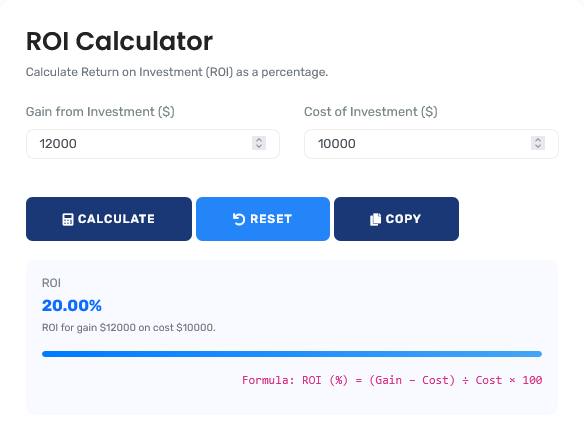
Our ROI calculator simplifies complex financial calculations, helping you determine exactly how much return you're getting on your investments. By comparing gains against costs, you can objectively assess which opportunities offer the best potential for growth and profitability.
Common applications of ROI calculations:
- Business Investments: Evaluating equipment purchases, marketing campaigns, or expansion projects
- Stock Market: Calculating returns on stock, bond, or mutual fund investments
- Real Estate: Assessing rental property or renovation project profitability
- Education: Determining the financial return on degrees or certifications
- Personal Finance: Comparing different savings or investment options
Understanding ROI helps you prioritize investments and allocate resources effectively. For related calculations, check our Profit Margin Calculator for business profitability analysis.
Real-Life ROI Scenarios
Small Business: Marketing Campaign Investment
Sarah owns a boutique bakery and invested $5,000 in a social media marketing campaign. She tracked the campaign's impact on sales over the next three months to calculate her ROI.
Marketing ROI Analysis:
- Campaign cost: $5,000 (design, ads, content creation)
- Attributed sales increase: $18,500 over 3 months
- Profit margin on sales: 45%
- Net profit from campaign: $18,500 × 0.45 = $8,325
- ROI calculation: ($8,325 - $5,000) ÷ $5,000 × 100 = 66.5%
- Key insight: Campaign paid for itself in about 2 months
- Decision: Continue and possibly expand the campaign
- Long-term benefit: Gained 150 new email subscribers for future marketing
By calculating ROI, Sarah could objectively evaluate her marketing spend and make data-driven decisions about future investments.
For calculating overall business profitability, try our Break-Even Calculator.
Home Renovation: Kitchen Remodel Investment
Mike and Lisa invested $35,000 in a kitchen remodel and wanted to understand the potential return when they sell their home in 3-5 years.
Home Improvement ROI Analysis:
- Remodel cost: $35,000 (materials, labor, appliances)
- Estimated home value increase: $48,000 (based on comparable sales)
- ROI calculation: ($48,000 - $35,000) ÷ $35,000 × 100 = 37.1%
- Time factor: Expected to sell in 4 years
- Annualized ROI: Approximately 9.3% per year
- Comparison: Better than many traditional investments
- Additional benefits: Enjoyment of upgraded kitchen for 4 years
- Market consideration: ROI varies by location and market conditions
This calculation helped them prioritize which home improvements would provide the best financial return.
For other financial calculations, use our Compound Interest Calculator.
Education: MBA Program Investment
Robert considered investing $85,000 in an MBA program and wanted to calculate the potential return on his education investment.
Education ROI Analysis:
- Program cost: $85,000 (tuition, books, lost wages)
- Current salary: $65,000 annually
- Expected post-MBA salary: $95,000 annually
- Salary increase: $30,000 annually
- Time to recoup investment: $85,000 ÷ $30,000 = 2.83 years
- 5-year ROI: (5 × $30,000 - $85,000) ÷ $85,000 × 100 = 76.5%
- Additional benefits: Career advancement, network expansion
- Consideration: ROI improves with longer career horizon
By calculating the ROI, Robert could make an informed decision about whether the MBA investment made financial sense for his situation.
For retirement planning, check our Retirement Savings Calculator.
ROI Formulas and Calculations
Essential ROI Formulas:
1. Basic ROI Formula:
ROI = (Net Profit ÷ Cost of Investment) × 100%
Example: Invest $10,000, gain $12,000 → ROI = (2,000 ÷ 10,000) × 100 = 20%
2. Annualized ROI:
Annualized ROI = [(1 + ROI)^(1 ÷ Years)] - 1
Example: 50% ROI over 3 years → (1.5^(1/3)) - 1 = 14.5% annually
3. ROI with Multiple Cash Flows:
Use Net Present Value (NPV) for irregular cash flows
More accurate for complex investments
4. Simple Payback Period:
Payback Period = Initial Investment ÷ Annual Cash Inflow
Quick measure of investment recovery time
ROI Benchmarks by Investment Type
| Investment Type | Typical ROI Range | Time Horizon | Risk Level | Liquidity |
|---|---|---|---|---|
| Stock Market (S&P 500) | 7-10% annually | Long-term (5+ years) | Medium-High | High |
| Real Estate (Rental) | 8-12% annually | Medium-Long term | Medium | Low |
| Small Business | 15-30% annually | 3-5 years | High | Low |
| Education | 10-15% annually | Lifetime | Low-Medium | N/A |
| Marketing Campaigns | 25-50% (varies widely) | Short-term | Medium | Medium |
Factors That Affect ROI Calculations
| Factor | Impact on ROI | How to Account For It | Common Mistakes | Best Practices |
|---|---|---|---|---|
| Time Horizon | Longer time usually increases ROI | Use annualized ROI for comparisons | Comparing different time periods directly | Always annualize for fair comparison |
| Inflation | Reduces real ROI | Calculate real ROI = nominal ROI - inflation | Ignoring inflation's impact | Use 2-3% inflation in long-term calculations |
| Taxes | Reduces net ROI | Use after-tax returns in calculations | Forgetting tax implications | Consult tax advisor for specific situations |
| Opportunity Cost | What you give up by choosing this investment | Compare against next best alternative | Ignoring what else you could do with the money | Always consider alternative investments |
| Risk | Higher risk should mean higher potential ROI | Adjust expected ROI for risk level | Chasing high ROI without considering risk | Balance risk and return appropriately |
Practical ROI Calculation Framework
5-Step Process for Accurate ROI Calculations:
- Identify all costs: Include purchase price, fees, maintenance, operating costs
- Calculate total benefits: Include revenue, savings, increased efficiency
- Determine time period: Be consistent in your time horizon
- Apply the formula: Use basic or annualized ROI as appropriate
- Compare alternatives: Use ROI to compare different investment options
This systematic approach ensures you don't miss important factors in your calculations. For percentage calculations, use our Percentage Calculator.
Common ROI Calculation Mistakes
The "Ignoring All Costs" Error
Common mistake: Only counting the purchase price as cost.
Example: Buying rental property for $200,000 but forgetting
closing costs ($10,000), repairs ($15,000), and ongoing maintenance.
Result: Calculated ROI: 8%, Actual ROI: 5.5%.
Solution: Create comprehensive list of all costs before
calculating.
Overestimating Benefits
Many investors overestimate how much benefit they'll receive from an investment, leading to disappointing actual returns.
Common error: Assuming best-case scenario for benefits.
Example: Business investment expecting $50,000 annual profit
but only achieving $35,000.
Better approach: Use conservative estimates for benefits.
• Best case: $50,000 profit
• Likely case: $35,000 profit
• Worst case: $20,000 profit
Calculate ROI for all scenarios to understand potential outcomes.
For financial planning, use our Future Value Calculator.
Advanced ROI Considerations
Case: Evaluating a Business Equipment Purchase
Scenario: A printing business considers purchasing a $25,000 digital press that promises to increase efficiency and revenue.
-
Total Cost Calculation:
- Equipment price: $25,000
- Installation: $2,000
- Training: $1,500
- First-year maintenance: $800
- Total initial cost: $29,300
-
Benefit Projections:
- Increased production capacity: $18,000 annually
- Labor cost reduction: $8,000 annually
- Energy savings: $1,200 annually
- Total annual benefit: $27,200
-
ROI Calculation:
- First-year net gain: $27,200 - $800 maintenance = $26,400
- First-year ROI: ($26,400 - $29,300) ÷ $29,300 = -9.9% (negative first year)
- Second-year net gain: $27,200 (no additional costs)
- Two-year ROI: (($26,400 + $27,200) - $29,300) ÷ $29,300 = 82.9%
- Payback period: Approximately 13 months
This analysis shows that while the first year shows negative ROI, the investment becomes profitable in the second year. For business calculations, try our Markup Calculator.
ROI vs. Other Financial Metrics
| Metric | What It Measures | Best For | Limitations | When to Use |
|---|---|---|---|---|
| ROI | Overall return percentage | Quick comparison of different investments | Doesn't consider time value of money | Initial screening of opportunities |
| NPV (Net Present Value) | Absolute dollar value considering time | Projects with multiple cash flows over time | More complex to calculate | Major capital investments |
| IRR (Internal Rate of Return) | Annualized return rate | Comparing projects of different sizes/durations | Can give multiple answers in some cases | Capital budgeting decisions |
| Payback Period | Time to recover initial investment | Assessing investment risk and liquidity | Ignores cash flows after payback | Risk-averse decision making |
| Profit Margin | Percentage profit on sales | Operating efficiency assessment | Doesn't consider investment size | Ongoing business performance |
When ROI Calculations Can Be Misleading
Situations Where ROI Needs Careful Interpretation:
- Very short time periods: ROI can appear extremely high or low
- Intangible benefits: Hard to quantify but valuable (brand reputation, customer loyalty)
- Strategic investments: May have low immediate ROI but high long-term value
- Required investments: Sometimes you must invest regardless of ROI (compliance, safety)
- Synergistic effects: Investments that enable other profitable activities
Always consider the broader context beyond just the ROI number. Some valuable investments don't show strong immediate ROI but are still worth making.
Key Insight: ROI is a powerful tool for comparing investment options, but it's not the only factor to consider. A good investment decision balances ROI with risk, time horizon, liquidity needs, and strategic importance. Use ROI as one important metric in your decision-making process, not the sole determinant. For comprehensive financial analysis, combine ROI calculations with other metrics and consider both quantitative and qualitative factors.
Quick ROI Reference Guide
Good ROI Benchmarks:
- Stock market index funds: 7-10% annually (long-term average)
- Real estate: 8-12% annually (varies by location and property)
- Small business: 15-30% annually (higher risk, higher potential)
- Marketing campaigns: Varies widely by industry and campaign type
- Education: 10-15% annually (lifetime earnings increase)
Red Flags:
- Promises of "guaranteed" high ROI (usually indicates scam)
- ROI calculations that ignore important costs
- Investments that seem too good to be true (they usually are)
- Pressure to invest quickly without time for due diligence
Remember: Past performance doesn't guarantee future results. Always do your own research and consider consulting with financial professionals for significant investments.
Frequently Asked Questions
A "good" ROI depends on the investment type, risk level, and time horizon. Generally:
- Low-risk investments: 3-5% annually (savings accounts, CDs)
- Medium-risk investments: 6-10% annually (stock market index funds)
- High-risk investments: 10%+ annually (individual stocks, startups)
- Business investments: 15-30%+ annually (varies by industry)
The key is comparing ROI against appropriate benchmarks and considering the risk involved.
For investments with multiple cash inflows and outflows over time, use these methods:
- Simple average: Total net cash flow ÷ total investment ÷ years
- Annualized ROI: [(Ending value ÷ Beginning value)^(1/years)] - 1
- NPV method: Discount future cash flows to present value, then calculate ROI
- IRR: The discount rate that makes NPV = 0 (more complex but accurate)
For regular investments, our calculator can handle multiple cash flow scenarios.
Use the standard ROI formula when comparing investments with the same time period. Use annualized ROI when comparing investments with different time periods. Example:
- Investment A: 50% ROI over 2 years
- Investment B: 30% ROI over 1 year
- Standard ROI suggests A is better (50% vs 30%)
- Annualized ROI: A = 22.5% annually, B = 30% annually → B is actually better per year
Always annualize when comparing different time periods.
Inflation reduces the purchasing power of your returns. To account for inflation:
- Nominal ROI: The percentage return without adjusting for inflation
- Real ROI: Nominal ROI - inflation rate
- Example: 8% nominal ROI with 3% inflation = 5% real ROI
For long-term investments, always consider real ROI to understand your true purchasing power increase.
ROI (Return on Investment) measures return relative to total investment. ROE (Return on Equity) measures return relative to shareholders' equity. Key differences:
- ROI: Used for individual projects or investments
- ROE: Used to evaluate company performance for shareholders
- Calculation: ROI uses total investment, ROE uses equity only
- Perspective: ROI = investor perspective, ROE = owner perspective
Use ROI for specific investment decisions, ROE for evaluating overall company performance.
Yes, ROI can be negative when an investment loses money. Negative ROI means:
- Your investment returned less than the original amount
- You experienced a net loss on the investment
- Example: Invest $10,000, get back $9,000 → ROI = -10%
Negative ROI doesn't necessarily mean a bad decision if there were important non-financial benefits or if it was a necessary investment (like safety equipment). However, for purely financial investments, negative ROI should be avoided when possible.
