Discount Calculator: How to Calculate Savings Like a Pro
Discounts are everywhere - from shopping sales to restaurant specials, from clearance racks to holiday promotions. But do you know how to calculate the actual savings accurately? Understanding discount calculations helps you make smarter purchasing decisions, compare deals effectively, and maximize your savings.
Whether you're shopping for clothes, planning a major purchase, or running a business, knowing how to calculate discounts properly ensures you get the best value for your money. Our discount calculator makes these calculations quick, accurate, and easy to understand.
Everyday uses for discount calculations:
- Shopping Smart: Comparing sale prices to find the best deals
- Budget Planning: Calculating actual costs during sales seasons
- Business Operations: Setting sale prices and calculating profit margins
- Financial Decisions: Evaluating credit card rewards and cashback offers
- Personal Finance: Understanding the true value of discounts and coupons
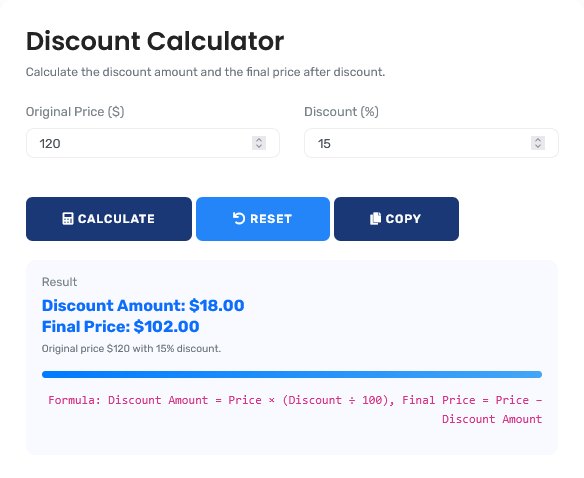
Our discount calculator takes the confusion out of percentage calculations. For related business calculations, check our Markup Calculator for pricing strategies.
Real-Life Discount Scenarios
Sarah's Black Friday Shopping Strategy
Sarah planned her Black Friday shopping carefully. She found a winter coat originally priced at $189.99 with a 30% discount, plus an additional 15% off with her store loyalty card. She needed to calculate the final price to compare with other stores.
Discount Calculation Analysis:
- Original price: $189.99
- First discount: 30% off
- Price after first discount: $189.99 × 0.70 = $132.99
- Second discount: Additional 15% off
- Final price: $132.99 × 0.85 = $113.04
- Total savings: $189.99 - $113.04 = $76.95
- Effective discount: $76.95 ÷ $189.99 × 100% = 40.5% total savings
- Key insight: Stacked discounts don't simply add (30% + 15% ≠ 45%)
- Comparison: Another store offered 35% off straight = $123.49
By calculating accurately, Sarah realized the stacked discounts gave her a better deal than a straight 35% discount would have.
For calculating percentage increases, try our Percentage Calculator.
Mike's Furniture Store Clearance Decision
Mike found a dining set he liked, originally priced at $1,299. The store offered 25% off, plus an additional $200 discount for floor models. He needed to calculate which furniture protection plan to choose based on the final price.
Complex Discount Analysis:
- Original price: $1,299
- Percentage discount: 25% off
- Price after percentage: $1,299 × 0.75 = $974.25
- Dollar discount: Additional $200 off
- Final price: $974.25 - $200 = $774.25
- Total savings: $1,299 - $774.25 = $524.75
- Effective discount rate: $524.75 ÷ $1,299 × 100% = 40.4%
- Protection plan (5% of final price): $774.25 × 0.05 = $38.71
- Smart move: Calculate if protection plan is worth it based on actual savings
Understanding the math helped Mike negotiate better terms on the protection plan and feel confident about his purchase decision.
For financial planning, use our Budget Planner Calculator.
Robert's Small Business Sale Pricing
Robert runs a small boutique and planned a seasonal sale. He needed to calculate sale prices that would attract customers while maintaining reasonable profit margins on items that cost him $45 each.
Business Pricing Analysis:
- Cost price: $45 per item
- Original selling price: $89.99 (100% markup)
- Target sale discount: 40% off
- Sale price: $89.99 × 0.60 = $53.99
- Profit per item at sale: $53.99 - $45 = $8.99
- Profit margin at sale: $8.99 ÷ $53.99 × 100% = 16.7%
- Break-even analysis: Need to sell 3× volume to match original profit
- Strategic decision: 30% discount might be better for maintaining margins
- At 30% off: $89.99 × 0.70 = $62.99, profit = $17.99, margin = 28.6%
By calculating different discount scenarios, Robert chose a 30% sale that balanced customer appeal with healthy profit margins.
For profit calculations, check our Profit Margin Calculator.
Discount Formulas and Calculations
Essential Discount Formulas:
1. Percentage Discount:
Sale Price = Original Price × (1 - Discount Percentage ÷ 100)
Example: $100 with 20% off = $100 × 0.80 = $80
2. Dollar Amount Discount:
Sale Price = Original Price - Discount Amount
Example: $100 with $25 off = $100 - $25 = $75
3. Multiple Discounts (Stacked):
Final Price = Original Price × (1 - D1) × (1 - D2) × ...
Example: $100 with 20% then 10% = $100 × 0.80 × 0.90 = $72
4. Finding Discount Percentage:
Discount % = (Discount Amount ÷ Original Price) × 100
Example: $25 off $100 = ($25 ÷ $100) × 100 = 25%
Common Discount Types and How They Work
| Discount Type | How It Works | Example | Best For | Calculation Tip |
|---|---|---|---|---|
| Percentage Off | Reduction by a percentage of original price | 25% off $100 = $75 | Seasonal sales, clearance events | Multiply by (100% - discount%) |
| Dollar Amount Off | Fixed amount subtracted from price | $20 off $100 = $80 | Coupons, rebates, special offers | Simple subtraction |
| Buy One Get One (BOGO) | Free or discounted additional item | Buy 1 get 1 50% off | Groceries, clothing, cosmetics | Calculate per unit cost |
| Bundle Discount | Discount for buying multiple items | 3 for $25 (normally $10 each) | Office supplies, books, electronics | Divide total by number of items |
| Loyalty Discount | Extra discount for members | Extra 10% for members | Department stores, subscription services | Apply after other discounts |
Smart Shopping: Calculating True Value
| Shopping Scenario | Original Price | Discount Offered | Final Price | Savings Analysis |
|---|---|---|---|---|
| Department Store Sale | $89.99 | 40% off + extra 20% at register | $89.99 × 0.60 × 0.80 = $43.20 | 52% total savings, not 60% |
| Online Flash Sale | $149.00 | $30 off + free shipping ($10 value) | $149 - $30 = $119 + free shipping | 27% savings on price, plus shipping |
| Clearance Rack Find | $75.00 | Marked down 60%, then 50% off clearance | $75 × 0.40 × 0.50 = $15.00 | 80% total savings - great deal! |
| Membership Warehouse | $249.99 | $50 instant savings for members | $249.99 - $50 = $199.99 | 20% savings, plus consider membership fee |
| Seasonal Promotion | $39.99 each | Buy 2 get 1 free | $39.99 × 2 ÷ 3 = $26.66 each | 33% savings per item when buying 3 |
Practical Discount Calculation Framework
4-Step Process for Smart Discount Calculations:
- Calculate step by step: Apply discounts in the order they're given
- Consider all costs: Include taxes, shipping, installation if applicable
- Compare alternatives: Check if a similar item is cheaper elsewhere
- Evaluate true need: A great deal is only great if you actually need the item
This systematic approach prevents impulse buys and ensures you get genuine value. For tax calculations on discounted items, use our VAT/GST Calculator.
Common Discount Calculation Mistakes
The "Adding Percentages" Error
Common mistake: Thinking 30% + 20% = 50% total discount.
Reality: Multiple percentages multiply, not add.
Example: $100 with 30% off = $70, then 20% off $70 = $56.
Correct total: 44% off, not 50% ($44 savings vs expected $50).
Forgetting to Calculate Per-Unit Cost
When buying in bulk or with BOGO deals, many shoppers look at the total price instead of calculating the cost per unit.
Common error: "3 for $25" sounds good without checking unit
price.
Smart calculation: $25 ÷ 3 = $8.33 per unit
Comparison: If single units cost $9.00, that's a 7.4% saving
per unit
Decision point: Is buying 3 worth it for the savings? Do you
need 3?
Always calculate cost per unit to compare deals accurately, especially for groceries and household items.
For business pricing strategies, try our Break Even Calculator.
Special Discount Considerations
Case: Major Appliance Purchase with Multiple Discounts
Scenario: You're buying a refrigerator priced at $1,199 with a 20% store-wide sale, a $150 manufacturer rebate, and free delivery (normally $75).
-
Calculate Base Discount:
- Original price: $1,199
- 20% discount: $1,199 × 0.20 = $239.80 off
- Price after percentage: $1,199 - $239.80 = $959.20
-
Apply Dollar Discounts:
- Manufacturer rebate: $150 off
- Price after rebate: $959.20 - $150 = $809.20
- Free delivery value: $75 savings
- Total value: $809.20 + $75 delivery savings = $884.20 value
-
Final Analysis:
- Total savings: $1,199 - $809.20 = $389.80 + $75 delivery = $464.80
- Effective discount: $464.80 ÷ $1,199 × 100% = 38.8%
- Tax consideration: In most areas, tax is on final price before rebate
- Smart move: Check if price matching available for additional savings
For large purchases, also consider using our EMI Calculator for payment planning.
Timing Your Purchases for Maximum Savings
| Product Category | Best Time to Buy | Typical Discounts | Smart Shopping Tips | Price Tracking Tools |
|---|---|---|---|---|
| Electronics | Black Friday, January, new model releases | 20-40%, bundle deals | Compare models, check refurbished options | Price history websites, alert apps |
| Furniture | Holiday weekends, January, July | 30-50%, free delivery | Negotiate floor models, ask for price matching | Store newsletters, clearance sections |
| Clothing | End of season, holiday sales | 40-70% off, additional % off clearance | Buy off-season, check quality before purchasing | Loyalty programs, coupon apps |
| Appliances | Holiday weekends, new model years | 15-30%, package deals | Compare energy efficiency, check installation costs | Manufacturer rebate sites |
| Groceries | Weekly sales, holiday weekends | BOGO, % off, coupon stacking | Plan meals around sales, buy in bulk wisely | Store apps, digital coupons |
Online vs. In-Store Discount Strategies
Key Differences and How to Maximize Each:
Online Shopping Advantages:
- Easy price comparison across multiple retailers
- Digital coupon codes and cashback websites
- Price drop alerts and historical price tracking
- Wider selection and customer reviews
In-Store Shopping Advantages:
- Immediate possession, no shipping wait
- Ability to inspect quality before purchase
- Floor model and clearance section deals
- Potential for price matching plus in-store discounts
Smart Strategy: Research online, then check if stores will match online prices plus offer additional in-store discounts.
Psychological Aspects of Discounts
Understanding Retail Psychology
Retailers use specific pricing strategies that affect how we perceive discounts:
Anchoring Effect: Showing the "original" price ($199) next to the sale price ($149) makes $149 seem like a great deal, even if $199 was never the real selling price.
Charm Pricing: $49.99 feels significantly cheaper than $50.00, even though it's only one cent different.
Decoy Pricing: Offering three sizes where the middle seems like the best value (Small $5, Medium $7, Large $8 - Large seems best value).
Smart Consumer Response: Focus on the actual price you'll pay, not the percentage saved. Ask yourself: "Would I buy this at full price?" and "Is this item worth [final price] to me?"
For calculating compound savings over time, use our Compound Interest Calculator.
Key Insight: The best discount isn't always the highest percentage off. Consider quality, need, timing, and total cost. A 90% discount on something you don't need is 100% wasted money. A 10% discount on something you were going to buy anyway is pure savings. Use discount calculations to make informed decisions, not to justify impulse purchases. For overall financial health, complement discount shopping with tools like our Net Worth Calculator.
Quick Reference: Common Discount Calculations
Percentage Discount Cheat Sheet:
- 10% off: Multiply by 0.90
- 20% off: Multiply by 0.80
- 25% off: Multiply by 0.75
- 30% off: Multiply by 0.70
- 40% off: Multiply by 0.60
- 50% off: Multiply by 0.50 (half price)
- 60% off: Multiply by 0.40
- 75% off: Multiply by 0.25 (quarter price)
Mental Math Shortcuts:
- 10%: Move decimal one place left ($45.00 → $4.50)
- 20%: Find 10% and double it
- 25%: Find 50% then halve it, or divide by 4
- 33%: Approximately divide by 3
- 15%: Find 10%, then add half of that amount
Remember: For stacked discounts, apply them sequentially, not by adding percentages!
Frequently Asked Questions
Apply discounts one at a time, starting with the original price. Example: $100 with 20% off then 15% off: First, $100 × 0.80 = $80. Then, $80 × 0.85 = $68. The total savings is $32 (32%), not $35 (20%+15%=35%). Always multiply the remaining percentages, not add them.
It depends on the original price. For expensive items, dollar amounts might be better. Example: 10% off $500 = $50 savings vs $75 off $500 = $75 savings. For inexpensive items, percentages might be better. Always calculate both to compare. Our calculator shows you both methods for easy comparison.
It varies by store policy. Some apply the store-wide discount to the current price (including existing discounts), some only to original prices, and some exclude clearance items. Always check the fine print. When in doubt, ask a manager or calculate based on the worst-case scenario to avoid disappointment.
For "buy one get one free," yes - it's 50% off each item when buying two. For "buy one get one 50% off," it's 25% off each when buying two. Calculate: (Full price + Half price) ÷ 2 = Average price per item. Example: $10 + $5 = $15 ÷ 2 = $7.50 each (25% off $10).
Check: 1) Is the "original" price realistic? 2) How does it compare to competitors? 3) Is this the historical low price? 4) Do you need it now or can you wait? 5) Consider total cost including shipping/taxes. Tools like price tracking websites and our discount calculator help determine if it's genuinely a good deal.
Only if: 1) You were already planning to buy it, 2) It's something you regularly use/need, 3) The sale price fits your budget, 4) You have storage space if buying in bulk, 5) The item isn't likely to go on deeper sale soon. Remember: The best discount is 100% off something you don't buy!
