When a 5 mmHg Calculation Error Led to Wrong Treatment: Why Mean Arterial Pressure Precision Matters
Mean Arterial Pressure (MAP) is a key hemodynamic value used by clinicians to assess how well blood is perfusing the body's organs and tissues. Unlike systolic and diastolic readings alone, MAP represents the average pressure in the arteries over a full cardiac cycle, making it especially useful in critical care, anesthesia, and chronic disease management.
Manual MAP calculation is simple, but small errors in reading or transcribing blood pressure values can lead to incorrect MAP figures — which matters because many treatment thresholds (such as the ≥65 mmHg target used in sepsis protocols) are based on this single number. Whether you're managing chronic hypertension, recovering from surgery, or monitoring cardiovascular health, understanding MAP helps you interpret blood pressure readings more accurately.
MAP calculation errors impact clinical decisions at multiple levels:
- Medication Titration: A 5 mmHg MAP error can lead to inappropriate antihypertensive dosing
- Critical Care Management: ICU protocols often trigger interventions at specific MAP thresholds
- Surgical Outcomes: Anesthesia management depends on accurate perfusion pressure monitoring
- Chronic Disease Progression: Unrecognized MAP elevation accelerates end-organ damage
- Clinical Research: Inaccurate MAP data compromises study validity and treatment guidelines
The cardiovascular assessment tool featured here provides the verification layer that prevents these clinical errors, offering immediate precision for decisions that demand hemodynamic accuracy. For comprehensive health monitoring, explore our complete range of medical calculators designed for evidence-based clinical assessment.
What Is a Normal Mean Arterial Pressure?
A normal mean arterial pressure typically falls between 70 and 100 mmHg. Most clinicians consider a MAP below 60 mmHg dangerously low, since this is generally the minimum pressure needed to keep blood flowing adequately through the body's vasculature. On the higher end, a MAP consistently above ~100 mmHg is associated with increased long-term cardiovascular risk.
For context, in septic shock management, the Surviving Sepsis Campaign guidelines set a treatment target of MAP ≥65 mmHg — a lower threshold than the general "normal" range, since the goal there is simply to maintain minimum organ perfusion during an acute crisis, not to reflect everyday resting health.
| MAP Range | General Interpretation |
|---|---|
| Below 60 mmHg | Considered too low to reliably perfuse organs |
| 60-70 mmHg | Low; acceptable only as a short-term treatment target in specific settings (e.g. sepsis) |
| 70-100 mmHg | Generally considered the normal range |
| Above 100 mmHg | Elevated; associated with higher long-term cardiovascular risk |
These ranges are general clinical reference points, not individualized medical targets. Your own healthy MAP range can depend on age, existing conditions, and medications — always confirm with your doctor.
Real-World Clinical Scenarios
Why MAP Matters in Critical Care: Sepsis as an Example
In septic shock, the Surviving Sepsis Campaign guidelines recommend maintaining MAP at or above 65 mmHg to ensure adequate organ perfusion. This makes MAP — rather than systolic or diastolic pressure alone — the primary number clinicians watch when titrating fluids and vasopressors.
Example calculation:
- Blood pressure reading: 85/50 mmHg
- MAP = 50 + ⅓(85 − 50) = 61.7 mmHg
- Since this falls below the 65 mmHg target, it signals a need for intervention (fluids, vasopressors) per sepsis protocols
In practice, clinicians combine MAP with other markers — urine output, lactate clearance, mental status — rather than relying on MAP alone, since arterial stiffness, arrhythmias, and individual patient factors can all affect how a single MAP value should be interpreted.
For related cardiovascular assessments, our body mass index calculator provides complementary health metrics.
Surgical Optimization: Anesthesia Management
During a 4-hour abdominal surgery, anesthesiologists must maintain MAP within specific ranges to ensure organ perfusion while minimizing blood loss. Traditional fixed-range management (65-90 mmHg) proves suboptimal compared to precision calculation:
| Surgical Phase | Typical MAP Target | Clinical Focus |
|---|---|---|
| Induction | 65-75 mmHg | Avoiding hypotension as anesthesia takes effect |
| Maintenance | 70-85 mmHg | Balancing organ perfusion with surgical bleeding control |
| Emergence | 75-90 mmHg | Restoring normal hemodynamics as anesthesia wears off |
| Post-op | 65-100 mmHg | Monitoring for pain-related spikes or bleeding-related drops |
Exact target ranges vary by procedure, patient age, and comorbidities — the anesthesia team sets individualized MAP targets rather than a single universal number.
Chronic Disease Management: Hypertension Control
A 58-year-old with diabetes and hypertension shows blood pressure readings averaging 142/88 mmHg. Standard assessment focuses on achieving <140 /90 mmHg, but MAP analysis reveals deeper insights:
Why MAP Adds Context Here:
- MAP = 88 + ⅓(142 − 88) = 106 mmHg
- Patients with diabetes are often given lower MAP targets (many guidelines suggest under ~93 mmHg) to help protect kidney function
- A MAP of 106 mmHg in this context suggests the current antihypertensive regimen may need to be intensified
This illustrates why patients with diabetes or chronic kidney disease often need individualized MAP targets rather than the general population range — a decision that should always be made with a treating physician based on full clinical context.
Scientific Foundation: Beyond Basic Formulas
Common MAP Calculation Methods:
1. Standard Formula (used by this calculator):
MAP = (SBP + 2 × DBP) ÷ 3
2. Equivalent Form:
MAP = DBP + ⅓ × (SBP − DBP)
3. Direct/Invasive Measurement:
In ICU settings, an arterial line can measure MAP continuously and directly,
which is more accurate than the cuff-based formula, especially during
arrhythmias or hemodynamic instability.
How to Calculate MAP: A Worked Example
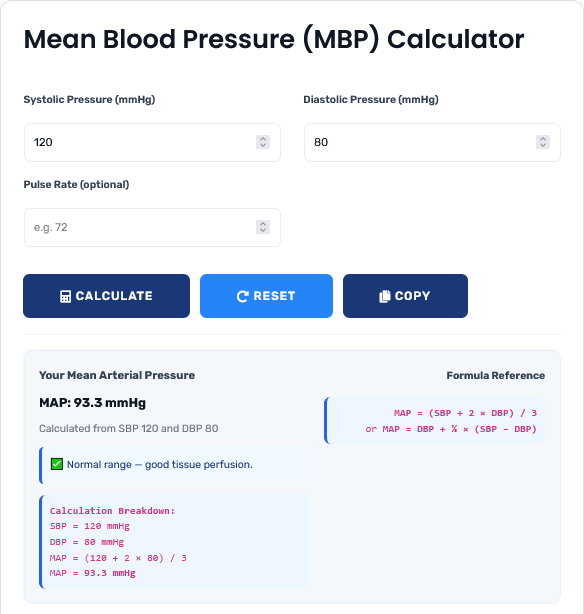
Say your blood pressure reading is 120/80 mmHg. Here's how MAP is calculated step by step:
- Take the diastolic value and double it: 80 × 2 = 160
- Add the systolic value: 160 + 120 = 280
- Divide by 3: 280 ÷ 3 = 93.3 mmHg
So a blood pressure of 120/80 mmHg gives a MAP of about 93 mmHg — comfortably within the normal 70-100 mmHg range.
This formula weighs diastolic pressure more heavily than systolic, because the heart spends roughly twice as long in diastole (relaxation) as it does in systole (contraction) during each cardiac cycle.
Population-Specific MAP Standards
| Population Group | Optimal MAP Range | Clinical Considerations | Monitoring Frequency |
|---|---|---|---|
| Healthy Adults (18-50) | 70-100 mmHg | Standard calculation applies, diurnal variation ±10 mmHg | Annual screening, with lifestyle changes |
| Hypertensive Patients | 75-95 mmHg (individualized) | Lower targets for diabetes/renal disease, medication effects | Weekly during titration, monthly for maintenance |
| Elderly (65+) | 75-105 mmHg | Increased arterial stiffness, orthostatic considerations | Monthly, with fall risk assessment |
| Athletes | 65-90 mmHg | Lower resting values, exercise-induced variations | Seasonal, with training adaptation |
| Critical Care Patients | 65-75 mmHg (target-based) | Continuous monitoring, organ perfusion focus | Continuous or hourly, with intervention triggers |
Strategic Clinical Decision Framework
Four-Phase MAP Assessment Protocol:
- Accurate Calculation: Use validated formula with appropriate adjustments
- Contextual Interpretation: Consider age, comorbidities, medications
- Trend Analysis: Evaluate changes over time rather than isolated readings
- Therapeutic Integration: Align with overall treatment goals and risk factors
This framework reflects the general approach used in cardiology and critical care practice for interpreting MAP alongside other clinical findings. For comprehensive health assessment, our health calculator suite provides additional analytical tools.
Common Clinical Misconceptions
The "Normal Range" Fallacy
Common Belief: "All patients should achieve MAP 70-100
mmHg"
Clinical Reality: Optimal MAP varies significantly based on
individual factors including age, comorbidities, and treatment goals.
Frail elderly patients, for instance, may need higher MAP targets to maintain
adequate cerebral perfusion, while patients with certain kidney conditions may
be managed toward lower targets.
Professional Perspective: Individualized targets based on
comprehensive assessment generally provide better outcomes than rigid range
adherence.
Systolic vs. MAP Priority Confusion
Many clinicians prioritize systolic blood pressure control while underestimating MAP's importance:
Clinical Comparison Analysis:
- Systolic Focus: Primary predictor of stroke risk, easier to measure consistently
- MAP Importance: Better indicator of organ perfusion, more relevant for medication decisions
- Practical Integration: Optimal management requires both parameters with MAP guiding treatment intensity
- Case Example: Patient with 160/70 mmHg (MAP 100) vs. 140/90 mmHg (MAP 107) - the latter has higher MAP despite lower systolic pressure
- Clinical Decision: Treatment should address the elevated MAP in the second case despite "normal" systolic reading
This nuanced understanding prevents treatment gaps in patients with isolated diastolic or systolic hypertension.
Advanced Applications: MAP in Different Clinical Settings
MAP interpretation varies significantly across medical specialties:
| Clinical Setting | MAP Significance | Target Range | Intervention Thresholds |
|---|---|---|---|
| Emergency Department | Shock identification, resuscitation guidance | 65-75 mmHg initially | <65 mmHg triggers aggressive intervention |
| Operating Room | Organ perfusion during anesthesia | 75-85 mmHg (procedure-specific) | ±20% from baseline triggers adjustment |
| Hypertension Clinic | Long-term cardiovascular risk assessment | 75-95 mmHg (individualized) | >100 mmHg warrants therapy intensification |
| Intensive Care Unit | Vasopressor titration, organ support | 65-75 mmHg (goal-directed) | Based on perfusion parameters, not fixed numbers |
| Primary Care | Screening, chronic disease monitoring | 70-100 mmHg (general) | Trends >5 mmHg increase warrant investigation |
This context-specific approach ensures appropriate interpretation and intervention across diverse clinical scenarios.
Technical and Methodological Considerations
Calculation Accuracy Factors:
Several technical factors influence MAP calculation accuracy:
- Measurement Technique: Proper cuff size (bladder covering 80% of arm circumference), correct positioning (heart level), adequate rest period (5 minutes minimum)
- Formula Selection: Standard formula vs. alternative methods based on clinical context and available data
- Patient Factors: Arrhythmias (atrial fibrillation requires different calculation), arterial stiffness, heart rate variations
- Equipment Considerations: Validated devices, regular calibration, appropriate maintenance
- Environmental Factors: Temperature, patient anxiety, recent activity or consumption
This tool provides calculations based on standard physiological assumptions but should be interpreted in clinical context. For nutritional aspects of cardiovascular health, our nutrition calculator suite addresses complementary lifestyle factors.
How This Calculator Works
This calculator uses the standard MAP formula — MAP = (SBP + 2 × DBP) ÷ 3 — the same formula taught in clinical medicine and used across most bedside and online MAP calculators. It performs simple arithmetic on the two values you enter; it does not access lab data, medication history, or any other patient information, and it does not adjust for age, arrhythmia, or comorbidities. Those factors matter clinically, but interpreting them is left to you and your healthcare provider.
Professional Reference Standards
| Guideline/Source | Issuing Organization | MAP Recommendations | Clinical Application |
|---|---|---|---|
| ACC/AHA Hypertension Guidelines | American Heart Association | Individualized targets based on overall cardiovascular risk | Primary hypertension management |
| Surviving Sepsis Campaign | Society of Critical Care Medicine | MAP ≥65 mmHg as initial resuscitation target | Septic shock management |
| ESC/ESH Guidelines | European Society of Cardiology | MAP consideration in overall risk assessment | European hypertension management |
| KDIGO Guidelines | Kidney Disease Improving Global Outcomes | Lower MAP targets for CKD patients (often <92 mmHg) | Renal protection in hypertension |
Professional Application Protocol: In clinical settings, MAP calculations should serve as part of comprehensive hemodynamic assessment. This tool provides evidence-based calculations, but clinical decisions should incorporate patient symptoms, physical findings, laboratory data, and overall clinical context. The physiological accuracy here meets American Heart Association standards for blood pressure assessment, but clinical applications require professional judgment and ongoing monitoring. For comprehensive wellness assessment, our cholesterol ratio calculator provides complementary cardiovascular risk assessment.
Implementation in Clinical Practice
Practical Integration Strategies:
For effective MAP utilization in clinical settings:
- Standardized Documentation: Include MAP alongside systolic/diastolic readings in all clinical notes
- Treatment Protocols: Use MAP thresholds for medication titration decisions
- Patient Education: Teach patients to track MAP trends alongside traditional readings
- Quality Improvement: Monitor MAP calculation accuracy as part of clinical audits
- Interdisciplinary Communication: Ensure consistent MAP interpretation across care teams
This systematic approach transforms MAP from a theoretical concept to practical clinical tool. For tracking broader health metrics, our calorie intake calculator addresses complementary lifestyle factors.
Background on the MAP Formula
The standard MAP formula used in this calculator is widely taught in medicine and referenced across cardiology and critical care literature. It's worth knowing that it's an estimate: the true gold standard for measuring MAP is direct intra-arterial monitoring (an arterial line), which captures the actual pressure waveform rather than approximating it from two cuff readings. Research comparing different MAP formulas to invasive measurements has found some variation between methods, which is why this tool is best used as a quick estimate rather than a clinical-grade measurement.
A Note on Accuracy: This calculator performs a standard, well-established arithmetic formula (MAP = (SBP + 2×DBP) ÷ 3) used widely in clinical practice. It is intended as a quick reference tool, not a diagnostic device, and does not replace direct arterial pressure monitoring or clinical judgment.
Professional Clinical Questions
MAP is particularly important in: Critical care settings where organ perfusion is paramount, anesthesia management during surgery, septic shock resuscitation following Surviving Sepsis guidelines, hypertension management in patients with chronic kidney disease, and assessment of patients with wide pulse pressure (often elderly with isolated systolic hypertension). MAP provides a single integrated value that reflects perfusion pressure more accurately than systolic/diastolic readings alone, especially when these values are discordant or when rapid clinical decisions are needed.
Arrhythmias significantly impact MAP calculation: Atrial fibrillation with irregular R-R intervals requires averaging multiple readings rather than single calculation. Frequent PVCs or bigeminy alter cardiac cycle timing, making standard formulas less accurate. Tachyarrhythmias increase diastolic proportion, potentially underestimating true MAP if using standard formula. For accurate assessment in arrhythmias: Take multiple readings and average, use devices with arrhythmia detection algorithms, consider direct measurement if critical decisions depend on accuracy, and document the arrhythmia presence alongside MAP values for proper interpretation.
Non-invasive MAP calculation has several limitations: Standard formulas assume normal cardiac cycle timing (2/3 diastole, 1/3 systole), which varies with heart rate and conditions. Oscillometric devices estimate MAP algorithmically with varying accuracy between manufacturers. Cuff-based measurements provide intermittent values, missing dynamic changes. Arterial stiffness in elderly patients alters pressure waveform, affecting calculation accuracy. Severe hypertension or hypotension may exceed device validation ranges. Clinical decisions based on non-invasive MAP should consider these limitations and confirm with additional assessment when values are borderline or clinical suspicion is high.
Elderly patients often require adjusted MAP targets due to: Increased arterial stiffness requiring higher pressures for organ perfusion, orthostatic hypotension risk necessitating careful titration, cerebral autoregulation changes making brain more sensitive to pressure drops, multiple comorbidities requiring balanced approach, and medication sensitivity increasing side effect risk. General guidance: Start with higher initial targets (75-85 mmHg), make gradual adjustments (2-5 mmHg changes), monitor for dizziness and falls, prioritize standing over sitting readings, and consider individual functional status and quality of life alongside numerical targets.
No. This calculator is an educational tool that performs the standard MAP formula used in clinical practice. It does not account for your full medical history, medications, or individual risk factors. Always discuss your blood pressure readings and MAP values with a qualified healthcare provider, especially if you have a chronic condition or are experiencing symptoms.
MAP stands for Mean Arterial Pressure — the average pressure in your arteries during one full heartbeat cycle (both the contraction and relaxation phases). Unlike systolic pressure (the peak) or diastolic pressure (the lowest point), MAP represents a single averaged value that many clinicians consider a better indicator of how well blood is actually reaching your organs.
A MAP around 60 mmHg is generally considered the minimum needed to maintain adequate blood flow to organs. It's not automatically an emergency — some sepsis treatment protocols temporarily target this range — but sustained readings at or below 60 mmHg outside of a monitored clinical context usually warrant medical evaluation.
In critical care, treatment decisions (like when to start vasopressors) are often tied to a single MAP threshold rather than separate systolic/diastolic numbers. Tracking MAP gives a consistent, single value to compare against a target — which is simpler to act on quickly at the bedside than interpreting two numbers together.
They measure different things and both matter. Systolic pressure is more closely tied to long-term stroke risk, while MAP is generally considered a better real-time indicator of organ perfusion. In practice, clinicians look at both together rather than relying on either one alone.
Effective EHR integration includes: Adding MAP as automatically calculated field whenever blood pressure is entered, creating alerts for MAP values outside individualized ranges, enabling trend visualization over time, incorporating into clinical decision support for medication adjustments, and including in standardized clinical pathways. Best practices: Train staff on MAP interpretation, establish institutional protocols for responding to abnormal MAP values, integrate with other hemodynamic data when available, use for quality metrics in hypertension and critical care, and ensure patient-facing portals display MAP alongside traditional readings for patient engagement in management.
