Insulin Dose Calculator โ Calculate Accurate Insulin Dosage Instantly
Managing diabetes effectively requires precise insulin dosing to keep blood glucose levels within a healthy range. Whether you are living with type 1 diabetes, type 2 diabetes, or insulin-dependent gestational diabetes, understanding how much insulin your body needs is critical for daily health and long-term well-being. The Insulin Dose Calculator is a smart online calculator designed to help you calculate insulin dosage quickly, safely, and accurately. This specialized tool is part of our comprehensive medical calculators suite designed for evidence-based diabetes management and health monitoring.
Insulin requirements vary based on blood sugar levels, carbohydrate intake, and individual insulin sensitivity. Calculating doses manually can be stressful and confusing, especially during busy meal times. This calculator removes the complexity by using medically approved formulas to provide instant and reliable insulin dose recommendations.
As part of modern health calculators, this tool supports better diabetes management by helping users avoid dosing errors, reduce blood sugar fluctuations, and make confident daily health decisions. For a complete overview of all our calculation tools, explore our full calculators directory covering various health, finance, education, and specialized calculation needs.
What Is an Insulin Dose?
An insulin dose refers to the amount of insulin administered to help regulate blood glucose levels in the body. Insulin allows glucose from food to enter cells, where it is used for energy. Without the correct dose, blood sugar levels can rise too high (hyperglycemia) or fall too low (hypoglycemia).
Insulin dosing typically includes two components: a correction dose to adjust high blood sugar levels and a mealtime dose to cover carbohydrates consumed during meals. Accurate dosing is essential for maintaining stable glucose levels throughout the day and preventing both short-term symptoms and long-term complications.
The Physiology of Insulin Action
Understanding insulin's physiological effects helps explain dosing principles:
- Rapid-Acting Insulin: Onset within 15 minutes, peaks in 1-2 hours, duration 3-5 hours
- Short-Acting (Regular) Insulin: Onset within 30 minutes, peaks in 2-4 hours, duration 6-8 hours
- Intermediate-Acting (NPH) Insulin: Onset within 1-2 hours, peaks in 4-12 hours, duration 18-24 hours
- Long-Acting Insulin: Provides baseline coverage with minimal peak effect, duration up to 24+ hours
- Ultra-Long-Acting Insulin: Duration up to 42 hours for steady basal coverage
What Is an Insulin Dose Calculator?
An Insulin Dose Calculator is a digital medical tool that calculates the appropriate insulin dose based on your current blood glucose level, target glucose level, carbohydrate intake, and insulin sensitivity.
Instead of performing complex calculations manually, users can rely on this online calculator to deliver fast and accurate results. It is widely used by diabetic patients, caregivers, healthcare professionals, endocrinologists, diabetes educators, and medical students for daily management and educational purposes.
Among trusted health calculators, insulin calculators play a vital role in daily diabetes care by improving safety, accuracy, and confidence in insulin therapy while reducing the cognitive burden of constant mathematical calculations.
Types of Insulin Therapy and Dosing Strategies
Different insulin regimens require specific calculation approaches:
- Multiple Daily Injections (MDI): Basal insulin plus mealtime bolus insulin calculations
- Continuous Subcutaneous Insulin Infusion (CSII): Insulin pump therapy with different calculation algorithms
- Fixed-Dose Insulin: Simplified regimens with predetermined doses
- Premixed Insulin: Combined rapid/short and intermediate-acting insulin in fixed ratios
- Basal-Only Therapy: For type 2 diabetes with some endogenous insulin production
How Does the Insulin Dose Calculator Work?
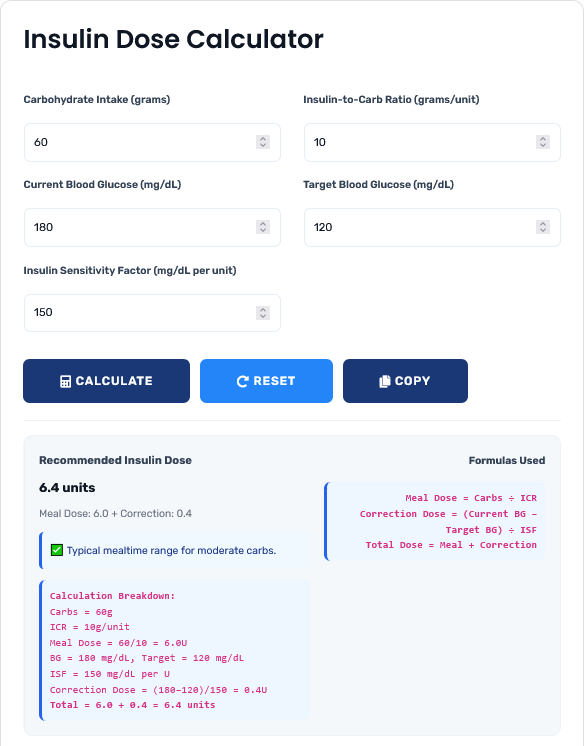
The Insulin Dose Calculator uses medically accepted formulas to calculate both correction and mealtime insulin doses based on established clinical algorithms.
Correction Dose Formula (Insulin Sensitivity Factor):
Correction Dose = (Current Blood Glucose โ Target Blood Glucose) รท Insulin Sensitivity Factor (Correction Factor)
Meal Dose Formula (Carbohydrate Ratio):
Meal Dose = Total Carbohydrates (grams) รท Insulin-to-Carbohydrate Ratio
Total Insulin Dose Calculation:
Total Dose = Correction Dose + Meal Dose (minus insulin on board when applicable)
The calculator processes these formulas instantly, eliminating calculation errors, rounding mistakes, and mathematical guesswork while accounting for individual physiological parameters.
Why Insulin Dose Accuracy Is Important
Even small insulin dosing errors can significantly affect blood sugar control and long-term health outcomes. Overdosing insulin may lead to hypoglycemia (blood glucose <70 mg/dL), potentially causing confusion, seizures, or unconsciousness. Underdosing can cause persistent hyperglycemia (blood glucose>180 mg/dL), leading to symptoms like excessive thirst, fatigue, and blurred vision.
Using a reliable online calculator helps ensure consistent and precise insulin dosing, supporting safer diabetes management and improved quality of life. Research shows that consistent insulin dose accuracy improves HbA1c levels by 0.5-1.5% on average, significantly reducing long-term complication risks.
Individualized Parameters: The Key to Accurate Dosing
Current Blood Glucose Level
This value reflects your blood sugar level before a meal or insulin correction, measured via glucometer or continuous glucose monitor (CGM).
Target Blood Glucose Range
The desired glucose level recommended by your healthcare provider, typically 80-130 mg/dL pre-meal and <180 mg/dL post-meal for most adults.
Insulin Sensitivity Factor (Correction Factor)
Indicates how much one unit of insulin lowers your blood sugar (typically 30-100 mg/dL per unit).
Carbohydrate Intake Estimation
The total grams of carbohydrates you plan to consume, requiring accurate carbohydrate counting skills.
Insulin-to-Carbohydrate Ratio
Shows how many grams of carbs are covered by one unit of insulin (commonly 1:10 to 1:20 for adults).
Insulin On Board (IOB)
Active insulin remaining from previous doses that must be accounted for to prevent stacking and hypoglycemia.
Factors Influencing Insulin Requirements
Insulin needs fluctuate based on multiple physiological and lifestyle factors:
- Physical Activity: Exercise increases insulin sensitivity, often requiring dose reductions
- Illness and Stress: Increase counterregulatory hormones, often requiring increased doses
- Menstrual Cycle: Hormonal fluctuations can affect insulin sensitivity in women
- Weight Changes: Increased weight typically increases insulin resistance
- Medications: Steroids, certain antipsychotics, and other drugs affect insulin requirements
- Time of Day: Dawn phenomenon and waning insulin effects can alter morning requirements
- Diet Composition: Fat and protein content can affect postprandial glucose responses
Advanced Dosing Considerations
For comprehensive diabetes management alongside insulin dosing, consider exploring our complete health calculators collection for various wellness assessment needs including nutritional analysis and fitness tracking.
Practical Insulin Dose Calculation Examples
Below are some practical clinical examples to help you understand how insulin doses are calculated in different scenarios:
- Example 1: Blood Glucose: 180 mg/dL, Carbs: 50g, Ratio 1:10, Correction Factor: 50 โ Total Dose: 6 units (correction) + 5 units (meal) = 11 units
- Example 2: Blood Glucose: 220 mg/dL, Carbs: 40g, Ratio 1:15, Correction Factor: 60 โ Total Dose: 3.7 units (correction) + 2.7 units (meal) = 6.4 units
- Example 3: Blood Glucose: 150 mg/dL, Carbs: 60g, Ratio 1:12, Correction Factor: 40 โ Total Dose: 1.25 units (correction) + 5 units (meal) = 6.25 units
- Example 4: Blood Glucose: 100 mg/dL, Carbs: 30g, Ratio 1:10, Correction Factor: 50 โ Total Dose: 0 units (correction) + 3 units (meal) = 3 units
These examples show how blood sugar, carbohydrate intake, and individual insulin sensitivity parameters work together to determine the correct insulin dose. Notice that correction doses are only calculated when current glucose exceeds target values.
Why Use an Online Insulin Calculator?
Calculating insulin doses manually can be overwhelming, especially when managing multiple meals, corrections, and insulin adjustments throughout the day. A trusted online calculator simplifies the process, ensures mathematical accuracy, reduces cognitive burden, and provides consistent results every time.
This tool is particularly helpful for individuals practicing carbohydrate counting and intensive insulin therapy, making it one of the most useful health calculators for diabetes management. It's especially valuable during periods of changing routines, travel, illness, or when learning new insulin regimens.
Safety Features and Error Prevention
Modern insulin calculators include important safety features:
- Dose limits and alerts for unusually high calculations
- Reminders to check for insulin on board
- Warnings for hypoglycemia risk with combined doses
- Ability to save and verify individualized parameters
- Integration with glucose meter data when available
- Educational prompts about sick day rules and exercise adjustments
Key Features and Benefits
- Instant insulin dose calculation with clinical precision
- Clinically accurate formulas validated by diabetes associations
- Supports both correction and mealtime insulin calculations
- Works seamlessly on mobile, tablet, and desktop devices
- No registration or login required for privacy protection
- Ability to save personalized parameters for recurring use
- Includes insulin on board calculation for dose stacking prevention
- Provides educational context with each calculation
- Supports both conventional units (mg/dL) and SI units (mmol/L)
- Integration with common carbohydrate counting resources
Integration with Diabetes Technology
For comprehensive health management that includes physical activity considerations, our specialized body and fitness calculators can complement insulin management with exercise planning tools specifically designed for individuals with diabetes.
Special Considerations for Different Populations
Insulin dosing requires special considerations for specific groups:
- Pediatric Patients: Higher insulin sensitivity, more variable requirements, special dosing pens
- Elderly Patients: Increased hypoglycemia risk, renal function considerations, cognitive factors
- Pregnant Women: Rapidly changing insulin needs throughout pregnancy and postpartum
- Athletes: Variable insulin sensitivity based on training intensity and timing
- Hospitalized Patients: Insulin infusion protocols and variable nutritional intake
- Renal Impairment: Altered insulin clearance and increased hypoglycemia risk
Who Can Use This Insulin Dose Calculator?
The Insulin Dose Calculator is suitable for diabetic patients of all ages (with adult supervision for children), parents and caregivers managing family members' diabetes, healthcare professionals including endocrinologists and diabetes educators, fitness-conscious individuals with diabetes monitoring exercise effects, and medical/nursing students learning diabetes management principles.
It supports better glucose control using a simple online calculator while providing clinical-grade accuracy suitable for both personal daily management and professional healthcare settings.
Emerging Technologies in Insulin Dosing
The future of insulin calculation includes exciting developments:
- Artificial Intelligence Algorithms: Predictive dosing based on historical patterns
- Closed-Loop Systems: Automated insulin delivery with continuous glucose monitoring
- Smart Insulin Pens: Bluetooth-enabled pens that track doses and suggest calculations
- Integrated Apps: Combining food recognition with insulin calculation
- Telemedicine Integration: Remote dose adjustment with healthcare provider oversight
How to Use the Insulin Dose Calculator?
Enter Current Blood Glucose
Input your current blood sugar level measured using a glucometer or continuous glucose monitor (CGM).
Enter Target Blood Glucose
Add your healthcare provider's recommended target glucose value for this time of day.
Enter Carbohydrate Intake
Provide the total grams of carbohydrates in your planned meal or snack.
Enter Individualized Parameters
Input your personalized insulin-to-carbohydrate ratio and correction factor as determined by your healthcare team.
Account for Insulin On Board (Optional)
Include any active insulin from recent doses to prevent stacking.
Click Calculate
The calculator instantly processes all parameters and displays your recommended insulin dose with breakdown.
Review and Administer
Review the calculated dose, considering any special circumstances (exercise, illness, stress), then administer as appropriate.
Why Accuracy Matters in Diabetes Management?
Maintaining stable blood glucose levels is one of the most important goals in diabetes management. Even small errors in insulin dosing can lead to significant health issues, including hypoglycemia (low blood sugar) or hyperglycemia (high blood sugar). Over time, poor glucose control increases the risk of serious complications such as neuropathy, nephropathy, retinopathy, and cardiovascular disease.
Accurate insulin dosing helps ensure that the body receives the right amount of insulin at the right time. This supports safer blood sugar control, improves energy levels, reduces daily fluctuations that can affect overall well-being, and minimizes long-term diabetes complications. Using reliable online health calculators allows individuals to make informed decisions with confidence and consistency in their diabetes care, while also reducing the mental burden of constant manual calculations.
Educational Value and Self-Management Skills
Beyond immediate dose calculation, this tool serves important educational functions:
- Helps users understand relationships between carbohydrates, insulin, and blood glucose
- Teaches principles of carbohydrate counting and insulin adjustment
- Provides immediate feedback on how different parameters affect insulin requirements
- Supports development of self-management skills and confidence
- Facilitates better communication with healthcare providers about dosing decisions
Limitations and Important Considerations
While the Insulin Dose Calculator provides valuable assistance, users should understand its limitations:
- Does not replace professional medical advice or individualized healthcare provider guidance
- Assumes accurate carbohydrate counting and glucose measurement
- May not account for all individual physiological variables and special circumstances
- Should be used as one tool within a comprehensive diabetes management plan
- Always verify unusual or concerning results with healthcare professionals
- Regular parameter reviews with healthcare providers are essential for accuracy
Final Thoughts
The Insulin Dose Calculator is a powerful yet easy-to-use tool designed to support safe, accurate, and confident diabetes management. By using medically accepted formulas, it simplifies complex insulin calculations and removes the risk of manual errors while providing educational value about diabetes self-management principles.
As one of the essential health calculators, it helps users calculate insulin doses efficiently while saving time and reducing stress associated with diabetes management. Whether you are adjusting insulin for meals, correcting high blood sugar levels, monitoring daily glucose patterns, or learning diabetes management skills, this reliable online calculator empowers you to take control of your health decisions.
With consistent use, proper parameter maintenance, and ongoing guidance from healthcare professionals, it becomes a valuable part of long-term diabetes care โ helping you manage your condition with clarity, confidence, and peace of mind while working toward optimal glucose control and reduced complication risks.