Pregnancy Due Date Calculator: Estimate Your Baby's Arrival
One of the first questions many expecting parents ask is, "When will the baby arrive?" An estimated due date (EDD) helps with scheduling prenatal visits, planning maternity leave, and generally preparing for a new family member, even though it's an estimate rather than a fixed appointment.
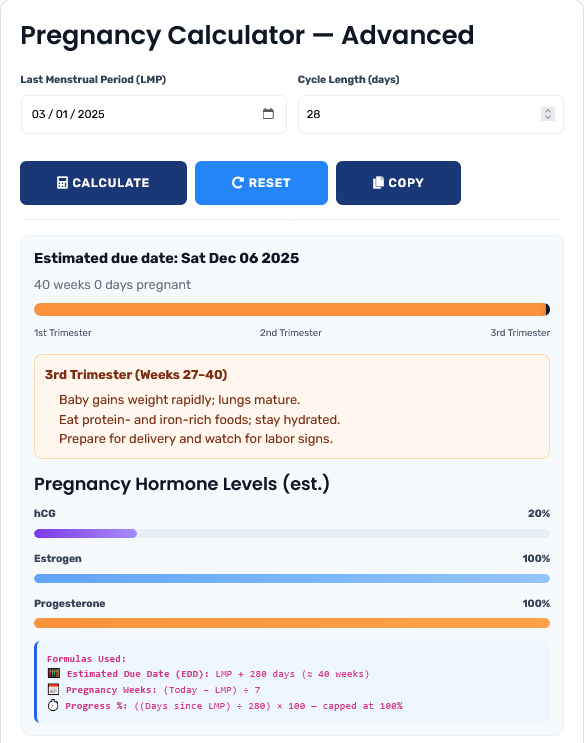
This Pregnancy Due Date Calculator estimates your due date using the standard method used in obstetric care: counting 280 days (40 weeks) from the first day of your last menstrual period (LMP). This tool is part of our broader collection of health and wellness calculators.
Keep in mind that this is only an estimate. Your healthcare provider may adjust your due date after an ultrasound, particularly if your cycles are irregular or your LMP date is uncertain.
Different Ways a Due Date Can Be Estimated
Not everyone dates a pregnancy the same way, and the right method depends on what information is available:
- Based on last menstrual period (LMP): The most common starting point. It assumes a fairly typical cycle length and that ovulation happened around two weeks after the period started. This is the method used by this calculator.
- Based on a known conception date: If someone knows their conception date precisely — for example, through fertility tracking or assisted reproduction — the due date can instead be estimated as roughly 266 days from conception.
- Based on IVF embryo transfer date: For IVF pregnancies, due dates are often calculated from the embryo transfer date, adjusted for whether a day-3 or day-5 (blastocyst) embryo was transferred. IVF pregnancies are frequently monitored more closely than average, since the exact conception timing is known.
- Based on early ultrasound measurements: When cycles are irregular or the LMP date is uncertain, an early ultrasound measuring the fetus directly (commonly the crown-rump length) tends to give a more reliable estimate than the calendar method alone.
Whichever method applies, your healthcare provider will typically confirm and, if needed, adjust your due date at your first prenatal visits.
Understanding Pregnancy Due Date Calculations
Common Pregnancy Dating Methods:
1. Naegele's Rule (Standard LMP-Based Method):
Due Date = First day of LMP + 7 days − 3 months + 1 year
This is mathematically the same as adding 280 days to the LMP.
2. Conception Date Method:
Due Date ≈ Conception date + 266 days
Used when the conception date is known with reasonable confidence.
3. Ultrasound Dating:
Based on fetal measurements, most commonly crown-rump length, taken in the
first trimester. This can shift the estimated due date from the LMP-based
calculation.
4. IVF-Specific Calculation:
Day 3 embryo transfer: Transfer date + approximately 263 days
Day 5 embryo (blastocyst) transfer: Transfer date + approximately 261 days
Pregnancy Timeline and General Milestones
| Trimester | Weeks | General Developments | Commonly Scheduled Tests | Common Maternal Changes |
|---|---|---|---|---|
| First Trimester | 1-13 | Major organs begin forming; heartbeat becomes detectable | Pregnancy confirmation, dating ultrasound | Nausea, fatigue, breast changes are common |
| Second Trimester | 14-27 | Fetal movement often first noticed; sex may be visible on ultrasound | Anatomy scan, glucose screening, other routine screening as advised | Energy often improves; a visible bump usually develops |
| Third Trimester | 28-40+ | Rapid growth; baby generally settles into a birth position | Growth checks, Group B strep test, monitoring as advised | Back discomfort, Braxton Hicks contractions are common |
Factors That Can Affect Due Date Accuracy
| Factor | General Effect on Due Date | Typical Approach |
|---|---|---|
| Irregular Cycles | LMP-based dating becomes less reliable | Early ultrasound dating is often preferred |
| IVF or Assisted Reproduction | Conception timing is generally known precisely | Embryo transfer date is used instead of LMP |
| First Pregnancy | Labor sometimes starts a little later than average | Providers may discuss monitoring options as the due date approaches |
| Twins or Multiples | Delivery commonly happens earlier than for a single baby | More frequent monitoring is typically recommended |
| Maternal Age Over 35 | May be associated with additional monitoring recommendations | Follow your provider's individualized monitoring plan |
A Simple Framework for Early Pregnancy Planning
A general starting sequence many people follow:
- Get an initial estimate: Use your LMP or known conception date for a starting due date
- Confirm with your healthcare provider: Your first prenatal visit often includes a dating ultrasound
- Plan key appointments: Ask your provider about the typical schedule of screenings for your situation
- Handle practical preparations: Maternity leave, nursery setup, and childbirth education classes, on your own timeline
For financial planning around a growing family, our Budget Planner Calculator may also be useful.
Common Misconceptions About Due Dates
The "Exact 40 Weeks" Assumption
Common assumption: Every pregnancy lasts exactly 40 weeks, and
babies arrive on their due date.
More accurate view: A due date is an estimate of the middle of
a normal range. Only a small share of babies are actually born on their exact
due date — most deliveries happen somewhat before or after it, generally within
the range considered full term.
Practical takeaway: It can help to think in terms of a "due
window" around the estimated date rather than a single fixed day.
Why the Due Date Sometimes Changes After an Ultrasound
It's common for a due date to shift slightly after the first ultrasound, and this is usually considered normal.
Why this happens: LMP-based dating assumes a fairly standard cycle length, while ultrasound measures the fetus directly. If actual ovulation happened later than the standard assumption, the ultrasound may show a smaller-than-expected fetus for the assumed dates, prompting a small adjustment.
General guidance: Early ultrasounds (particularly before about 13 weeks) tend to be considered more reliable for dating. Providers commonly adjust the due date when the difference from the LMP estimate is more than about a week; smaller differences are often left as-is.
A General Example: Planning Around a Pre-Existing Health Condition
For illustration, consider someone planning a pregnancy while managing a pre-existing condition such as diabetes. In situations like this, care teams commonly recommend a more structured approach:
-
Before conception:
- Working with a provider to optimize the condition ahead of time
- Reviewing medications for pregnancy safety
- Starting folic acid supplementation as advised
-
Early pregnancy:
- An early dating ultrasound
- Closer monitoring relevant to the condition
- Possible referral to a specialist in high-risk pregnancy care
-
Later pregnancy:
- More frequent growth checks and monitoring
- A individualized plan for timing of delivery, set by the care team
This is a general illustration, not medical advice — anyone with a pre-existing condition should work directly with their own healthcare provider on a plan suited to their situation. For blood sugar unit conversions, our Glucose Conversion Calculator may be helpful.
General Pregnancy Nutrition Reference
| Nutrient | Commonly Cited Daily Amount | General Role | Example Food Sources |
|---|---|---|---|
| Folic Acid | Commonly 600-800 mcg | Supports early neural tube development | Leafy greens, fortified grains |
| Iron | Commonly around 27 mg | Supports increased blood volume | Lean meat, beans, spinach |
| Calcium | Commonly around 1000 mg | Supports fetal bone development | Dairy, fortified alternatives |
| DHA | Commonly 200-300 mg | Supports brain and eye development | Fatty fish, algae-based supplements |
| Protein | Often somewhat higher than pre-pregnancy needs | Supports tissue growth and repair | Lean meat, eggs, legumes |
These figures reflect commonly cited general guidelines and are not personalized medical advice. Your provider or a registered dietitian can give recommendations tailored to your specific needs.
A General Preparation Timeline
A rough month-by-month guide many people find useful:
Early pregnancy: Confirm pregnancy, start prenatal vitamins as advised, schedule your first appointment.
Mid-pregnancy: Consider announcing the pregnancy, begin planning the nursery, look into childbirth education classes.
Later pregnancy: Install a car seat, pack a hospital bag, discuss a birth plan with your provider.
Final weeks: Rest as needed, watch for signs of labor discussed with your provider, confirm your route and plan to your birth location.
For tracking key dates, our Date Difference Calculator can help with planning around your due date.
If Pregnancy Continues Past the Due Date
General Approach When a Due Date Passes:
Many providers increase monitoring as a pregnancy goes beyond 40 weeks:
- Additional monitoring, such as non-stress tests, is commonly introduced around 41 weeks
- Induction is often discussed as an option in the days following the due date, based on individual circumstances
- By around 42 weeks, many providers recommend induction due to a gradual increase in certain risks
Exact timing and approach vary by provider and individual circumstances — this is a general pattern, not a fixed protocol, and should be discussed with your own care team.
Key takeaway: Your due date is a helpful planning guide, not a deadline. It's most useful for scheduling care and getting practically ready, rather than as a prediction of the exact day labor will start. For more general health tracking, explore our Medical Calculators collection.
When to Contact Your Healthcare Provider
Situations that generally call for prompt contact with your provider:
- Vaginal bleeding beyond light spotting
- Severe abdominal pain
- Noticeably decreased fetal movement, especially after the point your provider advised you to start counting movements
- Fluid leakage that could suggest your water breaking
- Severe headaches or changes in vision
- A significant fever
Routine prenatal visits are commonly scheduled roughly monthly early on, then more frequently as the due date approaches, though your provider will set the exact schedule for your situation.
When in doubt, reach out: If something feels wrong, it's reasonable to contact your healthcare provider even if it isn't on a typical warning list.
Frequently Asked Questions
Calculators using the standard LMP-based method work reasonably well for people with fairly regular cycles, but they're still an estimate rather than a guarantee. For irregular cycles or an uncertain LMP date, an early ultrasound is generally considered more reliable for dating than the calendar method alone.
If your LMP date is uncertain, you can use your best estimate as a starting point, but an early ultrasound (particularly between about 8 and 13 weeks) generally provides a more accurate estimate. If you know your conception date, that can also be used instead.
Pregnancy is conventionally dated from the first day of the last menstrual period because that date is usually known with more confidence than the exact conception date. This LMP-based approach, known as Naegele's rule, has long been the standard method in obstetric care and assumes ovulation occurs around two weeks into a typical cycle.
The calculated due date itself is worked out the same way for twins or multiples as for a single baby. In practice, though, multiples are often born somewhat earlier than that calculated date, and pregnancies with multiples are typically monitored more closely as they progress.
This is fairly common and usually considered a refinement rather than a concern. If an early ultrasound measurement differs meaningfully from the LMP-based calculation, many providers will update the due date accordingly, since this can affect the timing of certain screenings and expectations for delivery.
Once you have an estimated due date, many people track progress using a pregnancy app, calendar, or journal, alongside their scheduled prenatal visits. For general nutrition planning during pregnancy, our Calorie Intake Calculator may also be useful.
