Target Heart Rate Calculator: Find Your Heart Rate Zones for Safer, Smarter Exercise
Your heart rate is one of the simplest and most useful signals your body gives you during exercise. It tells you how hard your cardiovascular system is working in real time, which makes it a practical way to guide training intensity for goals like fat loss, endurance, or general heart health.
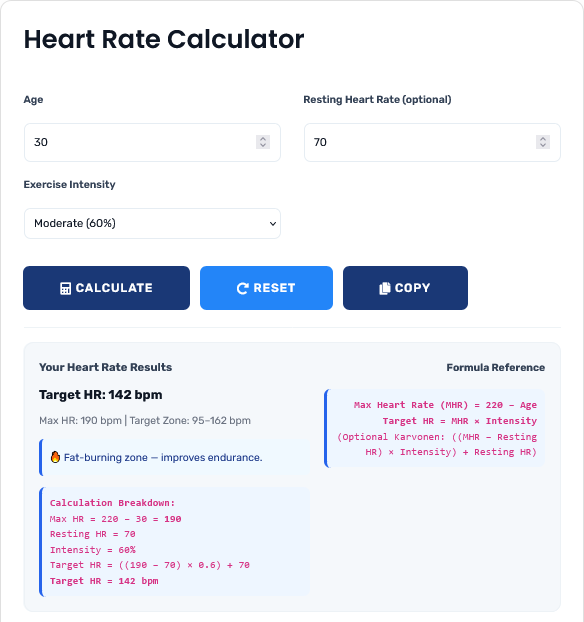
This target heart rate calculator estimates your maximum heart rate (MHR) and your target heart rate zones using two widely used approaches: the standard age-based formula and the Karvonen method, which also factors in your resting heart rate. The goal is to give you a reasonable starting range, not a rigid rule, so you can train with more structure and less guesswork.
For a broader picture of your fitness and health metrics, you can also explore our full set of health calculators.
Why Heart Rate Is a Useful Training Guide
Tracking heart rate during exercise can help you understand:
- How hard your heart is working at a given pace or effort level
- Whether your current workout intensity matches your training goal
- General trends in cardiovascular fitness over weeks and months
- Whether you may be training harder, or easier, than intended
- How your body responds to different types of workouts
Heart rate on its own doesn't tell the whole story, so it's best used alongside how you actually feel during a workout. If you're also tracking body composition, our BMI Calculator can be a useful companion metric.
How Different Training Goals Map to Heart Rate Zones
Training for Fat Loss and General Fitness
For fat loss and general conditioning, many exercise guidelines point toward lower-to-moderate intensity training — roughly Zone 2, or about 60-70% of estimated max heart rate. At this intensity, a person is usually able to hold a conversation with a bit of effort, and workouts can typically be sustained for longer periods.
A common pattern is that training right at maximum effort for short bursts feels productive, but it's often harder to sustain consistently. Moderate-intensity sessions that can be repeated several times a week tend to add up to more total training volume over time.
If you're combining exercise with nutrition planning, our Calorie Intake Calculator can help you look at the bigger picture.
Training for Endurance Events
Endurance training, such as preparing for a longer run or cycling event, generally benefits from a mix of intensities: a large share of easier, aerobic-zone training (roughly Zone 2-3), combined with a smaller portion of harder efforts. This approach is intended to build aerobic capacity without excessive fatigue from training too hard, too often.
Athletes who train almost entirely at a hard, threshold-level intensity sometimes find it harder to recover between sessions, which can limit how much total training they can handle in a week.
Our Daily Calorie Burn Calculator can help you plan energy needs around a heavier training schedule.
Training with Existing Health Conditions
For people managing conditions like high blood pressure, doctors often recommend staying within a specific, individually set heart rate range rather than relying only on a general formula. Starting at a lower, comfortable intensity and progressing gradually — under medical guidance — is a common and sensible approach.
Anyone with a diagnosed heart condition, high blood pressure, or who is on heart-rate-affecting medication should get personalized target heart rate limits from a physician rather than relying solely on an online calculator.
For general metabolic tracking, our BMR Calculator can be a useful supporting tool.
Understanding Your Heart Rate Zones
Heart Rate Zone Calculations:
Maximum Heart Rate (MHR):
Standard formula: 220 − Age
Alternative formula: 208 − (0.7 × Age)
Target Heart Rate Zones (as % of MHR):
• Zone 1 (Very Light): 50-60%
• Zone 2 (Light): 60-70% — often used for fat-burning and base training
• Zone 3 (Moderate): 70-80% — general aerobic fitness
• Zone 4 (Hard): 80-90% — anaerobic threshold training
• Zone 5 (Maximum): 90-100% — short, high-effort intervals
Heart Rate Zones Explained
| Zone | Intensity | % of Max HR | Typical Use | How It Generally Feels |
|---|---|---|---|---|
| Zone 1 | Very Light | 50-60% | Warm-up, recovery, beginners | Easy, comfortable, easy to talk |
| Zone 2 | Light | 60-70% | Fat-burning, endurance base | Conversation stays easy, light sweat |
| Zone 3 | Moderate | 70-80% | General aerobic fitness | Conversation possible but harder |
| Zone 4 | Hard | 80-90% | Anaerobic capacity, speed work | Breathing hard, few words at a time |
| Zone 5 | Maximum | 90-100% | Short high-intensity intervals | Maximum effort, talking not possible |
Factors That Can Affect Your Heart Rate
| Factor | General Effect | What to Consider |
|---|---|---|
| Age | Estimated max heart rate tends to decline with age | Recalculate your zones periodically as you get older |
| Fitness Level | Better-conditioned hearts often have a lower resting heart rate | The Karvonen method can better reflect individual fitness |
| Medications | Some medications, such as beta-blockers, can lower heart rate response | Ask your doctor for a personalized safe range |
| Hydration | Dehydration can push heart rate higher than usual for the same effort | Stay hydrated before and during exercise |
| Temperature and Humidity | Heat and humidity generally increase heart rate at a given pace | Consider easing intensity in hot conditions |
| Stress and Fatigue | Poor sleep or high stress can raise heart rate at the same workload | Listen to your body and adjust intensity as needed |
The Karvonen Method: A More Personalized Calculation
Why Some People Prefer the Karvonen Method:
The Karvonen method includes your resting heart rate in the calculation, which can make it more reflective of your individual fitness level than a simple percentage of age-based max heart rate.
Formula:
Target HR = ((Max HR − Resting HR) × Intensity) + Resting HR
Worked example (illustrative only):
For a 40-year-old with a resting heart rate of 65 bpm, aiming for 70% intensity:
Max HR = 220 − 40 = 180
Heart Rate Reserve = 180 − 65 = 115
Target HR = (115 × 0.70) + 65 = 145.5 bpm
This is simply a demonstration of the math — enter your own age, resting heart rate, and intensity in the calculator above to get your personal estimate.
How to Measure Your Heart Rate
Common Ways to Check Heart Rate
-
Manual Pulse Check
- Place two fingers on your wrist (radial artery) or neck (carotid artery)
- Count beats for 30 seconds and multiply by two, or count a full 60 seconds
- Useful for resting heart rate or quick checks during a break
-
Chest Strap Heart Rate Monitor
- Generally considered the most accurate option during exercise
- Uses electrical signals from the heart, similar to an ECG
- Pairs with watches, apps, or gym equipment
-
Wrist-Based Optical Sensors
- Convenient for everyday tracking on smartwatches
- Can be less accurate during fast or repetitive arm movements
- Good for general daily activity monitoring
-
Gym Equipment Sensors
- Handgrip sensors found on treadmills, bikes, and ellipticals
- Convenient, though readings can vary in consistency
- Reasonable for casual gym workouts
Matching Heart Rate Zones to Common Fitness Goals
| Fitness Goal | Commonly Used Zones | Typical Workout Types |
|---|---|---|
| Weight Management | Zone 2 (60-70%) | Brisk walking, light jogging, steady cycling |
| General Fitness | Zones 2-3 (60-80%) | Mixed moderate-intensity cardio |
| Endurance Training | Mostly Zone 2, some Zones 4-5 | Long steady sessions plus occasional intervals |
| High-Intensity Interval Training | Alternating Zones 4-5 and 1-2 | Sprint intervals, circuit-style training |
| Active Recovery | Zone 1 (50-60%) | Easy walking, gentle cycling or stretching |
Special Considerations for Different Populations
When to Be Extra Cautious
Talk to a doctor before relying on heart rate training if you have:
- A diagnosed heart condition — follow your doctor's specific limits
- High blood pressure — monitor closely and avoid sudden spikes in effort
- Diabetes — blood sugar levels can influence heart rate response
- A pregnancy — consult your OB/GYN for personalized guidance
- Heart-rate-affecting medications, such as beta-blockers
- Little to no recent exercise history — start at a lower intensity and progress gradually
Stop exercising and seek medical attention if you experience: chest pain or pressure, severe shortness of breath, dizziness or lightheadedness, an irregular heartbeat, or nausea during exercise.
Heart Rate Variability: A Related but Different Metric
What Is Heart Rate Variability (HRV)?
HRV measures the variation in time between individual heartbeats. It's a different metric from heart rate itself, and is generally used as an indicator of recovery status rather than exercise intensity.
How People Commonly Use HRV:
- Recovery tracking: A lower-than-usual HRV can be a signal to prioritize rest
- Overtraining awareness: A sustained drop in HRV is sometimes linked to accumulated fatigue
- Stress patterns: HRV reflects some aspects of nervous system balance
- Training readiness: Higher HRV is sometimes used as a sign of being ready for a harder session
HRV is usually measured with a dedicated app, watch, or chest strap, most often first thing in the morning, and interpreted as a trend over time rather than a single reading.
Common Heart Rate Training Mistakes
Mistakes Worth Avoiding
Training in the same zone every session:
Sticking to one intensity all the time can limit overall fitness gains. Mixing zones across the
week is a common recommendation.
Ignoring how you actually feel:
If a workout feels unusually hard even though your heart rate looks "normal," it's reasonable to
ease off and reassess.
Overlooking outside factors:
Heat, altitude, caffeine, illness, and stress can all shift heart rate independently of how hard
you're actually working.
Trusting equipment blindly:
Wrist-based sensors can lose accuracy during certain movements. It helps to know when a reading
might be off.
Not updating your zones over time:
As fitness changes, your realistic training zones may shift too. Revisiting the calculation every
few months is a reasonable habit.
Key takeaway: Heart rate is a helpful guide for structuring workouts, not an absolute rule. Combining heart rate data with how you feel, your training history, and your broader health picture generally leads to better decisions than any single number alone. You can pair this calculator with our Body Fat Calculator and Macro Nutrient Calculator for a fuller view of your fitness metrics.
Getting Started with Heart Rate Training
Weeks 1-2: Build a Baseline
- Calculate your estimated heart rate zones using the calculator above
- Check your resting heart rate on a few consecutive mornings
- Try a few easy workouts staying mostly in Zone 2
- Practice checking your heart rate manually during exercise
- Notice how different activities affect your heart rate
Weeks 3-4: Explore Different Zones
- Try workouts at different intensities (an easy Zone 2 day, a harder Zone 3 day)
- Pay attention to how each zone feels physically
- Experiment cautiously with short interval training
- Notice how quickly your heart rate comes back down after effort
- Adjust your zones if they consistently don't match how you feel
Remember: Consistency generally matters more than precision. Regular training at a reasonable intensity tends to produce better long-term results than occasional "perfect" sessions.
Frequently Asked Questions
Maximum heart rate is an estimate of the highest number of beats per minute your heart could reach during all-out effort. Target heart rate is the range you aim for during a specific workout, usually somewhere between 50-85% of your estimated maximum, depending on your training goal.
It's a widely used estimate, but it's still an approximation and can vary noticeably from person to person, especially for very fit individuals or those with little exercise background. The Karvonen method, which factors in resting heart rate, is often considered a more personalized alternative.
Beta-blockers typically lower both resting and exercise heart rate, so standard age-based formulas usually won't be accurate for you. It's best to work with your doctor to set a safe intensity approach, which may rely more on perceived exertion than heart rate numbers alone.
Several everyday factors can raise heart rate beyond what you'd expect for a given effort: dehydration, heat and humidity, caffeine, poor sleep, stress, being unwell, or exercising at altitude. Heart rate can also run higher for someone who is newer to regular exercise.
For steady-state cardio, many people aim for roughly 20-60 minutes within their target zone. Interval-style training often involves shorter bursts of a few minutes in a higher zone, followed by easier recovery periods. Beginners often start with shorter sessions and build up gradually.
Not necessarily. Easy or recovery days are meant to be at lower intensities. Also, as cardiovascular fitness improves, the heart tends to become more efficient, so the same workload can sometimes be achieved at a lower heart rate than before.
