Understanding Cholesterol Ratios: Why They Matter for Heart Health
Cholesterol ratios — Total Cholesterol/HDL and LDL/HDL — give clinicians a quick way to combine several lipid values into a single, more informative picture of cardiovascular risk. Rather than looking at LDL or HDL in isolation, the ratio captures how the "good" and "bad" cholesterol balance against each other, which many guidelines treat as more informative than either number alone.
These ratios are widely used alongside traditional risk calculators (like ASCVD or Framingham) rather than as a replacement for them. Whether you're reviewing a routine lipid panel or tracking treatment response over time, understanding what these ratios mean — and what they don't — helps you interpret your results more accurately.
Cholesterol ratios are relevant across several areas of care:
- Primary Prevention: Ratios add context to individual risk estimates alongside LDL and total cholesterol
- Treatment Monitoring: Tracking ratio changes over time can show whether therapy is improving overall lipid balance, not just LDL alone
- Guideline Use: Several major cardiology guidelines reference ratio thresholds as part of broader risk assessment
- Population Screening: Ratios are sometimes used in large-scale screening programs as a quick risk-stratification tool
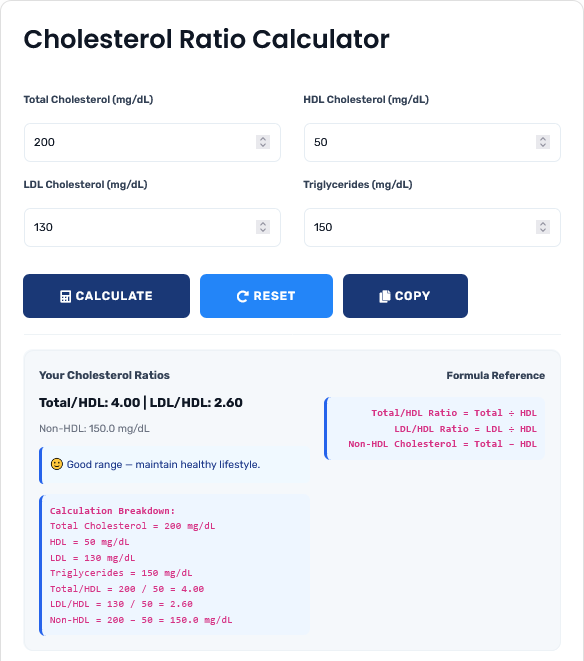
The calculator on this page performs the standard ratio calculations instantly from your lipid panel values. For comprehensive health monitoring, explore our full range of medical calculators designed for general health assessment.
Illustrative Scenarios: How Ratios Are Used
Looking Beyond LDL Alone
Consider a hypothetical patient with total cholesterol 210 mg/dL, HDL 35 mg/dL, LDL 135 mg/dL, and triglycerides 200 mg/dL. Looking at LDL alone might suggest only moderate concern, but the ratios tell a fuller story:
Ratio Breakdown:
- Total Cholesterol:HDL ratio = 210 ÷ 35 = 6.0 (higher-risk range)
- LDL:HDL ratio = 135 ÷ 35 = 3.86 (moderately elevated)
- Non-HDL cholesterol = 210 − 35 = 175 mg/dL
A low HDL value like this pulls both ratios into a less favorable range even though the LDL number by itself might look only moderately concerning — which is exactly why guidelines recommend using ratios as a complement to, not a replacement for, LDL and total cholesterol values.
For broader health assessment, our health calculator suite offers complementary tools for wellness evaluation.
Tracking Treatment Response Over Time
Ratios are also useful for tracking how lipid values shift together during treatment. In a hypothetical case where LDL drops from 160 to 105 mg/dL on statin therapy, looking at the ratio alongside the raw LDL number gives extra context:
| Parameter | Before | After |
|---|---|---|
| Total Cholesterol | 240 mg/dL | 185 mg/dL |
| HDL Cholesterol | 40 mg/dL | 42 mg/dL |
| Total:HDL Ratio | 6.0 | 4.4 |
| LDL:HDL Ratio | 4.0 | 2.5 |
Even with a good LDL response, a Total:HDL ratio of 4.4 may still sit above some clinicians' preferred target of under 4.0 — a useful reminder that ratios and absolute LDL values can tell slightly different parts of the same story, and both are typically reviewed together.
The Formulas
Standard Cholesterol Ratio Calculations:
1. Total Cholesterol : HDL Ratio
Total/HDL = Total Cholesterol ÷ HDL
2. LDL : HDL Ratio
LDL/HDL = LDL ÷ HDL
3. Non-HDL Cholesterol
Non-HDL = Total Cholesterol − HDL
General Ratio Reference Ranges
| Risk Category | Total:HDL Ratio | LDL:HDL Ratio |
|---|---|---|
| Optimal | Below 3.5 | Below 2.0 |
| Average / Moderate | 3.5 – 5.0 | 2.0 – 3.0 |
| Borderline High | 5.0 – 6.0 | 3.0 – 4.0 |
| High Risk | Above 6.0 | Above 4.0 |
These are general population reference ranges. Individualized targets — for example in diabetes, chronic kidney disease, or secondary prevention after a cardiac event — are often stricter and should be set with your doctor.
Why Ratios Can Diverge from LDL Alone
Common Assumption: "If my LDL is fine, my cholesterol
picture is fine."
More Complete Picture: A low HDL value can push the
Total:HDL and LDL:HDL ratios into a less favorable range even when LDL on its
own looks acceptable. This is one reason several major guidelines recommend
reviewing ratios alongside, not instead of, individual lipid values.
Takeaway: A patient with "acceptable" LDL but a low HDL and
an unfavorable ratio may still warrant discussion with their doctor about
overall lipid management.
Ratios Differ Between Men and Women
HDL levels tend to run higher in women than in men on average, which affects how ratios should be interpreted:
- Women generally have higher average HDL, which tends to produce more favorable ratios at the same total cholesterol level
- Men typically have lower average HDL, so the same total cholesterol can produce a less favorable ratio
- After menopause, HDL levels in women often decline, which can shift ratios in a less favorable direction over time
Because of this, doctors generally interpret ratio values in the context of age and sex rather than applying one fixed cutoff to everyone.
Other Lipid-Based Ratios You May See
Beyond the two ratios calculated here, a few other lipid ratios sometimes appear in clinical literature and lab reports:
| Ratio | Calculation | General Use |
|---|---|---|
| Triglyceride:HDL Ratio | Triglycerides ÷ HDL | Sometimes used as a rough marker linked to insulin resistance |
| ApoB:ApoA1 Ratio | Requires separate lab tests (ApoB, ApoA1) | Used in some risk models as an alternative to standard lipid ratios |
These require additional lab values beyond a standard lipid panel and are not calculated by this tool.
Things That Can Affect Your Results
Factors Worth Knowing About:
- Recent Illness or Surgery: Acute illness can temporarily shift lipid values
- Lab-to-Lab Variability: Different labs and measurement methods can produce slightly different results
- Medications: Certain drugs (steroids, some antipsychotics, some HIV medications) can affect lipid levels
- Genetic Conditions: Conditions like familial hypercholesterolemia need specialized assessment beyond standard ratios
- Ethnic and Population Differences: Average lipid patterns can vary somewhat across populations
This tool performs the standard ratio math on the numbers you enter; it doesn't know your medical history or medications. For overall health assessment, browse our full calculator directory.
How This Calculator Works
This calculator applies the standard Total/HDL, LDL/HDL, and Non-HDL formulas directly to the values you enter — no adjustments, estimates, or hidden assumptions. It performs simple arithmetic and does not access lab records, medication history, or any other personal data. Interpreting your results in the context of your full health picture is best done with your doctor.
Reference Guidelines
| Guideline/Source | Issuing Organization | General Recommendation |
|---|---|---|
| ACC/AHA Cholesterol Guideline | American Heart Association / American College of Cardiology | Uses lipid values, including ratios, as part of overall cardiovascular risk assessment |
| ESC/EAS Dyslipidaemia Guidelines | European Society of Cardiology | Recommends considering ratios alongside absolute lipid values |
| NICE Clinical Guideline (Lipid Modification) | National Institute for Health and Care Excellence (UK) | Incorporates cholesterol values into risk calculators such as QRISK |
Guideline recommendations are periodically updated. Refer to the issuing organization's current published guidance for the most up-to-date thresholds.
Using This Tool Alongside Clinical Care: Cholesterol ratios are one piece of a broader cardiovascular risk picture that includes blood pressure, family history, lifestyle factors, and other lab values. This calculator provides the ratio math instantly, but interpreting what it means for you is best done together with your doctor. For complementary cardiovascular tools, see our blood pressure calculator.
Frequently Asked Questions
Generally, a ratio below 3.5 is considered optimal, 3.5–5.0 is considered average, and above 5.0 is considered higher risk. These are general population reference ranges — your doctor may set a stricter individual target depending on your overall risk factors.
The ratio also depends on your HDL level. If your HDL ("good" cholesterol) is low, the ratio can be elevated even when your LDL looks acceptable on its own. This is part of why doctors look at ratios alongside, not instead of, individual lipid values.
Ratios don't capture everything relevant to cardiovascular risk — for example, they don't reflect LDL particle size, inflammation markers, or genetic lipid disorders. They're also less studied in people over 75 and can be affected by acute illness or lab-to-lab variability. Ratios work best as part of a broader risk assessment, not as a standalone diagnostic.
Statins mainly lower LDL, which tends to improve ratios. Some medications that raise HDL or lower triglycerides can also improve ratios. On the other hand, certain drugs — like some steroids or antipsychotics — can worsen lipid values. If you're on a lipid medication, your doctor will typically recheck your panel after a few weeks to see the effect.
No. This calculator performs the standard ratio formulas used in clinical practice, but it doesn't know your medical history, medications, or other risk factors. Always discuss your cholesterol results with a qualified healthcare provider.
People with diabetes or chronic kidney disease are often given stricter ratio and LDL targets than the general population, since these conditions raise baseline cardiovascular risk. The exact target depends on individual risk factors and should be set by your treating physician.
