Volume is the amount of three-dimensional space occupied by an object or enclosed by a solid shape. This calculator can find the volume of common 3D shapes including rectangular prisms, cubes, cylinders, spheres, cones, square pyramids, and triangular prisms.
Choose a shape, enter its required dimensions, and the calculator will display the result, formula, substituted values, calculation steps, and useful equivalent volume units.
For other geometry tools, explore our Geometry Calculators.
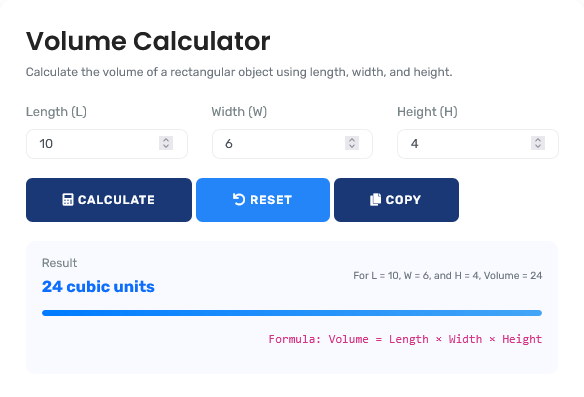
How to Use the Volume Calculator
- Select a shape: Choose the 3D solid you want to calculate.
- Select a unit: Choose millimeters, centimeters, meters, kilometers, inches, feet, or yards.
- Enter the dimensions: The required fields automatically change for the selected shape.
- Calculate: Press Calculate Volume to see the result.
- Review the steps: The result panel shows the formula, substitution, calculation steps, and equivalent volume values.
Volume Formulas for Common 3D Shapes
| Shape | Measurements Needed | Volume Formula |
|---|---|---|
| Cube | Side length (s) | V = s³ |
| Rectangular Prism | Length (l), width (w), height (h) | V = l × w × h |
| Cylinder | Radius (r), height (h) | V = πr²h |
| Sphere | Radius (r) | V = (4/3)πr³ |
| Cone | Radius (r), perpendicular height (h) | V = (1/3)πr²h |
| Square Pyramid | Base side (s), perpendicular height (h) | V = (1/3)s²h |
| Triangular Prism | Triangle base (b), triangle height (h), prism length (L) | V = (1/2)bhL |
What Is Volume?
Volume is the amount of three-dimensional space occupied by an object or contained within a solid shape. It is expressed in cubic units such as cm³, m³, in³, or ft³.
Unlike area, which measures two-dimensional space, volume uses three dimensions. For example, a rectangular prism uses length, width, and height. For 2D calculations, use our Area Calculator.
Worked Volume Examples
Example 1: Rectangular Prism
A box is 10 cm long, 5 cm wide, and 8 cm high.
Formula: V = l × w × h
Substitution: V = 10 × 5 × 8
Calculation: V = 400 cm³
Answer: The box has a volume of 400 cm³.
Example 2: Cylinder
A cylinder has a radius of 5 cm and a height of 10 cm.
Formula: V = πr²h
Substitution: V = π × 5² × 10
Calculation: V = 250π ≈ 785.398 cm³
Answer: The cylinder has a volume of approximately 785.398 cm³.
Volume Units and Conversions
Measurements should use one consistent length unit before applying a volume formula. Because volume is three-dimensional, the result is expressed in the cube of that unit. For example, centimeter measurements produce cm³ and foot measurements produce ft³.
| Volume | Equivalent |
|---|---|
| 1 cm³ | 1 mL |
| 1,000 cm³ | 1 L |
| 1 m³ | 1,000 L |
| 1 ft³ | 28.3168 L |
| 1 US gallon | 3.78541 L |
Volume vs Capacity
Volume describes the three-dimensional space occupied or enclosed by an object. Capacity describes how much a container can hold. The two concepts are closely related, but capacity is normally used when discussing containers and liquids.
Common Volume Calculation Mistakes
Mixing units: Do not use centimeters for one dimension and inches for another without converting first.
Using diameter instead of radius: Cylinder, sphere, and cone formulas use radius. Radius = diameter ÷ 2.
Using slant height: Cone and pyramid volume formulas use perpendicular height, not slant height.
Forgetting cubic units: Volume is three-dimensional, so a result based on centimeters is written as cm³, not cm or cm².
How to Verify a Volume Calculation
- Confirm that you selected the correct 3D shape.
- Check that each measurement uses the same selected unit.
- Confirm that radius, diameter, and perpendicular height have not been confused.
- Substitute the dimensions into the formula again and check the arithmetic.
For a rectangular prism, you can also rearrange V = l × w × h. Dividing the volume by length × width should return the original height.
How to Find the Volume of an Irregular Object
A common method for a small solid that can safely be submerged is water displacement. Measure the initial water volume, fully submerge the object, then subtract the initial reading from the final reading. The increase in water volume equals the object's volume. Because 1 mL = 1 cm³, a 25 mL increase corresponds to 25 cm³.
Calculation methodology: Utilixea applies the standard geometric volume formula for the selected shape. Input dimensions are interpreted using the selected measurement unit, and results are shown in cubic units with practical rounding. Equivalent unit conversions are calculated from the same volume value.
Last updated: July 22, 2026
Frequently Asked Questions
There is no single formula for every 3D shape. A rectangular prism uses V = l × w × h, a cylinder uses V = πr²h, and a sphere uses V = (4/3)πr³.
For a rectangular prism or box, multiply the length, width, and height. For example, 10 × 5 × 8 = 400 cubic units.
Volume measures three-dimensional space. Because three dimensions are multiplied together, the unit is cubed. Three centimeter measurements therefore produce cubic centimeters, or cm³.
Volume describes the three-dimensional space occupied or enclosed by an object. Capacity describes how much a container can hold. They are closely related but are used in slightly different contexts.
When a formula requires radius, divide the diameter by 2 first. For example, a diameter of 10 cm gives a radius of 5 cm.
For a solid object that can safely be submerged, use water displacement. Measure the initial water volume, submerge the object completely, then subtract the initial reading from the final reading.
Divide cubic centimeters by 1,000. For example, 2,500 cm³ equals 2.5 liters because 1,000 cm³ = 1 liter.
Surface area measures the total area covering the outside of a 3D object, while volume measures the space inside or occupied by the object. Use our Surface Area Calculator when you need the exterior area instead.
Need another geometry calculation? Try our Area Calculator, Surface Area Calculator, or browse all Geometry Calculators.
