Pythagorean Theorem Calculator: Find Missing Triangle Sides Instantly
The Pythagorean Theorem is one of the most famous and useful mathematical principles in history. Discovered by the ancient Greek mathematician Pythagoras, this theorem provides a simple yet powerful way to calculate relationships in right-angled triangles. Whether you're a student tackling geometry homework, a carpenter ensuring perfect corners, or a DIY enthusiast planning home projects, understanding and applying this theorem is essential.
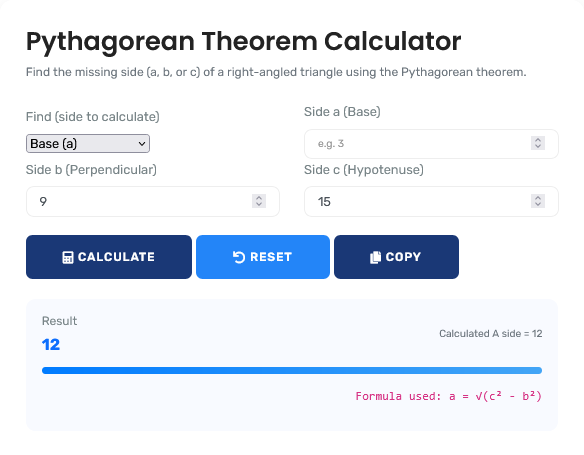
Our Pythagorean Theorem Calculator makes these calculations effortless. Simply enter any two sides of a right triangle, and instantly get the length of the third side. No more manual calculations, no more square root confusion—just accurate results in seconds.
Why the Pythagorean Theorem matters in everyday life:
- Construction & Carpentry: Ensuring perfect 90-degree angles and square corners
- Navigation & Mapping: Calculating shortest distances between points
- Home Improvement: Checking if walls are perpendicular, planning roof pitches
- Education: Fundamental concept in geometry and trigonometry
- Technology: Used in computer graphics, game development, and GPS systems
While this calculator focuses on right triangles, our complete Geometry Calculators collection offers tools for all your shape calculation needs.
The Pythagorean Theorem Explained Simply
The Pythagorean Theorem Formula:
a² + b² = c²
Where:
• a and b are the lengths of the two shorter sides (legs)
• c is the length of the longest side (hypotenuse)
• The triangle must have a 90-degree angle (right angle)
Rearranged formulas for finding any side:
• Find hypotenuse: c = √(a² + b²)
• Find leg: a = √(c² - b²) or b = √(c² - a²)
Real-Life Pythagorean Theorem Scenarios
Sarah's Home Renovation: Checking Square Corners
Sarah was installing kitchen cabinets and needed to ensure the corner was perfectly square (90 degrees). She measured 3 feet along one wall and 4 feet along the adjacent wall.
Calculation Analysis:
- Side a = 3 feet
- Side b = 4 feet
- If corner is square, diagonal c should be: √(3² + 4²) = √(9 + 16) = √25 = 5 feet
- Sarah measured the diagonal: 5.1 feet
- Conclusion: Corner is slightly off (0.1 foot = 1.2 inches)
- Solution: Adjust cabinet placement before installation
Using the 3-4-5 triangle method (a common carpenter's trick), Sarah avoided crooked cabinets that would have caused alignment problems with countertops and appliances.
For other home improvement calculations, try our Tile Calculator.
Mike's Fencing Project: Calculating Diagonal Braces
Mike was building a rectangular garden fence that needed diagonal braces for stability. The fence section was 6 feet high and 8 feet wide between posts.
Brace Length Calculation:
- Height (a) = 6 feet
- Width (b) = 8 feet
- Brace length (c) = √(6² + 8²) = √(36 + 64) = √100 = 10 feet
- Cutting consideration: Add extra length for attachment points
- Material purchase: Buy 10.5-foot boards for braces
- Angle check: Ensure brace forms right triangle with post and rail
Accurate brace length calculation prevented waste and ensured proper support for the fence, especially important in windy areas.
For construction material calculations, use our Concrete Volume Calculator.
Robert's TV Mounting: Finding Wall Stud Distance
Robert wanted to mount a 65-inch TV between two wall studs that were 16 inches apart (center to center). He needed to calculate the diagonal distance to ensure the TV mount would fit properly.
Mounting Analysis:
- Stud spacing (horizontal distance) = 16 inches
- Vertical mounting hole distance on TV bracket = 12 inches
- Actual diagonal needed: √(16² + 12²) = √(256 + 144) = √400 = 20 inches
- TV bracket hole spacing: Maximum 24 inches apart
- Result: 20 inches < 24 inches - Mounting will work!
- Safety factor: Always verify with actual measurements before drilling
This calculation saved Robert from mounting errors that could have damaged his wall or caused the TV to fall.
For distance-related calculations, check our Distance Between Points Calculator.
Common Pythagorean Triples
What are Pythagorean Triples?
Pythagorean triples are sets of three positive integers that satisfy the Pythagorean theorem. These are especially useful because they provide exact whole number solutions.
Most Common Triples:
- 3-4-5: 3² + 4² = 9 + 16 = 25 = 5²
- 5-12-13: 5² + 12² = 25 + 144 = 169 = 13²
- 6-8-10: 6² + 8² = 36 + 64 = 100 = 10² (double of 3-4-5)
- 7-24-25: 7² + 24² = 49 + 576 = 625 = 25²
- 8-15-17: 8² + 15² = 64 + 225 = 289 = 17²
- 9-12-15: 9² + 12² = 81 + 144 = 225 = 15²
- 20-21-29: 20² + 21² = 400 + 441 = 841 = 29²
Practical Use: Carpenters often use the 3-4-5 method to check for square corners. Measure 3 units along one side, 4 units along the other, and the diagonal should be exactly 5 units if the corner is square.
Pythagorean Theorem Applications by Field
| Field/Profession | Application | Example | Why It Matters |
|---|---|---|---|
| Construction & Carpentry | Checking square corners, roof pitch | 3-4-5 triangle method for 90° angles | Ensures structural integrity, proper fitting |
| Surveying & Land Measurement | Calculating property boundaries | Finding diagonal distances of rectangular plots | Accurate land division, legal boundaries |
| Navigation & GPS | Shortest path calculations | Direct distance between coordinates | Efficient routing, distance estimation |
| Computer Graphics | Distance calculations in 2D/3D space | Object positioning, collision detection | Realistic animation, game development |
| Electrical Engineering | Impedance calculations | AC circuit analysis with resistance/reactance | Circuit design, power optimization |
| Architecture | Structural design, space planning | Diagonal bracing calculations | Building stability, efficient space use |
Step-by-Step Calculation Examples
Example 1: Finding the Hypotenuse
Problem: A right triangle has legs of 9 cm and 12 cm. Find the hypotenuse.
- Identify known values: a = 9 cm, b = 12 cm
- Apply formula: c = √(a² + b²)
- Calculate squares: 9² = 81, 12² = 144
- Add squares: 81 + 144 = 225
- Find square root: √225 = 15
- Solution: The hypotenuse is 15 cm
Check: 9-12-15 is a Pythagorean triple (3×3-4-5), confirming our answer is correct.
Example 2: Finding a Missing Leg
Problem: A right triangle has hypotenuse 13 m and one leg 5 m. Find the other leg.
- Identify known values: c = 13 m, a = 5 m
- Apply formula: b = √(c² - a²)
- Calculate squares: 13² = 169, 5² = 25
- Subtract squares: 169 - 25 = 144
- Find square root: √144 = 12
- Solution: The missing leg is 12 m
Check: 5-12-13 is a well-known Pythagorean triple, confirming our answer.
Common Mistakes and How to Avoid Them
Mistake 1: Using the Theorem on Non-Right Triangles
Error: Applying a² + b² = c² to triangles without a 90-degree
angle.
Why it's wrong: Pythagorean Theorem only works for right
triangles.
How to avoid: Always verify the triangle has a right angle
before using the theorem.
Alternative: For non-right triangles, use Law of Cosines or Law
of Sines.
Mistake 2: Confusing Which Side is the Hypotenuse
The hypotenuse is always the longest side and opposite the right angle. Beginners often misidentify which side is which.
How to remember:
• Hypotenuse is always opposite the right angle
• Hypotenuse is always the longest side
• In the formula a² + b² = c², c is always the hypotenuse
Visual trick: Imagine the right angle "opening" to face the hypotenuse.
For more geometry practice, use our Area Calculator.
Mistake 3: Forgetting to Take the Square Root
A common error is stopping after adding a² + b² without taking the square root to find c.
Incorrect: 3² + 4² = 9 + 16 = 25, so c = 25
Correct: 3² + 4² = 9 + 16 = 25, so c = √25 = 5
Why it matters: The formula gives c², not c. You must take the square root to find the actual side length.
Memory aid: "Square, add, square root" - the three steps for finding the hypotenuse.
Beyond Basic Pythagorean Theorem
Advanced Applications and Extensions:
3D Pythagorean Theorem:
In three dimensions: d = √(x² + y² + z²)
Useful for finding distance between points in space, diagonal of a rectangular
box
Distance Formula:
The distance between two points (x₁, y₁) and (x₂, y₂) on a coordinate plane:
d = √[(x₂ - x₁)² + (y₂ - y₁)²]
This is essentially the Pythagorean Theorem applied to coordinate geometry.
Trigonometric Connections:
The Pythagorean Theorem is fundamental to trigonometry:
sin²θ + cos²θ = 1 (Pythagorean identity)
This identity comes directly from applying the theorem to a unit circle.
For trigonometric calculations, explore our Algebra Calculators collection.
Historical Context and Significance
| Historical Period | Development | Significance | Modern Impact |
|---|---|---|---|
| Ancient Babylon (1800-1600 BCE) |
Plimpton 322 tablet shows understanding of Pythagorean triples | Evidence that the relationship was known before Pythagoras | Early mathematics development |
| Ancient Greece (6th Century BCE) |
Pythagoras and his school formalized and proved the theorem | First rigorous proof, named after Pythagoras | Foundation of Euclidean geometry |
| Ancient China (3rd Century BCE) |
Chinese text "Zhoubi Suanjing" contains the Gougu theorem | Independent discovery in Chinese mathematics | Cross-cultural mathematical development |
| Ancient India (8th Century BCE) |
Sulba Sutras contain Pythagorean triples and geometric proofs | Early Indian contributions to geometry | Foundation for later Indian mathematics |
| Modern Era | Over 350 different proofs documented | Most proven theorem in mathematics | Fundamental to science, engineering, technology |
Teaching and Learning Resources
For Students:
- Start with 3-4-5 triangles: These provide whole number answers
- Use graph paper: Draw right triangles to visualize the theorem
- Practice with real objects: Measure actual right angles in your environment
- Memorize common triples: 3-4-5, 5-12-13, 8-15-17 will save time on tests
- Check your work: Always verify that the hypotenuse is the longest side
For Teachers:
- Use physical demonstrations: Square tiles on triangle sides
- Connect to coordinate geometry: Show how distance formula derives from theorem
- Incorporate technology: Use dynamic geometry software
- Real-world projects: Have students find Pythagorean applications at home
- Historical context: Discuss multicultural origins of the theorem
Key Insight: The Pythagorean Theorem is more than just a formula to memorize—it's a fundamental tool for understanding spatial relationships. From ancient architecture to modern technology, this simple equation a² + b² = c² has shaped our world. Whether you're building a deck, programming a game, or studying for a geometry test, mastering this theorem opens doors to practical problem-solving and deeper mathematical understanding.
Quick Reference: Pythagorean Theorem Cheat Sheet
Basic Formula: a² + b² = c² (where c is hypotenuse)
Rearranged Formulas:
- Find hypotenuse: c = √(a² + b²)
- Find leg a: a = √(c² - b²)
- Find leg b: b = √(c² - a²)
Common Pythagorean Triples:
- 3-4-5 (and multiples: 6-8-10, 9-12-15, etc.)
- 5-12-13
- 7-24-25
- 8-15-17
- 9-40-41
Quick Check Method (3-4-5 Rule):
To check if a corner is square: Measure 3 units along one side, 4 units along
the other. If the diagonal measures exactly 5 units, the corner is 90 degrees.
Remember: The theorem only works for right triangles (one 90° angle)!
Frequently Asked Questions
No, the Pythagorean Theorem only applies to right triangles (triangles with one 90-degree angle). For other triangles, you would use different formulas like the Law of Cosines or Law of Sines.
The Distance Formula is actually the Pythagorean Theorem applied to coordinate geometry. If you have two points (x₁, y₁) and (x₂, y₂), the horizontal distance is (x₂ - x₁) and the vertical distance is (y₂ - y₁). The straight-line distance between them is √[(x₂ - x₁)² + (y₂ - y₁)²], which is exactly the Pythagorean Theorem.
Our calculator uses precise mathematical operations and handles decimal values accurately. For most practical purposes, it's as accurate as your input measurements. For extremely precise scientific or engineering applications, always consider measurement precision and rounding rules specific to your field.
Yes! In three dimensions, the formula becomes: d = √(x² + y² + z²). This is useful for finding the diagonal of a rectangular box or the distance between points in 3D space. Our calculator focuses on 2D right triangles, but the principle extends to higher dimensions.
While the relationship was known to ancient Babylonians, Indians, and Chinese, Pythagoras and his school in ancient Greece were the first to provide a formal proof. In mathematics, theorems are typically named after those who first proved them, not necessarily those who first discovered the relationship.
Many professions use the Pythagorean Theorem: carpenters and construction workers (checking square corners), surveyors (measuring land), architects and engineers (designing structures), computer graphics programmers (calculating distances in 2D/3D space), navigators and pilots (calculating shortest routes), and even artists (perspective and proportion).
