Surface Area Calculator: Master 3D Geometry with Precision
Surface area is one of the most important concepts in geometry and real-world applications. It represents the total area that covers the outside of a three-dimensional object. Whether you're a student tackling geometry homework, a teacher preparing lessons, or a professional planning construction projects, understanding surface area calculations is essential.
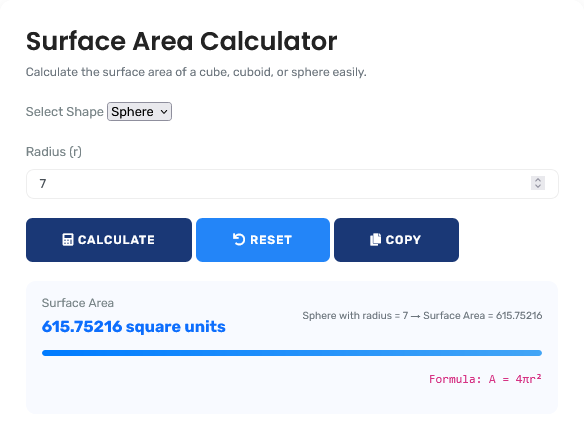
Our Surface Area Calculator simplifies complex calculations, providing accurate results instantly for cubes, spheres, cylinders, cones, and many other shapes. No more memorizing formulas or making calculation errors - our tool does the heavy lifting for you.
Why surface area matters in practical applications:
- Construction & Architecture: Calculating materials needed for buildings and structures
- Manufacturing: Determining packaging requirements and material costs
- Education: Helping students visualize and understand 3D geometry
- DIY Projects: Planning paint, wallpaper, or coating needs
- Science & Engineering: Solving physics and engineering problems
For more geometry tools, explore our complete Geometry Calculators collection.
Real-World Surface Area Applications
Sarah's Home Painting Project
Sarah wanted to paint her daughter's bedroom, which had an unusual shape with sloped ceilings and built-in shelves. She needed to calculate the exact surface area to buy the right amount of paint.
Project Analysis:
- Room dimensions: 12 ft × 15 ft with 9 ft ceilings
- Sloped ceiling area: triangular section 12 ft base, 4 ft height
- Built-in shelves: 3 rectangular faces to paint
- Windows and doors: 45 sq ft to deduct
- Total wall area: 2×(12×9) + 2×(15×9) = 486 sq ft
- Ceiling area: 12×15 = 180 sq ft + triangular section (24 sq ft)
- Shelves surface: 35 sq ft additional
- Net paintable area: 486 + 180 + 24 + 35 - 45 = 680 sq ft
- Paint needed: 680 ÷ 350 = 1.94 gallons (2 gallons with extra)
By accurately calculating the surface area, Sarah avoided buying too much paint (wasting money) or too little (requiring extra trips to the store).
For related home improvement calculations, try our Paint Calculator.
Mike's Packaging Design Project
Mike, a product designer, needed to create packaging for a new cylindrical candle. He had to calculate the exact surface area to determine material costs and design the label.
Packaging Analysis:
- Candle dimensions: Height 6 inches, diameter 3 inches
- Radius: 1.5 inches
- Cylinder surface area formula: 2πr(h + r)
- Calculation: 2 × 3.1416 × 1.5 × (6 + 1.5) = 2 × 3.1416 × 1.5 × 7.5
- Surface area: 70.69 square inches
- Label material cost: $0.15 per square inch
- Material cost per candle: 70.69 × $0.15 = $10.60
- Production run: 1,000 candles = $10,600 material cost
- Key insight: Even small errors in calculation could cost hundreds of dollars
Accurate surface area calculation helped Mike budget correctly and avoid costly material shortages or excess.
For business calculations, use our Profit Margin Calculator.
Construction: Calculating Concrete for a Swimming Pool
A contractor needed to calculate the surface area of a rectangular swimming pool to determine how much waterproof coating to apply.
Construction Analysis:
- Pool dimensions: 20 ft long × 10 ft wide × 5 ft deep
- Surface areas to coat:
- Bottom: 20 × 10 = 200 sq ft
- Long sides: 2 × (20 × 5) = 200 sq ft
- Short sides: 2 × (10 × 5) = 100 sq ft
- Total interior surface: 200 + 200 + 100 = 500 sq ft
- Coating coverage: 50 sq ft per gallon
- Gallons needed: 500 ÷ 50 = 10 gallons
- Waste factor (15%): 1.5 gallons extra
- Total purchase: 11.5 gallons (round to 12)
- Cost: 12 gallons × $45/gallon = $540
This calculation ensured the contractor bought exactly the right amount of expensive waterproof coating.
For construction volume calculations, try our Concrete Volume Calculator.
Surface Area Formulas for Common 3D Shapes
Essential Surface Area Formulas:
1. Cube:
Surface Area = 6 × side²
Example: side = 4 cm → 6 × 4² = 96 cm²
2. Rectangular Prism (Cuboid):
Surface Area = 2(lw + lh + wh)
Example: l=5, w=3, h=2 → 2(5×3 + 5×2 + 3×2) = 62 units²
3. Sphere:
Surface Area = 4πr²
Example: r = 7 in → 4 × 3.1416 × 7² = 615.75 in²
4. Cylinder:
Surface Area = 2πr(h + r)
Example: r=3, h=8 → 2 × 3.1416 × 3 × (8+3) = 207.35 units²
5. Cone:
Surface Area = πr(r + √(h² + r²))
Example: r=4, h=3 → 3.1416 × 4 × (4 + √(3²+4²)) = 113.10 units²
6. Triangular Prism:
Surface Area = bh + (a+b+c)l
Where: b=base, h=height, a,b,c=triangle sides, l=prism length
Surface Area vs. Volume: Understanding the Difference
| Aspect | Surface Area | Volume | Practical Difference |
|---|---|---|---|
| Definition | Total area covering the outside | Space occupied inside | Surface = covering, Volume = filling |
| Units | Square units (cm², ft², m²) | Cubic units (cm³, ft³, m³) | Area = 2D measurement, Volume = 3D measurement |
| Real-World Example | Paint needed for a box | Water needed to fill the box | Paint covers surfaces, water fills space |
| Calculation Focus | External covering | Internal capacity | Different formulas for each |
| Common Use | Material estimation | Capacity planning | Both essential for different purposes |
For volume calculations, use our Volume Calculator.
Surface Area Calculation Techniques
| Shape Type | Calculation Method | Key Measurements | Common Applications | Special Considerations |
|---|---|---|---|---|
| Regular Prisms | Sum of all face areas | Length, width, height | Boxes, buildings, furniture | Include all faces, even hidden ones |
| Cylinders | 2πr² + 2πrh | Radius, height | Cans, pipes, columns | Remember both circular ends |
| Spheres | 4πr² | Radius only | Balls, domes, planets | No edges or vertices |
| Cones | πr² + πr√(r²+h²) | Radius, height | Traffic cones, roofs | Need slant height for side area |
| Pyramids | Base area + ½ × perimeter × slant height | Base dimensions, slant height | Architecture, monuments | Triangular side faces |
Step-by-Step Calculation Framework
5-Step Process for Accurate Surface Area Calculations:
- Identify the shape: Determine exactly what 3D shape you're working with
- Gather measurements: Collect all necessary dimensions (length, width, height, radius, etc.)
- Select the formula: Choose the correct surface area formula for your shape
- Calculate systematically: Work through the formula step by step
- Verify and apply: Check your work and apply the result to your practical need
This methodical approach prevents common errors. For percentage-based calculations, use our Percentage Calculator.
Common Calculation Mistakes and How to Avoid Them
The "Missing Faces" Error
Common mistake: Forgetting to include all faces of a 3D
shape.
Example: Calculating surface area of a box as just top + bottom
+ front + back, forgetting the two sides.
Result: Significant underestimation of material needs.
Solution: Always count all faces. For a rectangular prism: 2
ends + 2 sides + top + bottom = 6 faces total.
Unit Conversion Errors
Mixing measurement units is one of the most common errors in surface area calculations. Working with inches and feet in the same calculation without proper conversion leads to wildly incorrect results.
Example of error: Length = 2 feet, Width = 18 inches
Incorrect: 2 × 18 = 36 square feet?
Correct: Convert 18 inches to 1.5 feet, then 2 × 1.5 = 3 square feet
Difference: 36 vs 3 - a 12× error!
Best practice: Convert all measurements to the same unit before calculating.
Advanced Applications and Special Cases
Case: Calculating Surface Area for a Complex Architectural Structure
Scenario: An architect needs to calculate the exterior surface area of a building with multiple geometric components.
-
Breakdown into Components:
- Main rectangular section: 50 ft × 30 ft × 20 ft
- Cylindrical tower: radius 8 ft, height 30 ft
- Pyramidal roof: base 20 ft × 20 ft, slant height 15 ft
-
Calculate Each Component:
- Rectangular section: 2(50×30 + 50×20 + 30×20) = 6,200 sq ft
- Cylindrical tower: 2π×8×(30+8) = 1,911 sq ft
- Pyramidal roof: 20×20 + ½×80×15 = 400 + 600 = 1,000 sq ft
-
Combine and Adjust:
- Total: 6,200 + 1,911 + 1,000 = 9,111 sq ft
- Deduct overlapping areas: 300 sq ft
- Final exterior surface: 8,811 sq ft
- Application: Calculate cladding material needed
For area calculations of different shapes, try our Area Calculator.
Material Estimation Guidelines
| Material Type | Coverage per Unit | Waste Factor | Calculation Method | Professional Tip |
|---|---|---|---|---|
| Paint | 350-400 sq ft/gallon | 10-15% | Surface area ÷ coverage rate | Buy extra for touch-ups |
| Wallpaper | 30 sq ft/roll | 10-20% | Account for pattern matching | Measure each wall separately |
| Tile | Varies by size | 10-15% | Surface area + cuts + breakage | Buy from same batch number |
| Cladding/Siding | Coverage per panel | 5-10% | Account for overlaps | Consider direction of installation |
| Insulation | Coverage per batt/roll | 5% | Exact surface measurement | Don't compress material |
Educational Value for Students
Why Surface Area Matters in Education:
- Visualizes 3D Geometry: Helps students understand spatial relationships
- Connects Math to Reality: Shows practical applications of formulas
- Develops Problem-Solving Skills: Requires systematic thinking
- Reinforces Measurement Skills: Practice with units and conversions
- Builds Foundation for Advanced Math: Essential for calculus and physics
Teachers can use our calculator to demonstrate concepts, verify student work, and create real-world problem scenarios. For statistical analysis in projects, try our Statistics Calculators.
Key Insight: Surface area calculations bridge theoretical mathematics and practical application. Whether you're a student learning geometry, a teacher creating lesson plans, a DIY enthusiast planning a project, or a professional estimating materials, accurate surface area calculations are essential. Our calculator provides the accuracy you need while our explanations help you understand the underlying principles. Remember: In geometry, as in many things, the surface often tells only part of the story—but it's a crucial part!
Quick Reference: Surface Area Formulas Cheat Sheet
Basic Shapes:
- Cube: 6a² (a = side length)
- Rectangular Prism: 2(lw + lh + wh)
- Sphere: 4πr²
- Cylinder: 2πr(h + r)
- Cone: πr(r + √(h² + r²))
- Pyramid: Base area + ½ × perimeter × slant height
Remember These Tips:
- Always use consistent units
- Count all faces of 3D shapes
- Include appropriate waste factors for real projects
- Double-check measurements before calculating
- When in doubt, break complex shapes into simpler components
Frequently Asked Questions
Lateral surface area includes only the sides of a 3D shape, excluding the top and bottom. Total surface area includes all faces. For example, for a cylinder: Lateral = 2πrh, Total = 2πr(h + r). Our calculator can compute both depending on your needs.
For irregular shapes, break them down into regular components (rectangles, triangles, circles), calculate each component's surface area, then add them together. For very complex shapes, approximation methods or specialized software may be needed. Our calculator handles common regular shapes with precise formulas.
Surface area calculations are essential for: estimating paint or material needs, designing packaging, planning construction projects, calculating heat transfer in engineering, determining drug dosage in medicine (based on body surface area), and much more. It's one of the most practical applications of geometry.
Yes! Our calculator works with any consistent unit system. You can input measurements in feet, inches, meters, centimeters, etc. Just ensure all measurements for one calculation use the same units. For conversions between systems, use our CM to Inches Converter.
Our calculator uses precise mathematical formulas and high-precision arithmetic. The accuracy depends on the precision of your input measurements. For most practical purposes, the results are exact. The calculator handles decimal places appropriately and rounds final results meaningfully.
For shapes not directly supported, you can often approximate by breaking them into supported components. Alternatively, consult geometry references for specialized formulas. Our calculator covers the most common 3D shapes used in education and practical applications. For perimeter calculations, try our Perimeter Calculator.
