Circle Sector Area Calculator: The Ultimate Guide to Calculating Circular Sections
From architectural designs and engineering projects to everyday geometry problems, calculating the area of a circle sector is a fundamental skill. A sector is essentially a "pizza slice" of a circle - the portion enclosed by two radii and their intercepted arc. Whether you're designing a circular garden, planning a mechanical part, or solving math homework, understanding sector area calculations is essential.
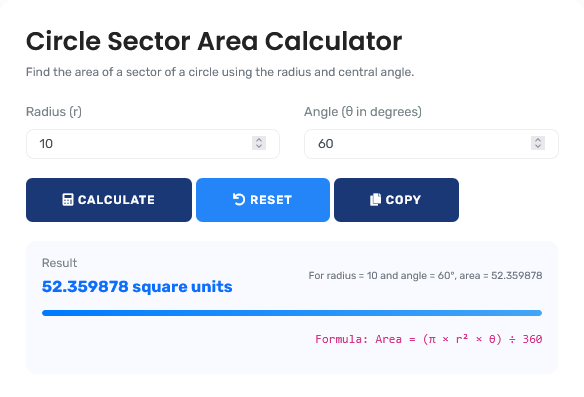
Our Circle Sector Area Calculator simplifies this mathematical process, providing accurate results in seconds. No more manual calculations, no more formula confusion - just enter the radius and central angle, and get precise sector area measurements instantly.
Common applications of circle sector area calculations:
- Architecture & Design: Calculating material needs for circular elements
- Engineering: Designing gears, pulleys, and circular mechanical parts
- Landscaping: Planning circular garden beds, patios, or walkways
- Education: Teaching geometry concepts and solving problems
- DIY Projects: Creating circular furniture, decorations, or art pieces
For comprehensive geometry solutions, explore our full collection of Geometry Calculators including area, perimeter, and volume tools.
Real-World Circle Sector Scenarios
Architectural Design: Circular Window Installation
An architect is designing a building with decorative circular windows that have stained glass sectors. Each window has a radius of 2.5 meters, and the design calls for four equal stained glass sectors in different colors.
Design Calculation Analysis:
- Window radius: 2.5 meters
- Full circle area: π × (2.5)² = 19.63 square meters
- Central angle per sector: 360° ÷ 4 = 90° each
- Sector area formula: (90° ÷ 360°) × 19.63 = 4.91 square meters
- Stained glass needed per sector: 4.91 square meters
- Total stained glass: 4 × 4.91 = 19.63 square meters
- Material cost: At $150/sq meter = $2,944.50 total
- Key insight: Each sector is exactly one-quarter of the full circle
Accurate calculation ensures the architect orders exactly the right amount of expensive stained glass, avoiding both shortages and costly waste.
For calculating perimeter measurements for the window frame, use our Perimeter Calculator.
Landscaping: Circular Garden Bed Design
A landscaper is creating a circular herb garden with different planting zones arranged as sectors. The garden has a 4-meter radius, and they want to allocate specific areas for different herb types based on their growing requirements.
Garden Planning Analysis:
- Garden radius: 4 meters
- Full garden area: π × 4² = 50.27 square meters
- Sector allocations:
- Basil: 60° sector = (60/360) × 50.27 = 8.38 square meters
- Rosemary: 90° sector = (90/360) × 50.27 = 12.57 square meters
- Thyme: 45° sector = (45/360) × 50.27 = 6.28 square meters
- Parsley: 165° sector = (165/360) × 50.27 = 23.04 square meters
- Total check: 60° + 90° + 45° + 165° = 360° ✓
- Soil calculation: Each sector needs different soil depth and composition
- Plant spacing: Based on sector area and plant requirements
Sector area calculations allow precise planning of planting zones, ensuring each herb type gets the appropriate space for optimal growth.
For calculating total garden area and converting between units, try our Area Calculator.
Engineering: Gear Tooth Design
A mechanical engineer is designing a gear with 12 teeth. Each tooth occupies a specific sector of the gear circle, and the engineer needs to calculate the space available for each tooth profile.
Engineering Design Analysis:
- Gear pitch diameter: 100 mm (radius = 50 mm)
- Gear area: π × 50² = 7,854 square millimeters
- Number of teeth: 12
- Angle per tooth: 360° ÷ 12 = 30°
- Sector area per tooth: (30/360) × 7,854 = 654.5 square millimeters
- Tooth width calculation: Based on sector geometry and pressure angle
- Material stress: Distributed across all teeth equally
- Manufacturing precision: Each tooth must be identical
Accurate sector calculations ensure uniform tooth spacing and proper gear meshing, preventing mechanical failure and ensuring smooth operation.
For related engineering calculations, explore our Physics Calculators.
Circle Sector Formulas: The Mathematics Behind the Calculations
Essential Circle Sector Formulas:
1. Basic Sector Area Formula:
Area = (θ ÷ 360°) × π × r²
Where θ = central angle in degrees, r = radius
2. Sector Area Using Radians:
Area = (1/2) × r² × θ
Where θ = central angle in radians
3. Arc Length Formula:
Arc Length = (θ ÷ 360°) × 2 × π × r
Useful for calculating the curved boundary
4. Sector Perimeter:
Perimeter = Arc Length + 2 × r
Total boundary length of the sector
Conversion: 1 radian = 180°/π ≈ 57.3°
Common Sector Angle Examples
| Sector Description | Central Angle | Fraction of Circle | Area Formula | Common Applications |
|---|---|---|---|---|
| Quarter Circle | 90° | 1/4 | (π × r²) ÷ 4 | Pizza slices, garden quadrants |
| Semi-Circle | 180° | 1/2 | (π × r²) ÷ 2 | Domes, half-moon designs |
| Third of Circle | 120° | 1/3 | (π × r²) ÷ 3 | Tricolor designs, three-section wheels |
| Sixth of Circle | 60° | 1/6 | (π × r²) ÷ 6 | Hexagonal patterns, pie charts |
| Twelfth of Circle | 30° | 1/12 | (π × r²) ÷ 12 | Clock faces, gear teeth |
Circle Sector Properties and Relationships
| Property | Formula | Relationship to Sector | Calculation Example | Practical Significance |
|---|---|---|---|---|
| Sector Area | (θ/360°) × πr² | Direct proportion to angle | 60° sector = 1/6 of circle area | Material quantity, space allocation |
| Arc Length | (θ/360°) × 2πr | Curved boundary length | 90° arc = 1/4 of circumference | Trim length, curved measurements |
| Chord Length | 2r × sin(θ/2) | Straight line across sector | 60° chord = r (when θ=60°) | Linear measurements, cut lengths |
| Sector Perimeter | Arc + 2r | Total boundary length | Quarter circle: (πr/2) + 2r | Fencing, edging requirements |
| Segment Area | Sector - Triangle | Area between chord and arc | Useful for partial areas | Irregular space calculations |
Practical Calculation Framework
4-Step Process for Perfect Sector Calculations:
- Measure accurately: Determine radius and central angle precisely
- Choose correct formula: Use degrees or radians based on your data
- Calculate systematically: Follow the formula step by step
- Verify results: Check that sector area ≤ full circle area
This methodical approach prevents common errors. For converting between angle units, use our Basic Math Calculators.
Common Circle Sector Calculation Mistakes
The "Angle vs Area" Proportionality Error
Common mistake: Assuming area increases linearly with angle in
all cases.
Mathematical reality: Area increases with the square of radius,
linearly with angle.
Example: Doubling the angle doubles the area, but doubling the
radius quadruples the area.
Key insight: Area ∝ r² × θ - both radius and angle matter
proportionally.
Degree-Radian Confusion
Many calculations go wrong when mixing degrees and radians. The formulas differ significantly:
- Using degrees: Area = (θ/360°) × πr²
- Using radians: Area = (1/2) × r² × θ
- Conversion: Radians = Degrees × (π/180)
- Common error: Using degree formula with radian values gives dramatically wrong results
Example: For r=5, θ=1.047 radians (60°):
Correct (radians): (1/2) × 5² × 1.047 = 13.09
Wrong (using degree formula): (1.047/360) × π × 25 = 0.23 (completely incorrect)
Our calculator automatically handles both units, preventing this common error.
Advanced Sector Applications
Case: Designing a Circular Conference Table with Sector Seating
Scenario: An interior designer is creating a circular conference table with radius 1.8 meters. They need to allocate equal space for 8 participants, each with their own "sector" of the table.
-
Table Specifications:
- Table radius: 1.8 meters
- Total table area: π × (1.8)² = 10.18 square meters
- Number of participants: 8
- Angle per sector: 360° ÷ 8 = 45°
-
Sector Calculations:
- Sector area per person: (45/360) × 10.18 = 1.27 square meters
- Arc length per sector: (45/360) × 2 × π × 1.8 = 1.41 meters
- Table edge per person: 1.41 meters of curved boundary
-
Practical Implications:
- Each person gets approximately 1.27 square meters of table space
- Chair placement along 1.41 meters of table edge
- Document space allocation per participant
- Technology integration (power outlets, AV connections) per sector
For calculating distances between seating positions, use our Distance Between Points Calculator.
Circle Sector in Different Fields
| Field | Sector Application | Typical Calculations | Precision Requirements | Tools Used |
|---|---|---|---|---|
| Architecture | Circular buildings, domes, windows | Material quantities, structural loads | High (construction standards) | CAD software, our calculator |
| Engineering | Gears, pulleys, rotating parts | Tooth spacing, force distribution | Very High (mechanical precision) | Engineering calculators, CAD |
| Landscaping | Circular gardens, patios, paths | Planting areas, material estimates | Medium (approximate measurements) | Measuring tools, our calculator |
| Education | Geometry teaching, problem solving | Theoretical calculations, examples | High (mathematical accuracy) | Textbooks, our calculator |
| Design & Art | Circular patterns, radial designs | Proportions, material cutting | Medium-High (visual precision) | Design software, our calculator |
Special Considerations for Accurate Calculations
Factors Affecting Sector Area Accuracy:
- Measurement precision: Radius and angle measurement accuracy
- Unit consistency: All measurements in same units
- Formula selection: Correct formula for degrees vs radians
- Pi approximation: Using π = 3.14 vs 3.14159 vs calculator π
- Rounding: When and how much to round results
- Practical tolerances: Allowable error for specific applications
Our calculator handles these considerations automatically, using precise mathematical constants and algorithms.
Step-by-Step Calculation Examples
Example 1: Pizza Sector Calculation
Problem: A 14-inch pizza is cut into 8 equal slices. What is the area of one slice?
Solution:
Radius: 14 ÷ 2 = 7 inches
Full pizza area: π × 7² = 153.94 square inches
Slices: 8, so angle per slice: 360° ÷ 8 = 45°
Sector area: (45/360) × 153.94 = 19.24 square inches per slice
Verification: 8 × 19.24 = 153.92 ≈ 153.94 ✓
Example 2: Garden Sprinkler Coverage
Problem: A sprinkler covers a 90° sector with radius 15 feet. What area does it water?
Solution:
Radius: 15 feet
Full circle area: π × 15² = 706.86 square feet
Sector angle: 90°
Sector area: (90/360) × 706.86 = 176.72 square feet
Practical application: This helps determine how many sprinklers needed to cover entire lawn.
For volume calculations related to water usage, try our Volume Calculator.
Key Insight: Circle sector calculations bridge abstract mathematics with practical applications. Whether you're dividing a pizza, designing a gear, or planning a garden, understanding sector areas enables precise planning and efficient resource use. The relationship between angle, radius, and area follows elegant mathematical principles that have countless real-world applications. For comprehensive mathematical solutions, explore our full range of Math Calculators.
Quick Reference: Sector Area Formulas
Using Degrees:
Sector Area = (θ ÷ 360) × π × r²
Using Radians:
Sector Area = (1/2) × r² × θ
Common Sector Fractions:
- 90° (quarter): Area = (πr²)/4
- 180° (half): Area = (πr²)/2
- 60° (sixth): Area = (πr²)/6
- 45° (eighth): Area = (πr²)/8
- 30° (twelfth): Area = (πr²)/12
Remember: Always verify that θ ≤ 360° for valid sectors!
Frequently Asked Questions
A sector includes the area between two radii and their arc. A segment is the area between a chord and its arc (essentially a sector minus the triangle formed by the two radii and chord). Our calculator focuses on sectors, but the principles help understand both concepts.
Yes! If you know arc length (s) and radius (r), you can find the angle: θ = (s × 360°) ÷ (2πr), then calculate area. Or use the direct formula: Area = (r × s) ÷ 2 when using radians. Our calculator can work with various input combinations.
Our calculator uses double-precision floating-point arithmetic and the exact value of π, making it accurate to many decimal places. For most practical applications, this is far more precise than manual measurements or calculations.
Angles greater than 360° represent more than one full revolution. Mathematically valid, but for sector calculations, you can reduce it modulo 360° (e.g., 450° = 450 - 360 = 90°). Our calculator handles this automatically.
No, this calculator is specifically for circular sectors. Elliptical sectors have different mathematical properties and require different formulas. For elliptical calculations, you would need specialized tools or formulas.
Degrees to radians: Multiply by π/180 ≈ 0.0174533. Radians to degrees: Multiply by 180/π ≈ 57.2958. Our calculator handles both units automatically, so you don't need to convert manually. For other conversion needs, check our Conversion Calculators.
