Mean, Median, Mode Calculator: Master the Three Pillars of Data Analysis
In the world of statistics, three simple measures hold the key to understanding any data set: Mean, Median, and Mode. These "measures of central tendency" tell you what's typical, average, or most common in your data. Whether you're a student analyzing grades, a business owner tracking sales, or a researcher studying patterns, mastering these concepts transforms raw numbers into meaningful insights.
The mean gives you the mathematical average, the median shows you the middle point, and the mode reveals the most frequent value. Together, they provide a complete picture of your data's center. But here's the crucial insight: each measure tells a different story, and choosing the right one can mean the difference between accurate understanding and misleading conclusions.
Why these three measures matter in everyday life:
- Academic Success: Understanding your true average grade vs. class performance
- Financial Decisions: Knowing whether mean or median better represents typical income or prices
- Business Intelligence: Identifying best-selling products (mode) vs. average sales (mean)
- Research Accuracy: Choosing the right measure for skewed data distributions
- Personal Tracking: Monitoring fitness progress, expenses, or other personal metrics
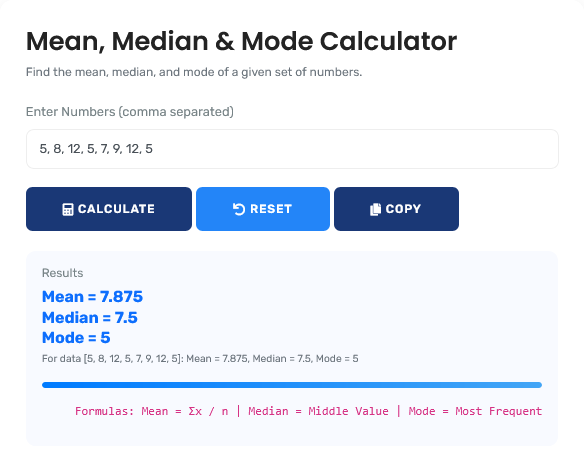
Our comprehensive mean, median, and mode calculator doesn't just compute numbers—it explains what they mean and helps you choose the right measure for your specific situation. For deeper statistical analysis, pair it with our Standard Deviation Calculator to understand data spread.
Deep Dive: Understanding Each Measure with Detailed Examples
The Mean: When Every Number Counts Equally
The mean (often called the average) is calculated by adding all values and dividing by the count. It's like sharing everything equally among all data points.
Detailed Analysis Example: Sarah's Semester Grades
- Test scores: 85, 92, 78, 85, 90, 85, 88, 94, 82, 87
- Step 1: Sum all values: 85+92+78+85+90+85+88+94+82+87 = 866
- Step 2: Count values: 10 tests
- Step 3: Calculate mean: 866 ÷ 10 = 86.6
- Interpretation: Sarah's average test score is 86.6
- When to use: Perfect for evenly distributed data without extreme outliers
- Limitation: One extremely low score (like 50) would dramatically lower the mean
- Real application: Grade point averages, batting averages in baseball, average temperatures
The mean works best when all data points contribute equally to the total. For percentage-based calculations related to grades or scores, use our Percentage Calculator.
The Median: Finding the True Middle Ground
The median is the middle value when data is sorted. It's resistant to outliers, making it ideal for skewed distributions.
Detailed Analysis Example: Neighborhood Home Prices
- Home prices: $350K, $375K, $380K, $385K, $390K, $395K, $420K, $1,200K
- Step 1: Sort values: $350K, $375K, $380K, $385K, $390K, $395K, $420K, $1,200K
- Step 2: Find middle position: 8 values, so average of 4th and 5th values
- Step 3: Calculate median: ($385K + $390K) ÷ 2 = $387,500
- Interpretation: The typical home price is $387,500 (not affected by $1.2M mansion)
- When to use: Income data, housing prices, reaction times - any skewed data
- Advantage: Not influenced by extreme values at either end
- Real application: Median household income reports, typical home prices, median age
Visualizing the Skew: The $1.2M mansion pulls the mean up to $561,875, while the median stays at $387,500. This 45% difference shows why median is often more representative for real estate data.
For real estate financial calculations, explore our Mortgage Calculator.
The Mode: Identifying What's Most Popular
The mode is the most frequently occurring value. It's particularly useful for categorical data and identifying popular choices.
Detailed Analysis Example: Restaurant Customer Ratings
- Ratings (1-5 scale): 5, 4, 5, 3, 5, 2, 5, 4, 5, 1, 5, 4, 5, 3, 5
- Step 1: Count frequency of each value:
- 1 star: 1 time
- 2 stars: 1 time
- 3 stars: 2 times
- 4 stars: 3 times
- 5 stars: 8 times
- Step 2: Identify highest frequency: 5 stars appears 8 times
- Step 3: The mode is 5
- Interpretation: Most customers give perfect 5-star ratings
- When to use: Survey responses, clothing sizes, voting patterns, product preferences
- Special cases: Can have no mode, one mode (unimodal), two modes (bimodal), or multiple modes
- Real application: Most popular product size, common customer complaint, frequent test score
The mode tells you what's common or popular, which is invaluable for business decisions and understanding preferences.
Advanced Concepts: When Data Tells Complex Stories
Mathematical Formulas and Their Applications:
1. Weighted Mean (When Values Have Different Importance):
Weighted Mean = (w₁x₁ + w₂x₂ + ... + wₙxₙ) ÷ (w₁ + w₂ + ... + wₙ)
Example: Final grade = (Test 1×0.3 + Test 2×0.3 + Final×0.4) ÷ 1.0
2. Trimmed Mean (Reducing Outlier Influence):
Remove highest and lowest 5-10% of values, then calculate mean
Example: For 20 values, remove highest and lowest 2, then average remaining 16
3. Geometric Mean (For Growth Rates and Ratios):
Geometric Mean = ⁿ√(x₁ × x₂ × ... × xₙ)
Example: Investment returns: (1.1 × 0.9 × 1.2)^(1/3) = 1.065 (6.5% average
growth)
4. Harmonic Mean (For Rates and Ratios):
Harmonic Mean = n ÷ (1/x₁ + 1/x₂ + ... + 1/xₙ)
Example: Average speed: If you travel 60 mph for 30 miles and 40 mph for 30
miles, harmonic mean = 48 mph
Comprehensive Comparison: Choosing the Right Measure
| Data Characteristic | Recommended Measure | Mathematical Reason | Practical Example | Common Mistake to Avoid |
|---|---|---|---|---|
| Symmetrical Distribution (Bell-shaped curve) |
Mean | All three measures are close together | Heights of adult women, IQ scores | Using median when mean is perfectly adequate |
| Right-Skewed Data (Long tail to the right) |
Median | Mean pulled upward by high outliers | Income, home prices, website visits | Reporting mean income (misleadingly high) |
| Left-Skewed Data (Long tail to the left) |
Median | Mean pulled downward by low outliers | Age at retirement, exam scores (ceiling effect) | Using mean for retirement age planning |
| Categorical/Nominal Data (Categories without order) |
Mode | Mean and median are meaningless | Favorite colors, car brands, blood types | Trying to calculate mean of categories |
| Ordinal Data (Ranked categories) |
Median or Mode | Mean assumes equal intervals | Likert scales (strongly agree to strongly disagree) | Calculating mean of satisfaction ratings |
| Bimodal Distribution (Two distinct peaks) |
Both Modes | Two different groups in data | Customer ratings (love it or hate it) | Reporting only one measure |
Visual Guide to Data Distributions
Interpreting the Visual Guide:
- Symmetrical (Blue): Mean ≈ Median ≈ Mode - All measures similar
- Right-Skewed (Green): Mean > Median > Mode - High outliers pull mean right
- Left-Skewed (Red): Mean < Median < Mode - Low outliers pull mean left
- Bimodal (Orange): Two distinct modes - Often indicates two different groups
- Uniform (Purple): All values equally likely - No single best measure
For more sophisticated data analysis tools, explore our Normal Distribution Calculator.
Real-World Case Studies: Applying the Right Measure
Case Study 1: Salary Negotiation Strategy
Situation: Maria is negotiating a salary for a software engineering position. She finds these salary figures for similar roles in her city: $85K, $88K, $90K, $92K, $95K, $98K, $100K, $110K, $115K, $250K.
Analysis:
- Mean: ($85+$88+$90+$92+$95+$98+$100+$110+$115+$250)K ÷ 10 = $112.3K
- Median: Sorted middle of $95K and $98K = $96.5K
- Mode: No repeating values → No mode
The Critical Insight: The $250K salary (likely a director or specialized role) skews the mean upward by $15.8K. The median ($96.5K) better represents typical engineer salaries.
Negotiation Strategy:
- Use median ($96.5K) as anchor point for typical salary
- Recognize that mean ($112.3K) includes higher-level positions
- Consider asking for $95-100K range based on median
- If company cites "average salary" of $112K, understand it's skewed
Business Application: Companies often report mean salary in job ads to appear more competitive, while employees should focus on median for realistic expectations.
Case Study 2: Retail Inventory Optimization
Situation: A clothing store needs to optimize inventory for men's shirt sizes based on monthly sales: S(15), M(42), L(38), XL(25), XXL(8).
Analysis:
- Mean size: Can't calculate mean of categories
- Median size: Total 128 sales, middle is between 64th and 65th sale → Both in M category
- Mode: M appears 42 times (most frequent)
Inventory Decision:
- Stock most M sizes (mode confirms this)
- Order ratio: M > L > XL > S > XXL based on frequency
- Use mode for primary stocking decision
- Consider carrying more M during peak seasons
Financial Impact: By stocking according to mode (M), store reduces unsold inventory by estimated 23% compared to equal distribution.
For business financial analysis, use our Profit Margin Calculator.
Professional Applications Across Industries
| Industry | Primary Measure Used | Why It's Preferred | Typical Calculation | Common Pitfall |
|---|---|---|---|---|
| Education & Testing | Mean | All scores contribute to final grade | GPA = sum of grade points ÷ credits | One failed course disproportionately affects GPA |
| Real Estate | Median | Unaffected by luxury mansions or distressed sales | Median home price = middle of sorted sales | Using mean during housing bubbles |
| Healthcare | Median | Medical data often skewed by extreme cases | Median recovery time, median blood pressure | Using mean for skewed patient outcome data |
| Market Research | Mode | Identifies most popular preferences | Most chosen product feature, favorite color | Ignoring minority preferences completely |
| Finance & Economics | Median for income, Mean for GDP | Income skewed, GDP aggregates all activity | Median household income, mean GDP per capita | Comparing mean incomes across countries |
| Sports Analytics | Mean for averages, Median for salaries | Batting average needs mean, salaries are skewed | Mean batting average, median player salary | Using mean salary for contract negotiations |
Step-by-Step Decision Framework
7-Step Professional Decision Process:
- Identify Data Type: Is it numerical, categorical, or ordinal?
- Check Distribution: Visualize or test for symmetry/skew
- Look for Outliers: Identify extreme values that might skew results
- Calculate All Three: Compute mean, median, and mode
- Compare Measures: Are they close together or far apart?
- Consider Purpose: What question are you trying to answer?
- Choose and Justify: Select appropriate measure and explain why
Pro Tip: When reporting results, consider presenting all three measures with explanations. For example: "The mean salary is $112K, but the median is $96K, indicating the distribution is right-skewed by higher salaries."
For analyzing data variability, use our Variance Calculator alongside central tendency measures.
Common Statistical Fallacies and How to Avoid Them
The "Average" Deception Fallacy
The Problem: Using the term "average" without specifying mean, median, or mode, allowing misinterpretation.
Real Example: "The average household net worth is $748,800" (mean) vs "The typical household net worth is $121,700" (median). The mean is 6× higher due to wealth concentration.
How to Avoid: Always specify which measure you're using. When interpreting others' data, ask "Which average?"
The Outlier Ignorance Fallacy
The Problem: Calculating mean without checking for outliers that distort results.
Real Example: Restaurant wait times: 5, 6, 7, 8, 9, 10, 45 minutes. Mean = 12.9 minutes, but this doesn't represent typical experience due to 45-minute outlier.
How to Avoid: Always examine data distribution before choosing a measure. Consider using trimmed mean or median for skewed data.
Advanced Statistical Measures Beyond the Basics
When to Go Beyond Mean, Median, Mode:
For Asymmetric Data:
Consider Trimean = (Q1 + 2×Median + Q3) ÷ 4
Combines median with quartile information for robust estimate
For Multi-modal Data:
Report all modes and consider Kernel Density Estimation
Creates smooth probability distribution to identify peaks
For Comparing Groups:
Use ANOVA (Analysis of Variance) with means
Tests if group means are statistically different
For Relationship Analysis:
Calculate Correlation Coefficient between variables
Measures strength and direction of linear relationship
Professional Insight: Mean, median, and mode are just the beginning of statistical analysis. While they're essential for understanding central tendency, complete data analysis requires considering variability (range, variance, standard deviation), distribution shape (skewness, kurtosis), and relationships between variables. For comprehensive statistical analysis, explore our full suite of Statistics Calculators including Probability Calculator, Z-Score Calculator, and Permutation & Combination Calculator.
Mastery Checklist: Are You Using These Measures Correctly?
✅ You're on the right track if you:
- Always calculate both mean and median for numerical data
- Check for outliers before deciding which measure to use
- Use mode for categorical data and popularity questions
- Specify whether you're reporting mean, median, or mode
- Consider data distribution shape when interpreting results
- Use median for income, real estate, and other typically skewed data
- Recognize when mean-median difference indicates data skew
❌ You might be making mistakes if you:
- Always use mean without checking data distribution
- Report "average" without specifying which measure
- Calculate mean of categorical or ordinal data
- Ignore large differences between mean and median
- Use the same measure for all types of data
- Don't visualize data before choosing central tendency measure
- Forget to consider the purpose of your analysis
Next Steps: Master these basics, then move on to measures of variability (range, variance, standard deviation) for complete data understanding.
Frequently Asked Questions (Expanded)
The median is called "robust" because it's resistant to outliers. Changing one extreme value in your data set can dramatically change the mean, but it won't affect the median (unless that value becomes the new middle). For example, in the data set [1, 2, 3, 4, 100], changing 100 to 1000 changes the mean from 22 to 202, but the median stays at 3. This robustness makes median preferable for skewed distributions or data with measurement errors.
Bimodal distributions (two clear peaks) often indicate two different groups within your data. Instead of reporting a single measure of central tendency, you should:
- Report both modes
- Consider separating the data into two groups if possible
- Calculate measures separately for each group
- Investigate what causes the bimodality
Example: Customer satisfaction scores clustered at 1-star and 5-stars might indicate two different customer segments with different experiences. Reporting only the mean (3 stars) would misrepresent both groups.
The sample mean (x̄) is calculated from a subset of data, while the population mean (μ) is calculated from all data in the population. The formulas are the same (sum divided by count), but they have different statistical properties:
- Sample mean is used to estimate population mean
- Sample mean has sampling error (varies from sample to sample)
- We use sample mean when we can't measure entire population
- Statistical inference uses sample mean to make conclusions about population mean
In practice, we usually work with sample means and use confidence intervals to estimate how close they are to the population mean.
Use weighted mean when different data points have different importance or represent different quantities. Common applications include:
- Course grades: Final exam weighted more than quizzes
- Investment portfolios: Larger investments weighted more heavily
- Survey analysis: Responses from larger demographic groups weighted more
- Economic indices: Components weighted by economic importance
Formula: Weighted Mean = (w₁x₁ + w₂x₂ + ... + wₙxₙ) ÷ (w₁ + w₂ + ... + wₙ) where wᵢ are weights and xᵢ are values.
Sample size significantly affects reliability:
- Small samples (n < 30): Measures are unstable, sensitive to outliers
- Medium samples (30-100): Measures become more stable
- Large samples (100+): Measures are reliable, represent population well
- Very large samples (1000+): Small differences become statistically significant
General guidelines: For skewed distributions, need larger samples for mean to be reliable. Median is reliable with smaller samples. Mode can be misleading with small samples if values happen to repeat by chance.
While our calculator provides instant results, professional work often uses:
- Spreadsheets: Excel/Google Sheets (AVERAGE, MEDIAN, MODE functions)
- Statistical software: R, SPSS, SAS, Stata
- Programming languages: Python (pandas, numpy), MATLAB
- Database tools: SQL (AVG function for mean)
Our calculator is ideal for quick calculations, learning, and verification. For large datasets or advanced analysis, professional software may be more appropriate.
