Standard Deviation Calculator: Understanding Data Variability
Standard deviation is one of the most important concepts in statistics, helping you understand how spread out your data is. Whether you're analyzing test scores, measuring product quality, tracking financial returns, or examining scientific data, standard deviation tells you how much variation exists from the average.
Understanding standard deviation helps you make better decisions based on data. A small standard deviation means your data points are clustered closely around the mean, while a large standard deviation indicates they're spread out over a wider range. This insight is valuable in everything from quality control to investment analysis.
Practical applications of standard deviation:
- Education: Analyzing test scores to understand class performance variability
- Finance: Measuring investment risk through return volatility
- Quality Control: Monitoring manufacturing consistency and product quality
- Science & Research: Assessing experimental precision and result reliability
- Sports Analytics: Evaluating player consistency and performance stability
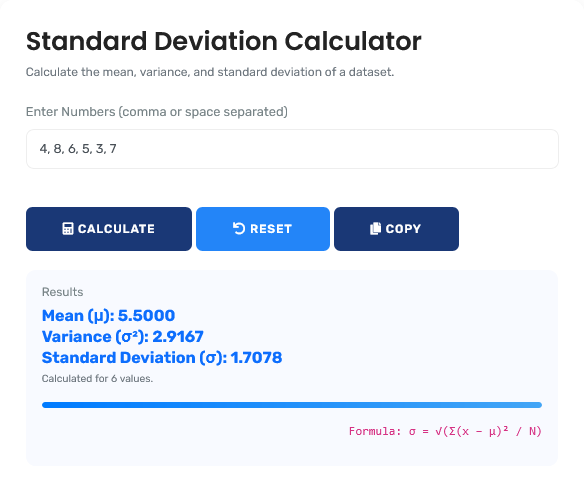
Our standard deviation calculator makes these calculations quick and accurate. For related statistical calculations, check our Mean Median Mode Calculator for complete data analysis.
Real-Life Standard Deviation Examples
Class Test Scores Analysis
A teacher wants to understand her class's performance on a recent math test. The scores are: 78, 85, 92, 65, 88, 76, 95, 81, 72, 90. She needs to calculate the standard deviation to see how spread out the scores are.
Test Score Analysis:
- Scores: 78, 85, 92, 65, 88, 76, 95, 81, 72, 90
- Mean (average): 82.2 points
- Standard deviation: 9.3 points
- Interpretation: Most scores fall between 72.9 and 91.5 points (mean ± 1 SD)
- Key insight: A 9.3-point spread indicates moderate variability
- Teaching implications: Some students need extra help (scores below 73), while others could be challenged more (scores above 91)
- Comparison: If next test has SD = 5.2, that shows more consistent performance
By calculating standard deviation, the teacher gains insights beyond just the average score. She can identify which students are significantly above or below the class norm and adjust her teaching accordingly.
For calculating the average score, use our Average Calculator.
Investment Portfolio Risk Assessment
An investor is comparing two mutual funds. Fund A has monthly returns of: 2.5%, 1.8%, -0.5%, 3.2%, 2.1%, 1.5%, 0.8%, 2.9%, 1.2%, 2.4%. Fund B has returns: 5.2%, -2.1%, 4.8%, -1.5%, 3.9%, 0.2%, 6.1%, -0.8%, 4.5%, 1.8%.
Investment Risk Analysis:
- Fund A mean return: 1.79% monthly
- Fund A standard deviation: 1.07%
- Fund B mean return: 2.21% monthly
- Fund B standard deviation: 2.95%
- Risk comparison: Fund B has almost 3× the volatility of Fund A
- Risk-return tradeoff: Higher potential return comes with higher risk
- Practical implication: Conservative investors might prefer Fund A, aggressive investors might choose Fund B
- Portfolio construction: Might include both for diversification
Standard deviation serves as a key risk metric in finance. Investors use it to compare investments and build portfolios that match their risk tolerance.
For calculating investment returns, try our ROI Calculator.
Manufacturing Quality Control
A factory produces bolts that should be 50mm long. Quality control measures 20 bolts: 49.8, 50.1, 50.3, 49.9, 50.0, 50.2, 49.7, 50.1, 50.0, 49.8, 50.2, 50.1, 49.9, 50.0, 50.3, 49.8, 50.1, 50.0, 49.9, 50.2.
Quality Control Analysis:
- Target length: 50.0 mm
- Mean length: 50.01 mm
- Standard deviation: 0.17 mm
- Process capability: ±3σ range = 49.50 to 50.52 mm
- Quality assessment: Low standard deviation indicates consistent manufacturing
- Specification limits: If tolerance is ±0.5 mm, process is well within limits
- Monitoring: Track standard deviation weekly to detect process changes
- Improvement goal: Reduce SD to 0.10 mm for higher precision
In manufacturing, standard deviation is critical for quality control. A low standard deviation means consistent production, while an increasing standard deviation signals potential problems in the manufacturing process.
For other business calculations, use our Profit Margin Calculator.
Standard Deviation Formulas Explained
Standard Deviation Calculation Methods:
1. Population Standard Deviation (σ):
σ = √[Σ(xᵢ - μ)² / N]
Use when you have data for entire population
2. Sample Standard Deviation (s):
s = √[Σ(xᵢ - x̄)² / (n - 1)]
Use when you have a sample of a larger population
3. Step-by-step calculation:
1. Calculate mean (average)
2. Find differences from mean
3. Square the differences
4. Sum the squared differences
5. Divide by N (population) or n-1 (sample)
6. Take square root
4. Variance (σ² or s²):
Variance = (Standard Deviation)²
Often used in advanced statistical analysis
Interpreting Standard Deviation Values
| Standard Deviation | Interpretation | Example Context | Visual Description | Practical Implication |
|---|---|---|---|---|
| Very Small (σ ≈ 0) | Extremely consistent data | Precision manufacturing | All points clustered at mean | Highly predictable outcomes |
| Small (σ < 0.5×mean) | Consistent, reliable data | Quality test scores | Tight cluster around mean | Good process control |
| Moderate (σ ≈ 0.5-1×mean) | Typical variation | Most natural measurements | Moderate spread | Normal variability expected |
| Large (σ > 1×mean) | High variability | Volatile investments | Wide dispersion | Unpredictable, higher risk |
| Very Large (σ > 2×mean) | Extreme variability | Speculative assets | Very wide spread | High risk, potential outliers |
Empirical Rule (68-95-99.7 Rule)
| Standard Deviations | Data Percentage | Range | Example (mean=100, σ=15) | Practical Application |
|---|---|---|---|---|
| ±1σ | 68% of data | Mean ± 1SD | 85 to 115 | Typical range |
| ±2σ | 95% of data | Mean ± 2SD | 70 to 130 | Most data range |
| ±3σ | 99.7% of data | Mean ± 3SD | 55 to 145 | Virtually all data |
Practical Calculation Framework
5-Step Process for Using Standard Deviation:
- Collect data: Ensure accurate, relevant measurements
- Calculate mean: Find the average of your data points
- Compute standard deviation: Use appropriate formula (population vs sample)
- Interpret results: What does the standard deviation tell you about your data?
- Take action: Use insights to make decisions or improvements
This systematic approach ensures you get meaningful insights from your data. For probability calculations related to standard deviation, use our Probability Calculator.
Common Standard Deviation Mistakes
The "Population vs Sample" Confusion
Common error: Using population formula for sample data.
Why it matters: Sample formula (dividing by n-1) gives better
estimate of population standard deviation.
Example: For 10 test scores (sample of all possible scores),
use sample formula.
Rule of thumb: If you have ALL data (e.g., all students in
class), use population. If you have SOME data (e.g., survey of 100 customers),
use sample.
Ignoring Data Distribution Shape
Standard deviation assumes roughly normal distribution. For skewed data, standard deviation can be misleading.
Example: Income data is typically right-skewed (few very high
incomes). Standard deviation might suggest more variability than truly exists
for most people.
Solution: Examine data distribution first. For skewed data,
consider using median and interquartile range alongside standard deviation.
Visual check: Create a histogram of your data. If it looks roughly bell-shaped, standard deviation is appropriate. If heavily skewed, interpret with caution.
For analyzing data distribution, check our Normal Distribution Calculator.
Special Applications of Standard Deviation
Case: Analyzing Website Traffic Consistency
Scenario: A website owner wants to analyze daily visitor consistency over 30 days.
-
Data Collection:
- Daily visitors: 1,245, 1,189, 1,312, 1,156, 1,278, 1,201, 1,334, 1,167, 1,290, 1,223, etc.
- Total 30 days of data
-
Calculation:
- Mean daily visitors: 1,254
- Standard deviation: 68 visitors
- Coefficient of variation: (68 ÷ 1,254) × 100% = 5.4%
-
Interpretation:
- Typical daily range: 1,186 to 1,322 visitors (mean ± 1 SD)
- Most days (95%): 1,118 to 1,390 visitors (mean ± 2 SD)
- Low coefficient of variation (5.4%) indicates stable traffic
- Action: No major marketing changes needed - traffic is consistent
For percentage change calculations, use our Percentage Calculator.
Standard Deviation in Different Fields
| Field | What's Measured | Typical SD Values | Interpretation | Decision Impact |
|---|---|---|---|---|
| Education | Test scores | 10-15% of mean | Class performance consistency | Teaching methods, curriculum |
| Finance | Investment returns | 1-5% monthly | Portfolio risk level | Investment strategy |
| Manufacturing | Product dimensions | 0.1-2% of target | Production consistency | Quality control procedures |
| Healthcare | Blood pressure readings | 5-10 mmHg | Measurement reliability | Diagnostic accuracy |
| Sports | Player performance metrics | 10-25% of mean | Performance consistency | Team selection, training |
When Standard Deviation Isn't Enough
Complementary Statistics to Use with Standard Deviation:
- Mean: Center of your data
- Median: Better for skewed data
- Range: Minimum to maximum values
- Interquartile Range (IQR): Middle 50% of data
- Coefficient of Variation: SD as percentage of mean
- Skewness & Kurtosis: Distribution shape metrics
Always use multiple statistics to get a complete picture of your data. Standard deviation is powerful but works best alongside other measures.
Practical Examples for Different Data Types
Example 1: Small Dataset (Manual Calculation Check)
Data: 5, 7, 9, 11, 13
Steps:
1. Mean: (5+7+9+11+13) ÷ 5 = 9
2. Differences: -4, -2, 0, 2, 4
3. Squared differences: 16, 4, 0, 4, 16
4. Sum: 40
5. Divide: 40 ÷ 5 = 8 (population), 40 ÷ 4 = 10 (sample)
6. Square root: √8 = 2.83 (population), √10 = 3.16 (sample)
Example 2: Understanding Weather Variability
Scenario: Comparing temperature consistency between two
cities.
City A: Mean temp = 65°F, SD = 5°F (consistent climate)
City B: Mean temp = 65°F, SD = 15°F (variable climate)
Interpretation: Both have same average temperature, but City B
has more variable weather. Packing for City B requires preparation for wider
temperature ranges.
For temperature conversions, use our Celsius to Fahrenheit Converter.
Key Insight: Standard deviation is more than just a mathematical formula—it's a practical tool for understanding variability in any data. Whether you're a student analyzing grades, an investor assessing risk, a manager monitoring quality, or a researcher evaluating results, understanding standard deviation helps you make better, data-informed decisions. Remember to always consider your data's context and distribution when interpreting standard deviation. For advanced statistical analysis, check our Z-Score Calculator.
Quick Reference: Standard Deviation Guidelines
Rule of Thumb Interpretations:
- SD < 0.1×Mean: Extremely consistent data
- SD = 0.1-0.3×Mean: Good consistency
- SD = 0.3-0.5×Mean: Moderate variability
- SD = 0.5-1×Mean: High variability
- SD > 1×Mean: Very high variability
Common Benchmarks:
- Test scores: Typically SD = 10-15% of possible points
- Quality control: Aim for SD < 2-5% of target value
- Financial returns: Annual SD of 15-20% for stocks is typical
- Scientific measurements: SD indicates measurement precision
Remember: Context matters! What's "high" variability in one field might be "low" in another.
Frequently Asked Questions
Population standard deviation (σ) uses all data points and divides by N. Sample standard deviation (s) uses sample data and divides by n-1 (Bessel's correction). Use population formula when you have data for every member of a group (all students in a class). Use sample formula when you have data for some members (survey of 100 customers from thousands). The sample formula gives a better estimate of the population standard deviation when working with samples.
For reasonably reliable standard deviation, aim for at least 20-30 data points. With fewer than 10 points, standard deviation can be quite unstable. With 100+ points, you get a stable estimate. However, even with small samples, standard deviation can still provide useful information about variability—just interpret with appropriate caution.
Yes, standard deviation can be greater than the mean, especially with data that includes very small or negative values. For example, investment returns that include significant losses might have a mean of 2% but standard deviation of 8%. When standard deviation exceeds the mean, it indicates high relative variability. The coefficient of variation (SD/mean) helps compare variability across datasets with different means.
A standard deviation of zero means all data points have exactly the same value—there's no variability at all. For example, if every student in a class scores 85 on a test, the standard deviation would be zero. In practice, standard deviation of zero is rare outside of controlled situations. If you calculate SD = 0, double-check your data and calculations.
Variance is the square of standard deviation. Standard deviation = √Variance. Variance has squared units (e.g., if data is in meters, variance is in meters²), while standard deviation has the same units as the original data. Standard deviation is generally easier to interpret because it's in the original units. Variance is used in more advanced statistical calculations.
Use standard deviation when: data is roughly normally distributed, you want a measure sensitive to all data points, and you need to use the empirical rule. Use range for quick, simple variability assessment. Use interquartile range (IQR) when data is skewed or has outliers. Use coefficient of variation when comparing variability across datasets with different means. Often, using multiple measures together gives the best understanding.
