Perimeter Calculator: Measure Any Shape's Boundary in Seconds
Perimeter calculations are essential for countless practical applications - from planning garden fences and measuring room borders to calculating material needs for construction projects. Understanding perimeter helps you determine the exact length around any shape, ensuring accurate measurements and efficient planning.
Whether you're a student tackling geometry homework, a DIY enthusiast planning a home project, or a professional needing quick measurements, our Perimeter Calculator provides instant, accurate results for all common shapes. No more memorizing formulas or making calculation errors - just enter your measurements and get precise perimeter values.
Common real-world uses for perimeter calculations:
- Home & Garden: Fencing, trimming, border planning
- Construction: Material estimation for framing, molding, edging
- Crafts & DIY: Measuring fabric, ribbon, or trim lengths
- Education: Geometry practice and verification
- Sports: Calculating track lengths, field boundaries
Our calculator handles all the math for you. For related geometric calculations, check our Area Calculator for surface measurements.
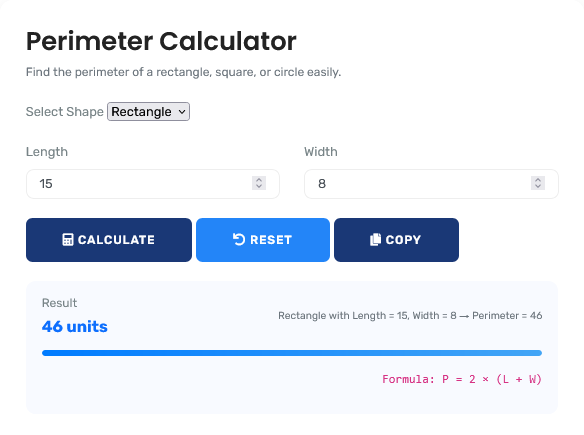
Real-Life Perimeter Calculation Scenarios
Sarah's Garden Fencing Project
Sarah wanted to install a decorative fence around her rectangular vegetable garden. The garden measures 15 feet by 25 feet, and she needed to calculate how much fencing material to purchase, including gates and corner posts.
Fencing Calculation Analysis:
- Garden dimensions: 15 ft × 25 ft
- Perimeter formula for rectangle: 2 × (length + width)
- Calculation: 2 × (15 + 25) = 2 × 40 = 80 feet
- Gate opening: 3 feet wide (to deduct from fencing)
- Net fencing needed: 80 - 3 = 77 feet
- Corner posts: 4 posts required
- Gate hardware: 1 set for 3-foot gate
- Material planning: Purchase 80 feet of fencing (allows for cuts and waste)
- Cost estimate: Fencing at $8 per foot = $640 for materials
By calculating the exact perimeter, Sarah avoided buying too much expensive fencing while ensuring she had enough to complete her project.
For calculating how much paint she'll need for the fence, Sarah could use our Paint Calculator.
Mike's Picture Frame Project
Mike, an amateur woodworker, wanted to create custom picture frames for his art collection. He needed to calculate the perimeter of various-sized artworks to determine how much molding to purchase.
Frame Molding Calculation Analysis:
- Artwork 1: 8 inches × 10 inches
- Perimeter: 2 × (8 + 10) = 36 inches
- Miter cuts: Add 10% for waste = 3.6 inches
- Total molding: 39.6 inches
- Artwork 2: 11 inches × 14 inches
- Perimeter: 2 × (11 + 14) = 50 inches
- Miter waste: 5 inches (10%)
- Total molding: 55 inches
- Purchasing strategy: Buy molding in 8-foot lengths (96 inches)
- Efficiency: One 8-foot piece can make both frames with minimal waste
Accurate perimeter calculations helped Mike minimize material waste and cost while ensuring he had enough molding for perfect frames.
.Robert's Running Track Measurement
Robert, a high school coach, needed to verify the perimeter of the school's oval running track for competition compliance. The track consists of two straight sections and two semicircular ends.
Track Perimeter Analysis:
- Straight sections: 2 × 100 meters = 200 meters
- Semicircle diameter: 64 meters
- Radius: 32 meters
- Circumference of full circle: 2 × π × 32 = 201.06 meters
- Two semicircles = one full circle: 201.06 meters
- Total track perimeter: 200 + 201.06 = 401.06 meters
- Standard track: 400 meters (within acceptable variance)
- Lane adjustments: Each lane adds approximately 7.67 meters to perimeter
This calculation confirmed the track met competition standards and helped Robert plan lane assignments for races.
Perimeter Formulas for Common Shapes
Essential Perimeter Formulas:
1. Square:
Perimeter = 4 × side
Example: Side = 5 ft → P = 4 × 5 = 20 ft
2. Rectangle:
Perimeter = 2 × (length + width)
Example: Length = 10 ft, Width = 6 ft → P = 2 × (10 + 6) = 32 ft
3. Triangle:
Perimeter = side₁ + side₂ + side₃
Example: Sides = 7 ft, 9 ft, 12 ft → P = 7 + 9 + 12 = 28 ft
4. Circle (Circumference):
Perimeter = 2 × π × radius
Example: Radius = 4 ft → P = 2 × 3.1416 × 4 = 25.13 ft
5. Regular Polygon:
Perimeter = number of sides × side length
Example: Hexagon with side = 3 ft → P = 6 × 3 = 18 ft
Perimeter vs. Area: Understanding the Difference
| Aspect | Perimeter | Area | Practical Example |
|---|---|---|---|
| Definition | Total distance around a shape | Total space inside a shape | Fence length vs. lawn space |
| Measurement | Linear units (feet, meters) | Square units (sq ft, sq m) | Feet of fencing vs. square feet of sod |
| Calculation | Add all side lengths | Multiply dimensions | Add 4 sides vs. multiply length × width |
| Practical Use | Bordering, framing, edging | Covering, filling, painting | Picture frame vs. photo paper |
| Example Formula | Rectangle: 2(L+W) | Rectangle: L×W | Room: Baseboard vs. flooring |
Common Shape Perimeters and Their Formulas
| Shape | Formula | Example | Real-World Application | Special Notes |
|---|---|---|---|---|
| Square | P = 4s | s = 5 ft → P = 20 ft | Square tablecloth trim | All sides equal |
| Rectangle | P = 2(L+W) | L=10 ft, W=6 ft → P=32 ft | Room baseboard | Opposite sides equal |
| Triangle | P = a+b+c | 3,4,5 ft → P=12 ft | Triangular garden bed | Sum of all sides |
| Circle | P = 2πr | r=7 ft → P≈44 ft | Round table edge | Also called circumference |
| Parallelogram | P = 2(a+b) | a=8 ft, b=5 ft → P=26 ft | Slanted fence section | Opposite sides equal |
| Regular Pentagon | P = 5s | s=4 ft → P=20 ft | Pentagon-shaped sign | All sides equal |
Step-by-Step Perimeter Calculation Framework
4-Step Process for Perfect Perimeter Calculations:
- Identify the shape: Determine what geometric shape you're measuring
- Gather measurements: Measure all necessary sides or dimensions
- Apply correct formula: Use the appropriate perimeter formula
- Check and verify: Review calculations for accuracy and reasonableness
This methodical approach ensures accurate results every time. For complex shapes, break them into simpler components, calculate each perimeter, then combine results.
Common Perimeter Calculation Mistakes
The "Missing Sides" Error
Common mistake: Forgetting to include all sides in perimeter
calculation.
Example: L-shaped room measured as two rectangles separately
but added incorrectly.
Correct approach: Break into rectangles, calculate each
perimeter, then combine while accounting for shared sides.
Key principle: Perimeter includes every outside edge exactly
once.
Unit Conversion Errors
Many calculation errors occur when mixing measurement units without proper conversion. For example, measuring two sides in feet and one side in inches, then adding them directly.
Common error: 5 ft + 3 ft + 18 inches = 8 ft 18 inches
(incorrect)
Correct calculation: Convert all to same unit first:
18 inches = 1.5 feet
Total = 5 + 3 + 1.5 = 9.5 feet
Best practice: Convert all measurements to the same unit before calculating. Our calculator handles unit conversions automatically.
For percentage-based calculations related to projects, use our Percentage Calculator.
Special Perimeter Applications
Case: Calculating Crown Molding for a Room
Scenario: Installing crown molding in a rectangular room with a doorway.
-
Room Measurements:
- Length: 14 feet
- Width: 12 feet
- Standard perimeter: 2 × (14 + 12) = 52 feet
-
Adjustments:
- Doorway width: 3 feet (no molding needed here)
- Net molding: 52 - 3 = 49 feet
- Inside corners: 4 corners require miter cuts
- Waste factor: 10% for cuts = 4.9 feet
-
Final Calculation:
- Total molding needed: 49 + 4.9 = 53.9 feet
- Molding comes in 8-foot lengths: 53.9 ÷ 8 = 6.74 lengths
- Purchase: 7 lengths (56 feet total)
- Extra: 2.1 feet for mistakes or future repairs
For other home improvement calculations, try our Cost Estimation Calculator.
Measurement Tips for Accurate Perimeter Calculations
| Situation | Recommended Tool | Measurement Technique | Common Pitfalls | Accuracy Tips |
|---|---|---|---|---|
| Small Indoor Spaces | Tape measure | Measure wall to wall, corner to corner | Forgetting baseboards or trim | Measure at multiple heights |
| Large Outdoor Areas | Measuring wheel, laser measure | Walk perimeter, mark corners | Sloping ground, obstacles | Take multiple measurements |
| Irregular Shapes | Combination of tools | Break into regular shapes | Missing curved sections | Approximate curves as polygons |
| Circular Objects | Flexible tape, string method | Measure diameter, calculate | Measuring circumference directly | Measure diameter in multiple directions |
| Sloped or Angled | Laser measure, trigonometry | Measure horizontal components | Using slope length as horizontal | Use level for horizontal ref |
Perimeter in Different Contexts
Perimeter Applications Across Fields:
- Architecture: Building footprints, room layouts, facade treatments
- Landscaping: Garden beds, pathways, property boundaries
- Manufacturing: Material cutting, packaging, component sizing
- Sports: Field markings, track measurements, court dimensions
- Art & Design: Frame sizing, border designs, pattern repeats
- Education: Geometry problems, practical math applications
Understanding perimeter calculations enhances efficiency and accuracy in all these fields.
Advanced Perimeter Concepts
Perimeter of Composite Shapes
Problem: Calculate perimeter of shape combining rectangle and semicircle.
Shape: Rectangle 10 ft × 4 ft with semicircle on one 10-ft side
Solution:
1. Rectangle sides: 10 + 4 + 4 = 18 ft (three sides only)
2. Semicircle: Diameter = 10 ft, Radius = 5 ft
3. Circumference of full circle: 2π × 5 = 31.42 ft
4. Half circumference: 31.42 ÷ 2 = 15.71 ft
5. Total perimeter: 18 + 15.71 = 33.71 ft
Note: The straight side where semicircle attaches is not part
of perimeter
Perimeter Scaling
Problem: If a square's side length doubles, what happens to perimeter?
Original: Side = s, Perimeter = 4s
Scaled: Side = 2s, Perimeter = 4(2s) = 8s
Result: Perimeter doubles when side length doubles
General rule: Perimeter scales linearly with dimension changes
This principle is useful for planning scaled projects or models.
Key Insight: Perimeter calculations are fundamental to measurement and planning in both theoretical mathematics and practical applications. The ability to accurately calculate perimeters saves time, money, and materials in projects ranging from simple crafts to complex construction. Remember that perimeter is always a linear measurement representing a boundary length. For three-dimensional measurements, explore our Volume Calculator.
Quick Reference: Perimeter Formulas Cheat Sheet
Basic Shapes:
- Square: P = 4s (s = side length)
- Rectangle: P = 2(L+W)
- Triangle: P = a+b+c
- Circle: P = 2πr or πd (d = diameter)
- Parallelogram: P = 2(a+b)
- Regular Polygon: P = n×s (n = sides, s = side length)
Useful Constants:
- π ≈ 3.14159 (use 3.14 for quick estimates)
- 1 foot = 12 inches
- 1 yard = 3 feet
- 1 meter ≈ 3.28084 feet
Measurement Tips:
- Always use same units for all measurements
- Measure twice, calculate once
- Add 5-10% waste for cutting and errors
- For irregular shapes, break into regular components
Frequently Asked Questions
Perimeter is the general term for the distance around any closed shape. Circumference specifically refers to the perimeter of a circle. So all circumferences are perimeters, but not all perimeters are circumferences.
For irregular shapes, break them into regular shapes (rectangles, triangles, circles), calculate each section's perimeter, then add them together. Be careful not to double-count interior boundaries that aren't part of the outer perimeter.
Generally no - different shapes can have the same area but different perimeters. For specific shapes with additional information (like a square where Area = s², so s = √Area, then P = 4√Area), it's possible. But for most shapes, area alone doesn't determine perimeter.
Use linear units: feet, meters, inches, yards, etc. The key is consistency - use the same unit for all measurements. Our calculator can handle different units and convert between them automatically.
Accuracy requirements depend on the application:
• Construction: Very accurate (to 1/8 inch or less)
• Landscaping: Moderately accurate (to nearest
inch)
• Estimating: Reasonably accurate (to nearest foot)
• Educational: As accurate as measurement tools allow
It depends on what you're calculating:
• For room perimeter: Include the full wall length
(openings are part of wall)
• For baseboard/molding: Deduct openings where trim
won't be installed
• For fencing: Include gates in perimeter but deduct
their width from fencing material
Always consider whether the opening is part of the boundary you're
measuring.
