Ovulation Calculator: Estimate Your Fertile Window
Understanding your menstrual cycle can be useful whether you're trying to conceive, practicing natural family planning, or simply want to know your body's patterns better. Ovulation marks the point in your cycle when an egg is released and pregnancy is most likely. This Ovulation Calculator gives you an estimate of your likely ovulation day and fertile window based on your cycle start date and typical cycle length, using the standard calendar-based method.
Cycle length varies from person to person and even from month to month, so these results are an estimate rather than a guarantee. Many people combine calendar predictions with physical signs — like cervical mucus changes or a small rise in basal body temperature — to get a clearer picture of their fertile days. For a wider view of your overall health, you can also explore our full range of health calculators.
This tool is part of our medical calculators collection.
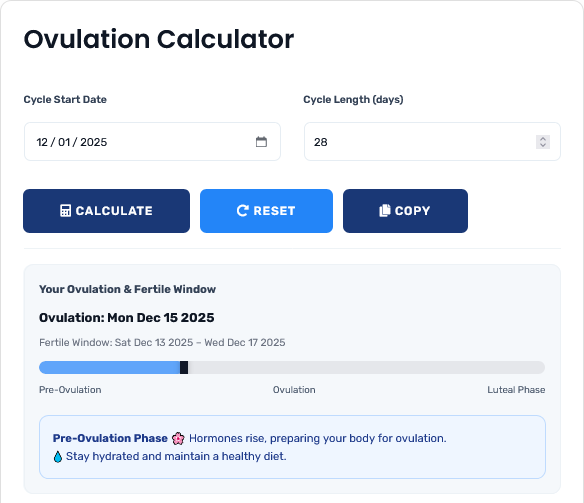
How Ovulation Timing Relates to Your Cycle
A few general points that shape how ovulation calculators work:
- The time between ovulation and the next period (the luteal phase) is fairly consistent for most people, commonly around 12-14 days
- The time from a period to ovulation (the follicular phase), however, can vary noticeably, which is why ovulation timing shifts with cycle length
- Shorter cycles generally mean earlier ovulation, and longer cycles generally mean later ovulation, relative to the day 14 assumption often quoted for a 28-day cycle
- Sperm can survive in the reproductive tract for several days, while a released egg is typically viable for roughly a day, which is why the fertile window spans more than just the day of ovulation itself
If cycle irregularity or fertility is a concern, it's worth discussing with a doctor rather than relying on a calculator alone. For overall wellness tracking, our BMI Calculator can be a useful companion tool, since body weight can influence cycle regularity.
Understanding Your Menstrual Cycle Phases
How This Calculator Estimates Ovulation:
Standard Calendar Method:
Estimated Ovulation Day = Cycle Length − 14 days (counted from the start of
your cycle)
This assumes a typical ~14-day luteal phase.
Fertile Window:
Roughly the few days before ovulation through about a day after, to account
for sperm survival time and egg viability.
If Your Cycle Length Varies:
Using an average of your last several cycles tends to give a more realistic
estimate than relying on a single cycle.
Cycle Phase Breakdown and Typical Timing
| Cycle Phase | Typical Timing (28-day cycle) | Key Events | General Hormone Pattern |
|---|---|---|---|
| Menstruation | Days 1-5 (varies) | Uterine lining sheds | Estrogen and progesterone at their lowest |
| Follicular Phase | Days 1 through ovulation | Follicles mature, uterine lining rebuilds | Estrogen rises as follicles develop |
| Ovulation | Around day 14 in a 28-day cycle | An egg is released from the ovary | LH surge, estrogen near its peak |
| Luteal Phase | From ovulation to next period | Body prepares for possible pregnancy | Progesterone rises, then falls if no pregnancy occurs |
Physical Signs Some People Use Alongside a Calculator
| Sign | What People Commonly Notice | When It May Appear | Notes |
|---|---|---|---|
| Cervical Mucus | Clearer, stretchier, egg-white-like consistency | In the days leading up to ovulation | Often checked upon waking |
| Basal Body Temperature | A small, sustained rise after ovulation | The day or two after ovulation | Confirms ovulation already occurred, rather than predicting it in advance |
| Mild One-Sided Pelvic Discomfort | Light cramping on one side | Around ovulation | Not everyone notices this |
| Ovulation Predictor Kits | Detect a surge in luteinizing hormone (LH) | Typically 24-36 hours before ovulation | Used according to the manufacturer's instructions |
A Common Misconception: "Everyone Ovulates on Day 14"
Common assumption: Ovulation always happens on day 14 of the cycle.
More accurate view: Day 14 is simply what a 14-day luteal phase
works out to if someone has a 28-day cycle. A shorter cycle generally
means ovulation happens earlier, and a longer cycle generally means it happens
later.
Why it matters: Using a fixed "day 14" assumption regardless of
actual cycle length can lead to missing the real fertile window.
Getting More Reliable Estimates from Cycle Tracking
Tracking cycles only occasionally, or only when fertility is top of mind, tends to produce less reliable patterns than tracking consistently over several months. A few habits that generally help:
- Recording the start date of each period, every cycle, not just some
- Noting cycle length over at least 3-6 months before assuming a "typical" length
- Pairing calendar estimates with a physical sign, such as cervical mucus changes, rather than relying on the calendar alone
- Reviewing your tracked data periodically, since patterns can shift over time
For related nutrition planning, you may also find our Calorie Intake Calculator useful.
Factors That Can Affect Ovulation and Cycle Regularity
| Factor | General Effect | What May Help | When to Seek Medical Advice |
|---|---|---|---|
| Stress | Can delay or occasionally prevent ovulation | Stress management, adequate sleep and rest | If cycles stay irregular for several months |
| Significant Weight Change | Can disrupt the hormonal signals involved in ovulation | Gradual, sustainable changes rather than extremes | If periods become very irregular or stop |
| Very Intense Exercise | Can be associated with irregular or absent periods in some people | Balancing training load with adequate nutrition and recovery | If periods stop entirely |
| Age | Cycle regularity commonly changes approaching perimenopause | Tracking patterns and adjusting expectations over time | If sudden, major changes occur well before the typical perimenopausal age |
| Underlying Medical Conditions | Conditions such as PCOS or thyroid disorders are commonly associated with irregular ovulation | Medical evaluation and treatment as needed | If a known condition affects your cycle, or cycles are consistently very irregular |
Comparing Common Ways to Estimate Ovulation
Calendar / Calculator Method
- Simple and free, and works reasonably well when cycles are fairly regular
- Less reliable on its own when cycles vary a lot from month to month
Symptom Tracking (cervical mucus, basal body temperature)
- Adds physical confirmation to calendar estimates
- Requires daily observation and some practice to interpret consistently
Ovulation Predictor Kits
- Detect a hormonal surge that typically precedes ovulation by roughly a day or two
- Often used by people actively trying to conceive who want more precise timing than a calendar alone provides
Many people find that combining more than one method — for example, a calculator estimate plus a physical sign — gives a clearer picture than relying on just one.
Nutrition and Lifestyle Factors Often Linked to Cycle Regularity
Habits commonly associated with more regular cycles include:
- Balanced nutrition: adequate protein, healthy fats, and complex carbohydrates
- A stable, healthy body weight for your individual circumstances
- Reasonable stress management and consistent sleep
- Moderate, sustainable exercise rather than extremes in either direction
- Limiting alcohol and tobacco use
For nutritional planning, our Daily Calorie Burn Calculator can help you understand your general energy needs.
Important note: This calculator provides an estimate based on typical cycle patterns — it is not a medical device and does not diagnose anything. If you're trying to conceive and haven't after about 12 months of trying (or 6 months if you're over 35), or if you have concerns about irregular cycles or fertility, it's a good idea to speak with a healthcare provider.
Quick Reference: Cycle Length and Ovulation Timing
By Cycle Length (general pattern, based on a ~14-day luteal phase):
- 21-day cycle: Ovulation tends to fall around day 7
- 28-day cycle: Ovulation tends to fall around day 14
- 35-day cycle: Ovulation tends to fall around day 21
- Irregular cycles: It's usually more useful to track several months and look for a pattern than to rely on any single estimate
Remember: These are general patterns — your own cycle is what matters most, and it can differ from these examples.
Frequently Asked Questions
An ovulation calculator gives a reasonable estimate for people with fairly regular cycles, but it's still an estimate rather than a guarantee, since ovulation timing can shift from cycle to cycle. Combining calculator estimates with physical signs, such as cervical mucus changes or basal body temperature, generally gives a clearer picture than the calendar estimate alone.
An ovulation calculator alone is not a reliable form of birth control, since actual ovulation timing can vary from the estimate. If you're interested in fertility awareness as a family planning method, it's best to learn a structured method from a trained instructor and combine multiple tracking signs, or to use an established contraceptive method such as barrier methods, hormonal contraception, or an IUD.
If your cycle length varies a lot from month to month, treat the calculator's estimate as a rough starting point rather than a precise prediction, and lean more on physical signs or an ovulation predictor kit. If your cycles remain very irregular over several months, or you go a long time without a period, it's worth discussing this with a healthcare provider, since conditions like PCOS or thyroid issues can affect ovulation.
Most home pregnancy tests are designed to detect pregnancy hormone levels roughly one to two weeks after ovulation, and are generally most reliable around the time your next period is expected. Testing earlier than that increases the chance of a false negative. If a test is negative but your period doesn't arrive, testing again after a few days is a reasonable next step. Once pregnancy is confirmed, our Pregnancy Due Date Calculator can help estimate a due date.
Not always. Some people notice ovulation-like symptoms without an egg actually being released, which is sometimes called an anovulatory cycle. Ovulation predictor kits and basal body temperature tracking are generally considered more reliable confirmation methods than symptoms alone. If you're trying to conceive and suspect you may not be ovulating despite noticing typical signs, it's worth speaking with a healthcare provider.
Yes, significant or prolonged stress can influence the hormonal signals that regulate ovulation, sometimes delaying it or, in some cases, preventing it in a given cycle. This is one reason cycles can lengthen or periods can be missed during particularly stressful periods of life. General stress-management habits, such as adequate sleep and regular, moderate activity, are commonly recommended alongside cycle tracking.
